
Cold email is one of the most powerful — and most misunderstood — business tools in existence.
Every day, thousands of deals are closed, partnerships are formed, and careers are accelerated because someone sent an email to a person they had never met. No warm introduction. No prior relationship. No shared history. Just a well-crafted message landing in the right inbox at the right moment.
And every day, millions of terrible cold emails are sent that get ignored, deleted, or marked as spam — damaging the sender's reputation and giving the entire practice a bad name.
The difference between the two is not the channel. It is the understanding.
This guide explains exactly what cold email is, how it works, why it works when it is done correctly, how it differs from spam and warm email, what the data says about its effectiveness in 2026, and how to get started — even if you have never sent a single outreach email in your life.
Whether you are a founder trying to land your first customers, a sales professional building a pipeline, a recruiter sourcing candidates, or simply someone who wants to understand this channel from the ground up — this is the guide you need.
What Is Cold Email? (The Definition)
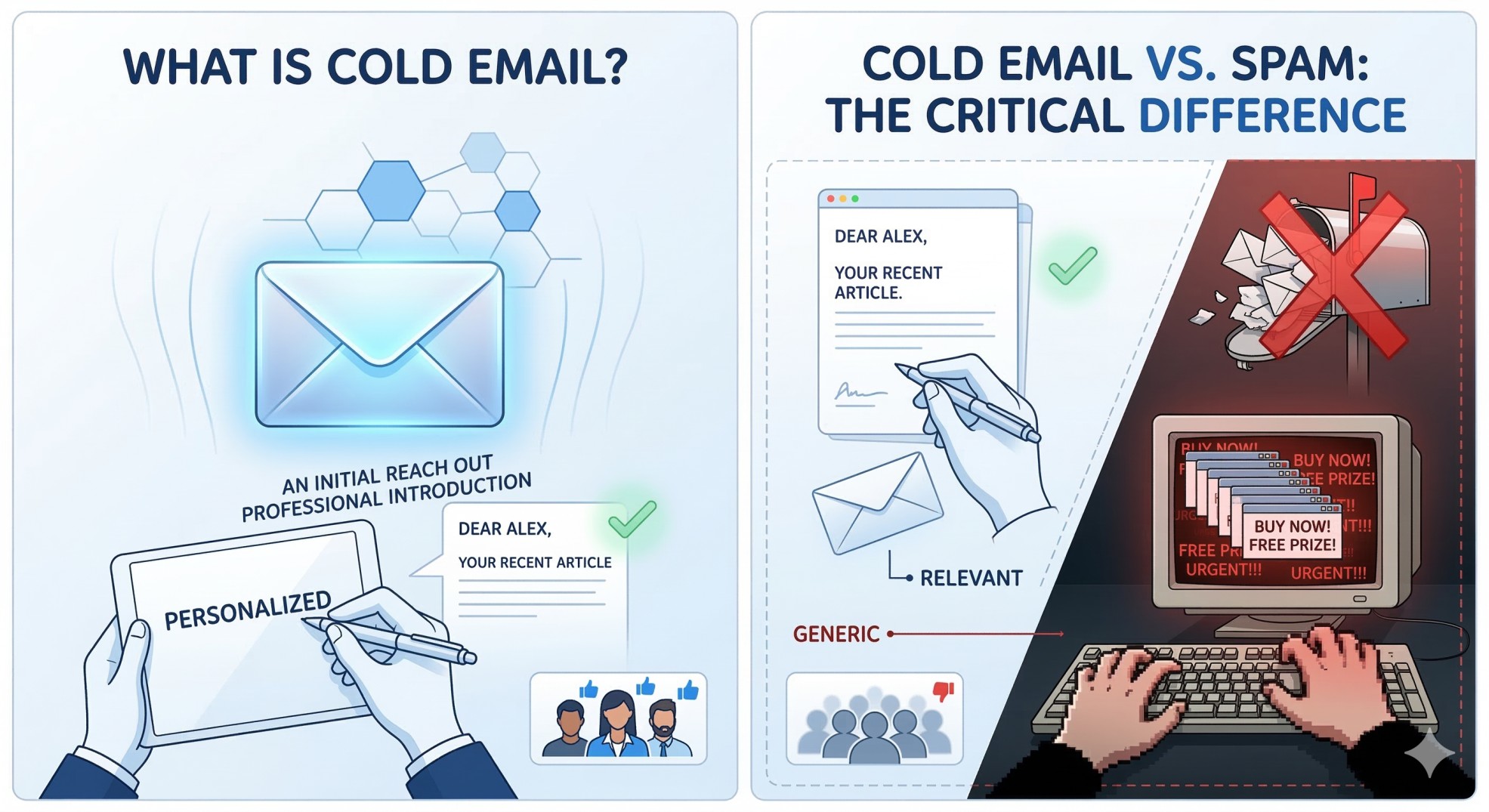
Cold email is an unsolicited email sent to a recipient with whom the sender has no prior relationship, with the goal of starting a business conversation.
Let's break that definition down:
Unsolicited means the recipient did not request it, sign up for it, or give prior consent. Unlike a newsletter or marketing email, the recipient never asked to hear from you. This is the "cold" part — the absence of a prior relationship or permission.
No prior relationship is what distinguishes cold email from warm email. If you met someone at a conference yesterday and emailed them today, that is a warm email — you have context and a shared experience. Cold email goes to someone who has never heard of you, your company, or your product.
Goal of starting a business conversation is the purpose. Cold email is not marketing broadcast. It is not advertising. It is the opening move in a one-to-one business relationship — the digital equivalent of approaching someone at a networking event and introducing yourself.
Cold Email in One Sentence
Cold email is a targeted, personalized, one-to-one message sent to a specific professional with the intent of starting a mutually valuable business conversation.
That definition contains three critically important words: targeted (sent to the right person), personalized (written for that specific person), and one-to-one (not a mass broadcast). Remove any of those three elements and what remains is not cold email — it is spam.
Cold Email vs. Spam: The Critical Difference
The most common misconception about cold email is that it is the same as spam. It is not. The differences are fundamental — legally, ethically, and practically. Spam Targeting Specific, researched recipient Random or purchased bulk list Personalization Tailored to the individual Generic, identical for all recipients Purpose Start a legitimate business conversation Trick, deceive, or extract Legal compliance Follows CAN-SPAM, GDPR, CASL Disregards all regulations Sender identity Honest — real name, real company Often spoofed or fake Opt-out Always provided and honored Nonexistent or broken Volume Thoughtful, controlled Mass, indiscriminate Value to recipient Intended to be relevant and useful No consideration for recipient Deliverability intent Designed to reach the inbox Often designed to evade filters
The legal distinction is equally important. In the United States, the CAN-SPAM Act explicitly permits unsolicited commercial email — provided the sender uses honest identification, does not use deceptive subject lines, includes a physical address, and provides a functioning opt-out mechanism. GDPR in the EU permits B2B cold email under the "legitimate interest" basis, provided specific conditions are met. Spam, by contrast, violates these laws by design.
When 71% of decision-makers say they ignore cold emails because they don't address their specific needs — they are describing spam behavior, not genuine cold email. Done right, cold email is not an interruption. It is a relevant, timely, valuable communication from one professional to another.
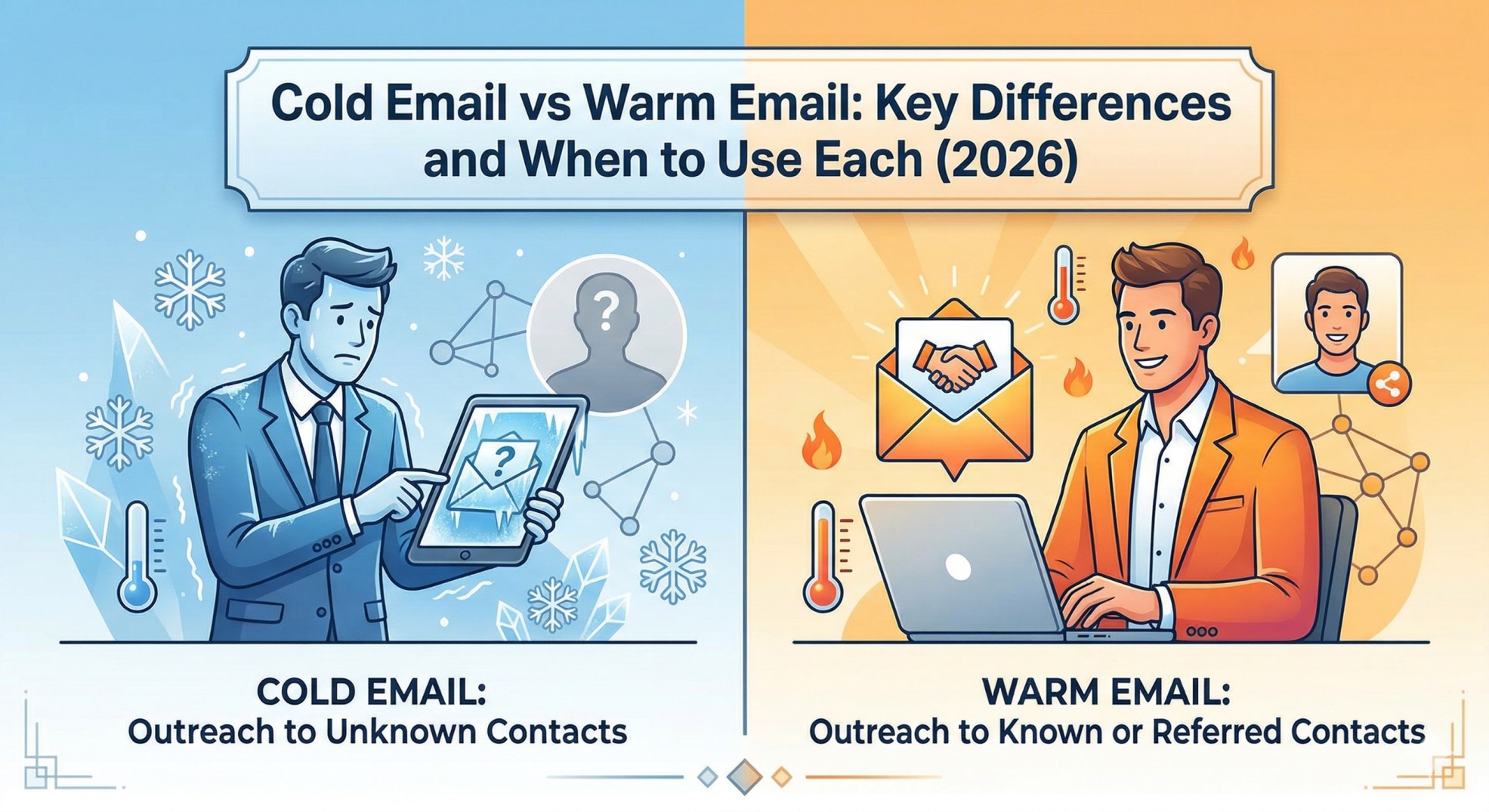
Cold Email vs. Warm Email: What's the Difference?
Understanding the spectrum from cold to warm helps you understand where different types of outreach fall — and how to treat each one.
Type Relationship Expected Response Rate Approach Cold email No prior relationship 3–15% depending on quality Research-heavy, highly personalized Lukewarm email Indirect connection (mutual contact, shared community) 15–30% Reference the connection explicitly Warm email Prior interaction (met at event, previous conversation) 30–60% Reference the shared context Hot email Active interest expressed (filled form, attended webinar) 50–80% Address their stated interest directly
The warmer the contact, the higher the expected response rate — which is why referrals are such a powerful force multiplier for cold email. Every mutual connection you can reference, every shared context you can name, moves a cold email up the temperature spectrum and meaningfully improves its chances of a response.
How Does Cold Email Work? (Step by Step)
For a complete beginner, here is exactly how cold email works from end to end:
Step 1: Define Your Target (The ICP)
Cold email starts with knowing who you are reaching out to — not just generally, but specifically. This is called your Ideal Customer Profile (ICP). It defines the exact type of company and person most likely to benefit from what you offer, and most likely to become a customer.
A well-defined ICP includes: industry, company size, company stage, job title, seniority level, geographic region, and — critically — the specific situation or trigger that makes them a buyer right now.
The quality of your ICP definition directly determines the quality of your cold email results. Vague targeting produces vague results. Precise targeting produces precise results.
Step 2: Build a Verified Prospect List
Once you know who you are targeting, you find them. Tools like LinkedIn Sales Navigator, Apollo.io, Hunter.io, and ZoomInfo allow you to search for prospects by the exact criteria in your ICP and export lists of matching contacts with their email addresses.
Every email address on your list should be verified before you send — using a tool like ZeroBounce or NeverBounce — to ensure you are not sending to invalid addresses that generate bounces and damage your sender reputation.
Step 3: Set Up Your Sending Infrastructure
Cold email requires proper technical infrastructure — not your personal Gmail account. This means:
A secondary domain (separate from your primary business domain) for cold outreach
Properly configured SPF, DKIM, and DMARC authentication records
Email inboxes that have been "warmed up" over 3–4 weeks before sending
A purpose-built cold email sending tool that handles automation, follow-ups, and inbox rotation
For the complete technical setup guide, see our email deliverability guide.
Step 4: Write the Email
A high-performing cold email has six elements:
Subject line — under 45 characters, specific, personalized, not promotional
Opening line — specific, researched, about the recipient, never about you
Relevance bridge — connects their situation to what you do
Credibility signal — one specific proof point with a real number
Call to action — one soft, binary ask ("Worth 15 minutes?")
Clean signature — name, title, company, website only
The ideal length: under 80 words. Short enough to read in 15 seconds on a mobile screen.
For the complete step-by-step writing guide with 8 before/after rewrites, see our guide on how to write a cold email.
Step 5: Send and Follow Up
Cold email is never a single send. It is a sequence — typically 4–7 emails over 14–25 days — where each follow-up adds a new angle, new value, or new context. 42% of all cold email replies come from follow-up steps. Stopping after one email means losing nearly half your available responses.
For the complete sequence framework, see our cold email follow-up sequences guide.
Step 6: Measure, Learn, and Improve
After each campaign, track your open rate, reply rate, positive reply rate, and meetings booked. Compare against benchmarks for your industry. Identify what worked and what didn't. Apply learnings to the next campaign. Over time, this feedback loop compounds into a cold email system that improves continuously.
What Is Cold Email Used For? (The 7 Most Common Use Cases)
Cold email is far more versatile than most people realize. Here are the most common — and most effective — use cases:
Use Case Goal Who Uses It B2B sales prospecting Book meetings with potential customers SDRs, founders, account executives Recruiting Source and engage passive candidates Recruiters, HR teams, hiring managers Partnership development Initiate collaboration with complementary businesses Business development, founders Investor outreach Get meetings with VCs and angel investors Founders, fundraisers PR and media pitching Pitch stories and secure coverage PR professionals, marketing teams Agency new business Win new client relationships Agency owners, business development Job searching Reach hiring managers directly Job seekers, career changers
Each use case follows the same fundamental principles — targeted list, personalized message, clear value proposition, soft ask — but adapted for the specific relationship dynamic and desired outcome.
Does Cold Email Actually Work in 2026? (The Data)
Cold email skeptics exist. And their skepticism is understandable — everyone has received terrible cold emails. But the data tells a clear and consistent story.
The 2026 Cold Email Statistics
Metric 2026 Data Source B2B decision-makers who prefer email for vendor outreach 61% Saleshandy / Snov.io 2026 Average cold email open rate 27.7% Snov.io / Instantly 2026 Average cold email reply rate 3.43% overall; 8.2% top performers Instantly Benchmark 2026 Elite campaign reply rate 10–15%+ Instantly Benchmark Report 2026 ROI per $1 spent on cold email $42 Leads Monky 2026 Cold email vs. social media for customer acquisition 40x more effective GrowthList 2026 Decision-makers who ignore cold emails due to lack of personalization 71% Saleshandy 2026 Personalization impact on reply rates +142% GrowthList 2026 Meetings booked per 1,000 emails (top accounts) 24 Saleshandy 2026 Follow-up contribution to total replies 42% Instantly 2026
The ROI statistic is the most striking: $42 returned for every $1 spent is a 4,200% return — higher than paid search, social advertising, and most content marketing investments. This is not a theoretical number from a controlled study — it is derived from real campaign analysis across thousands of B2B companies.
The caveat is critical: this ROI applies to well-executed cold email. Generic, mass-blasted, impersonal cold email produces a fraction of these results — and generates the spam complaints and deliverability damage that give the channel its bad reputation.
Why Cold Email Works: The Psychology
Cold email works for five fundamental psychological reasons:
1. Reciprocity. When someone does something for you — shares a useful insight, offers relevant information, demonstrates they paid attention to your work — you feel a natural impulse to reciprocate. Cold emails that lead with genuine value trigger this response.
2. Curiosity. The brain seeks closure on open loops. A subject line or opening that creates a small, relevant mystery compels the reader to open and read further to find resolution.
3. Relevance. People respond when a message lands at the moment it is most useful to them. Research-driven cold email that identifies and responds to specific triggers — a funding round, a new hire, a content piece the prospect wrote — feels serendipitous rather than intrusive.
4. Social proof. Credibility signals — a recognizable client name, a specific result, a mutual connection — shift the prospect's mental model from "random stranger pitching me" to "credible professional with relevant expertise."
5. Ease of yes. The easier the next step, the more likely a prospect is to take it. A cold email asking for 15 minutes produces dramatically more responses than one asking for a 45-minute demo. Lowering the activation energy of saying yes is one of the highest-leverage things a cold emailer can do.
The 7 Biggest Cold Email Myths — Debunked With Data
Misconceptions about cold email are widespread — and believing them is expensive.
Myth 1: "Cold email is dead"
Reality: 61% of B2B decision-makers prefer email over any other outreach channel in 2026. Companies that use cold email as part of their outbound motion generate $42 for every $1 spent. Cold email is not dead — bad cold email is increasingly ineffective.
Myth 2: "Cold email is just spam"
Reality: Spam is unsolicited bulk email with no targeting, no personalization, and deceptive intent. Cold email, done correctly, is targeted, personalized, legally compliant, and genuinely valuable to the recipient. The channel is the same. The execution is fundamentally different.
Myth 3: "Nobody responds to cold emails"
Reality: The average reply rate is 3.43%, but elite senders consistently achieve 10–15%+. Top accounts on Saleshandy's platform book 24 meetings per 1,000 emails sent. The people getting no responses are sending generic, impersonal emails to poorly targeted lists.
Myth 4: "You need a huge list to get results"
Reality: Smaller, highly targeted lists consistently outperform larger, generic ones. Some under-10,000 email senders hit 60% open rates and 8–10% reply rates. Volume without precision is waste. Precision without volume still produces pipeline.
Myth 5: "You only need to send one great email"
Reality: 42% of all cold email replies come from follow-up steps. 70% of salespeople never send a single follow-up. The sequence — not the individual email — is what produces consistent results. A single email, no matter how good, captures only 58% of available replies.
Myth 6: "The longer the email, the more convincing it is"
Reality: Elite performers average fewer than 80 words per first-touch email. Multiple studies correlate brevity with higher reply rates. Long emails lose the reader before the CTA. Shorter emails force clarity and respect the prospect's time — which is itself a form of value delivery.
Myth 7: "Cold email requires a big budget"
Reality: If your email tool costs $50/month and you're sending 1,000 emails per month, your cost per lead can be under $20. Compare that to $100–$500+ per lead from LinkedIn ads or Google Ads in most B2B categories. Cold email is the highest-ROI outbound channel available to teams of any size, including zero-budget startups.
Cold Email in Different Industries: What to Expect
Cold email performance varies significantly by industry — understanding the norms for your vertical helps you set realistic expectations and evaluate your results accurately.
Industry Typical Open Rate Typical Reply Rate Key Personalization Trigger B2B SaaS 35–47% 3–8% Funding rounds, job postings, product launches Marketing & Agencies 43–48% 5–8% Content they've published, campaigns they've run Recruiting 48–55% 8–15% Career trajectory, specific achievements Professional Services 38–44% 5–9% Company milestones, leadership changes Real Estate 44–50% 5–10% Local market data, portfolio signals Healthcare 36–42% 4–7% Regulatory changes, practice growth signals Financial Services 34–40% 3–5% Funding news, regulatory developments Construction 44–48% 5–8% Project announcements, regional expansion Legal Services 35–42% 7–10% Highest reply rate across industries Nonprofit 45–55% 12–18% Mission alignment, impact stories
The most important benchmark is not the industry average — it is your own improvement over time. A 5% reply rate that was 2% three months ago is far more meaningful than hitting an industry average that has remained flat.
Getting Started With Cold Email: Your First 30 Days
If you are brand new to cold email, here is a realistic 30-day plan for getting started without making the mistakes that sink most beginners.
Days 1–7: Foundation
Define your ICP with specifics — not "marketing people" but "VP of Marketing at B2B SaaS companies with 50–200 employees"
Register a secondary sending domain (separate from your primary domain)
Configure SPF, DKIM, and DMARC authentication on the new domain
Set up your email inbox and connect to a cold email sending tool
Begin the warm-up process — do not send cold emails yet
Days 8–14: List and Copy
Build your first prospect list of 50–100 highly qualified contacts using LinkedIn Sales Navigator or Apollo.io
Verify every email address with a verification tool
Write your core email template for this segment — hook, value prop, credibility signal, CTA
Write a 3-email follow-up sequence (bump, value-add, breakup)
Research each prospect individually and write a personalized opening line for each
Days 15–21: First Campaign
Launch your first campaign to 50 prospects (inbox still warming — keep volume low)
Monitor open rates and reply rates daily
Respond to every reply within 24 hours
Log what you observe — what subject lines are working, what is not getting opened
Days 22–30: Analyze and Improve
Calculate your open rate and reply rate for the first campaign
Compare against industry benchmarks
Identify the 2–3 biggest opportunities for improvement
Write a second campaign applying your learnings
Scale your list size based on the results — and add more inboxes as needed
For every element of this 30-day journey, the resources you need are already written:
Writing the email → how to write a cold email
Writing subject lines → cold email subject lines guide
Building your sequences → cold email follow-up sequences
Getting more replies → cold email templates
Personalizing at scale → cold email personalization guide
Fixing deliverability → email deliverability guide
Avoiding mistakes → cold email mistakes guide
Understanding your metrics → cold email open rates and cold email response rate
Frequently Asked Questions About Cold Email
What is cold email?
Cold email is an unsolicited email sent to a recipient with whom the sender has no prior relationship, with the goal of starting a business conversation. Unlike spam, cold email is targeted to a specific individual, personalized to their situation, legally compliant, and intended to deliver genuine value to the recipient. It is one of the most cost-effective B2B lead generation channels available, generating an average ROI of $42 for every $1 spent when executed correctly.
Is cold email legal?
Yes — cold email is legal in most jurisdictions when conducted properly. In the United States, the CAN-SPAM Act permits unsolicited commercial email provided the sender uses honest identification, does not use deceptive subject lines, includes a physical address, and provides a functioning opt-out mechanism. In the EU, GDPR permits B2B cold email under the "legitimate interest" basis when specific conditions are met. In Canada, CASL is stricter — requiring implied or express consent. Cold email becomes illegal when it involves deceptive practices, fails to provide opt-out mechanisms, or violates data protection regulations.
What is the difference between cold email and spam?
Spam is unsolicited bulk email sent with no targeting, no personalization, and often with deceptive or harmful intent. Cold email is targeted (sent to a specific, researched individual), personalized (tailored to their situation), legally compliant, and intended to be relevant and valuable. The channel is the same — both use email. The execution, intent, and legal compliance are fundamentally different. When 71% of decision-makers say they ignore cold emails, they are describing spam behavior, not genuine personalized outreach.
What is the difference between cold email and email marketing?
Email marketing is sent to a list of subscribers who have opted in to receive communications — they gave permission. Cold email is sent to people who have not given prior permission. Email marketing is typically sent to large lists with shared content. Cold email is ideally one-to-one, personalized to the specific recipient. Both use email as the channel, but the relationship, the permission structure, and the approach are entirely different.
How effective is cold email in 2026?
Cold email remains highly effective when executed correctly. The average reply rate is 3.43% across all senders, but elite campaigns consistently achieve 10–15% reply rates or higher. The average ROI is $42 per $1 spent — one of the highest of any B2B marketing channel. However, effectiveness depends heavily on targeting precision, personalization depth, deliverability quality, and follow-up discipline. Generic, mass-blasted cold email sees dramatically lower results and damages sender reputation.
How is cold email different from cold calling?
Both cold email and cold calling are outbound prospecting methods — the sender initiates contact with no prior relationship. Cold email is asynchronous (the recipient reads and responds on their own schedule), easily scalable, and provides time for reflection before responding. Cold calling is synchronous (real-time conversation), more intrusive, harder to scale, but allows for immediate back-and-forth dialogue. In 2026, cold email is preferred by 61% of B2B decision-makers for initial vendor contact, while cold calling has seen a 7.51% year-over-year decline in adoption. Most high-performing outbound teams use both in coordinated sequences.
What makes a cold email successful?
A successful cold email combines six elements: (1) a short, personalized subject line free of promotional language; (2) an opening line that references something specific and researched about the recipient; (3) a relevance bridge connecting their situation to your value proposition; (4) one specific credibility signal with a real number or real company name; (5) a single, soft call to action ("Worth 15 minutes?"); and (6) a clean signature. The entire email should be under 80 words. Personalization drives up to 142% higher reply rates — the single highest-leverage variable in cold email success.
The Bottom Line
Cold email is not a trick. It is not spam. It is not outdated or ineffective.
It is a discipline — a skill built on research, precision, empathy, and craft. When a cold email is sent to the right person, at the right moment, with the right message, it does not feel like an intrusion. It feels like a well-timed introduction from someone who actually paid attention.
That is the standard worth aiming for. Not "how many emails can I send?" but "how relevant can I make every email I send?"
The data — $42 ROI per dollar spent, 61% of decision-makers preferring email for vendor contact, elite senders hitting 15%+ reply rates — is not describing luck. It is describing the outcome of doing cold email correctly, consistently, at scale.
Now you know what cold email is. The next step is building the system to do it well.
Start building your cold email system: learn how to write a cold email that gets replies, use proven cold email templates to hit the ground running, write cold email subject lines that earn every open, master cold email personalization at scale, build follow-up sequences that capture every available reply, understand your open rate and response rate benchmarks, avoid the cold email mistakes that silently kill results, ensure your emails reach the inbox with our email deliverability guide, and add cold email to your full B2B lead generation strategy. Start your cold email journey today at mailfra.com.
Comments(0)
Loading comments...