
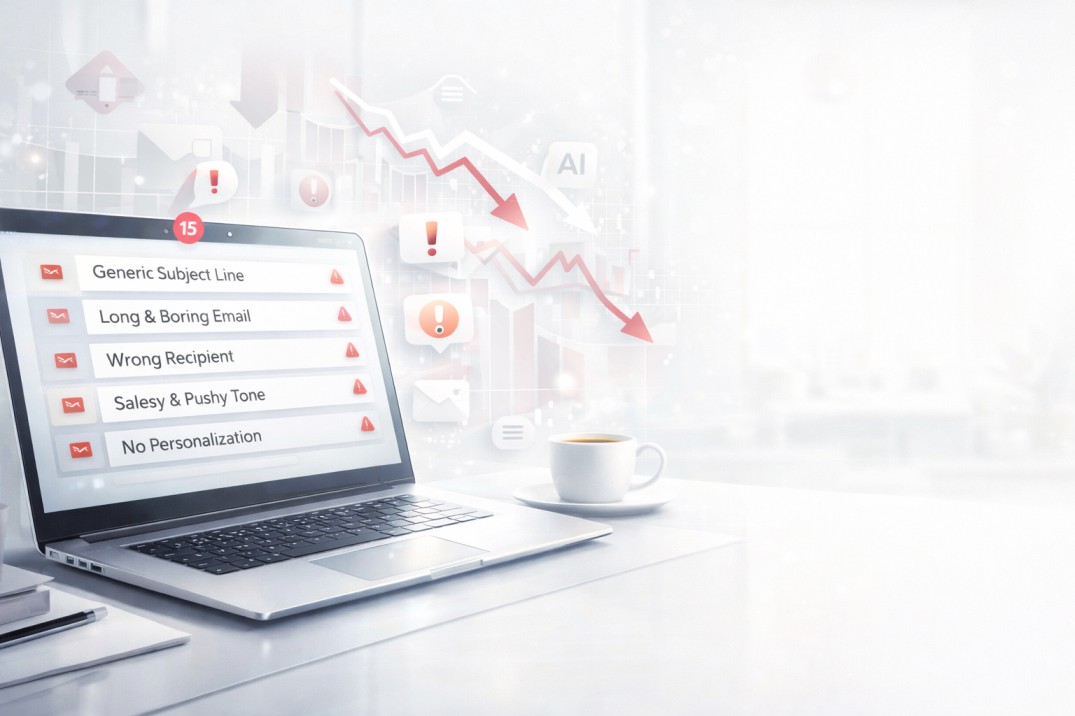
The average cold email response rate in 2025 is between 4% and 5.1% — meaning roughly 95 out of every 100 cold emails sent get no reply whatsoever.
That is not a deliverability problem. It is not a targeting problem. For most senders, it is a mistakes problem.
The painful truth about cold email is that the gap between a 2% reply rate and a 15% reply rate is almost never about sending more emails. It is about stopping the specific, identifiable mistakes that silently drain your results — mistakes that are entirely fixable once you know what they are.
This guide breaks down the 15 most damaging cold email mistakes we see across thousands of outreach campaigns, backed by real data, with a before/after rewrite for each one so you can see exactly what the fix looks like in practice.
If your cold emails are not getting the replies they deserve, the answer is almost certainly somewhere on this list.
Why Cold Emails Fail: The Big Picture
Before we get into individual mistakes, it helps to understand the three categories they fall into — because each requires a different kind of fix.
Targeting mistakes mean your email is landing in the wrong inbox. No amount of great copy fixes a misaligned ICP.
Content mistakes mean your email is reaching the right person but failing to move them. This is where most reply rate problems live.
Technical mistakes mean your email is not even reaching the inbox. Your copy is irrelevant if it never gets seen.
Most senders are making mistakes in all three categories simultaneously. The good news: fixing even two or three of these will produce a noticeable and immediate improvement in your reply rates.
The 15 Cold Email Mistakes — And How to Fix Them
Mistake #1: Writing an Opening Line About Yourself
The mistake: The most common opening line in cold email is some version of: "My name is [Name] and I work at [Company]. We help companies like yours..."
This is the fastest way to ensure your email gets deleted. The opening line is about you — and the recipient does not care about you. Not yet. They care about themselves, their problems, and their goals.
Generic cold emails that talk at the recipient with a cookie-cutter sales pitch, rather than to the recipient about their specific needs, are the single biggest driver of cold email failure in 2025.
The fix: Make your opening line 100% about the recipient. Reference something specific and real — a post they wrote, a company announcement, a recent hire, a funding round. The goal is for them to read the first sentence and think: "This person actually knows something about me."
❌ Before:
"Hi Sarah, my name is James and I'm the Head of Partnerships at Acme. We help B2B companies generate more pipeline..."
✅ After:
"Hi Sarah, your LinkedIn post last week about SDR ramp time hit on something I hear constantly from sales leaders at your stage — the gap between hire date and first quota attainment is brutal right now."
Mistake #2: Sending One Email and Giving Up
The mistake: Nearly half of all salespeople send one cold email and never follow up. This single habit is responsible for more lost pipeline than any other mistake on this list.
60% of prospects respond after the second follow-up — not the first. One analysis found that roughly 80% of sales require five or more touchpoints, yet most senders stop after one.
Your prospect is not ignoring you because they are uninterested. They are busy. Your email got buried. They meant to reply and forgot. A structured follow-up sequence solves this — not by pestering, but by giving your email a second, third, and fourth chance to land at the right moment.
The fix: Build a 4–5 email sequence for every prospect. Each follow-up should add something new — a fresh angle, a relevant case study, a different framing of your value. Never send the same email twice with a different subject line. For a complete sequence structure with templates, read our guide to cold email follow-up sequences.
The data: First follow-up messages increase responses by up to 50%. That uplift alone justifies building the habit.
Mistake #3: Subject Lines That Scream "Sales Email"
The mistake: Subject lines like "Revolutionize your sales pipeline," "Exciting partnership opportunity," or "Quick intro" are the cold email equivalent of a spam folder magnet. They tell the recipient exactly what is coming — a pitch — before they open a single word.
The fix: Write subject lines that feel personal, specific, and conversational — not promotional. The best cold email subject lines look like they were typed by a human to another specific human, not generated by a marketing team.
An ideal subject line should be 2 to 4 words and personalized. A short, specific subject line is more likely to get noticed and read.
❌ Before:
"Exciting opportunity to grow your revenue in 2025"
✅ After:
"Idea for [Company]'s onboarding"
For a full breakdown of what drives opens — including 60 proven subject line examples across every category — see our complete guide to cold email subject lines.
Mistake #4: Emails That Are Way Too Long
The mistake: Long cold emails signal two things to the reader: that you respect neither their time nor your own ability to communicate clearly. Every additional sentence is an additional opportunity to lose them.
Around 50–125 words correlates with higher response rates in large datasets, according to analysis of millions of cold emails. Yet the average cold email sent by struggling senders runs 200–400 words — two to four times that benchmark.
The fix: Cut ruthlessly. Your cold email should have: one specific opening line, two to three sentences explaining why you are relevant, one credibility signal, and one clear call to action. That is it. If you cannot make your case in 100–150 words, you have not clarified your thinking enough yet.
❌ Before (247 words):
A rambling email covering company background, three different product features, a list of customer logos, a case study paragraph, two calls to action, and a P.S. offering a free trial.
✅ After (89 words):
"Hi Marcus,
Noticed [Company] just opened three new AE roles — building out a sales team fast usually means new rep ramp time becomes a serious problem before Q3.
We help B2B SaaS teams cut average ramp time from four months to six weeks. We did it for [Similar Company] last year and they hit quota attainment records in the same quarter.
Worth 15 minutes to see if the approach makes sense for [Company]?
James"
Mistake #5: A Vague or High-Friction Call to Action
The mistake: Asking for too much too soon is one of the quietest reply rate killers. "I'd love to schedule a full demo of our platform" or "Let's set up a 45-minute call to walk through our capabilities" are asks that require significant commitment from someone who has never spoken to you.
The fix: Ask for the smallest possible next step. The call to action of a first cold email should always be a 15-minute call, a simple yes/no question, or an expression of interest — nothing more. Soft CTAs like "Worth a quick chat?" can increase reply rates by 10–20%.
❌ Before:
"Would you be available for a 45-minute product demonstration next week so I can walk you through everything we offer?"
✅ After:
"Would it make sense to spend 15 minutes seeing if this is relevant for [Company]?"
Mistake #6: Zero Personalization Beyond First Name
The mistake: Inserting {{First Name}} into the opening line and calling it personalization is no longer enough — and most prospects can feel the difference immediately. True personalization requires evidence that you researched this specific person, not just that you have their name in a spreadsheet.
Only 5% of senders personalize every email, and those who do get 2–3x better results. Highly personalized campaigns using multiple custom fields have boosted replies by 142% compared to non-personalized blasts.
The fix: Add one genuinely researched detail per email — something from their LinkedIn, their company's recent news, a post they wrote, a job listing, a product launch. One real signal of research is worth more than ten generic personalization tokens.
❌ Before:
"Hi {{First Name}}, I hope this finds you well! I came across your company and was really impressed..."
✅ After:
"Hi Priya, your Q1 blog post on demand gen without paid budget was one of the clearest frameworks I've seen on the topic — especially the point about content repurposing as a distribution lever."
Mistake #7: Talking About Features Instead of Outcomes
The mistake: Cold emails that lead with product features — "Our platform uses AI to automate your outreach with advanced sequencing and multi-inbox rotation" — force the prospect to do the mental work of figuring out why they should care. Most won't bother.
The fix: Lead with the outcome, not the mechanism. What specifically changes for the prospect's business if they work with you? How does their world look different? State that first, then — briefly — explain how you deliver it.
❌ Before:
"Our AI-powered platform includes multi-inbox rotation, automated sequence management, real-time analytics, and built-in email warming."
✅ After:
"We help B2B teams book 3x more meetings from the same list — by fixing the deliverability and sequence issues most outbound tools don't even surface."
Mistake #8: Sending From a Poorly Configured Domain
The mistake: You can write the world's best cold email and it will not matter if it is landing in the spam folder. Sending from an unwarmed domain, without proper SPF, DKIM, and DMARC authentication, is one of the most common and most invisible mistakes in cold outreach.
SPF, DKIM, and DMARC authentication reduces spam flags by 50%, while using your own domain for emailing improves deliverability by 40%.
The fix: Before sending a single cold email, verify that your authentication records are correctly configured, your sending domain has been properly warmed, and your daily send volume is within safe limits. For a complete technical setup guide, read our deep dive on email deliverability.
Signs you have a deliverability problem: open rates below 20%, zero replies despite high opens, sudden drops in engagement after scaling volume, or your emails landing in your own spam folder when you test.
Mistake #9: Sending at the Wrong Time
The mistake: Cold emails sent on Monday mornings (when inboxes are overloaded), Friday afternoons (when attention has checked out), or outside business hours tend to get buried before the recipient even has a chance to read them.
The fix: Thursday pulls in an average reply rate of 6.87% — the highest of any weekday. Wednesday and Tuesday are strong contenders. Monday remains the underachiever with just 5.29%.
For send time: Wednesday mornings between 7–11 AM yield peak response rates of approximately 5.8%. Most cold email tools allow you to schedule sends in the recipient's local time zone — use this feature.
That said, message quality matters far more than send time. Do not optimize timing at the expense of copy.
Mistake #10: Too Many Links and a Cluttered Email
The mistake: Including multiple links — to your website, a case study, a calendar booking page, a LinkedIn profile, and a product video — makes your email look like a marketing blast and triggers both spam filters and reader skepticism simultaneously.
Emails with 1–3 hyperlinks achieve a 15% higher click-through rate. Every link beyond that diminishes returns and raises spam filter red flags.
The fix: Include a maximum of one link in your first cold email. Make it the most important one — usually your Calendly or equivalent booking link, or a specific case study you are referencing. Remove everything else. Your signature does not need five social media icons and a banner image.
Mistake #11: Asking Multiple Questions
The mistake: Peppering your prospect with questions — "What are your current challenges? How big is your team? Have you tried X? What does your process look like?" — feels like an interrogation and dramatically reduces reply rates.
Emails with no questions scored the highest reply rate in one dataset. Add 1–5 questions, and the rate drops significantly. Too many questions feel like a quiz — one strong CTA beats a list of asks every time.
The fix: Ask one question, or no questions at all — just make a clear, single statement with a call to action. If you do ask a question, make it one that can be answered with a one-word yes or no, or a very short reply.
❌ Before:
"What does your current outbound process look like? What tools are you using? How many SDRs do you have? Would it be helpful to chat about how we could improve it?"
✅ After:
"Would it make sense to spend 15 minutes comparing notes on this?"
Mistake #12: Targeting the Wrong Person
The mistake: Even a flawlessly written cold email fails if it reaches someone who has no authority over, budget for, or interest in what you are selling. Targeting the wrong persona is a targeting mistake that no amount of good copy can overcome.
The fix: Map your Ideal Customer Profile to the specific job title and seniority level of the person who owns the problem you solve, can approve spending, and has a reason to act now. These three criteria — problem owner, budget authority, and current relevance — define the right person. For a complete framework, read our guide to sales prospecting techniques.
A useful rule: if you cannot articulate in one sentence why this specific person would care about your email, your targeting is not specific enough.
Mistake #13: Making It All About Your Company
The mistake: Cold emails that spend three paragraphs explaining the sender's company history, founding story, product awards, and team credentials are making the classic sales error: talking about themselves when the prospect only cares about themselves.
The fix: The ratio of "you/your" to "I/we" language in your email should be at least 3:1 in favor of the prospect. Every sentence should pass the test: does this help the reader understand what is in it for them? If it does not, cut it.
Run your next draft through a simple audit: highlight every sentence about you in red, every sentence about the prospect in green. Most struggling emails are 80% red. The goal is 80% green.
Mistake #14: No Social Proof or Credibility Signal
The mistake: Claiming you can deliver a result without any evidence that you have done it before is a hard sell to a stranger. Most cold emails make bold claims — "we help companies 3x their pipeline" — with zero supporting evidence, and wonder why nobody responds.
The fix: Include one specific, credible proof point. A customer name (if you can share it), a specific result with a number, or a recognizable client in the prospect's industry. The closer the proof point is to the prospect's own situation — same industry, same company size, same role — the more credible and relevant it becomes.
❌ Before:
"We help B2B companies significantly improve their outbound results."
✅ After:
"We helped [Similar Company] — a Series B SaaS team of similar size to yours — cut their average cost per meeting from $340 to $90 in one quarter."
Mistake #15: Stopping the Sequence the Moment Someone Doesn't Reply
The mistake: Treating non-response as rejection is one of the most expensive interpretations in sales. Sending only 1–2 emails means you are missing out on 75% of potential responses. Non-response almost never means no — it almost always means not yet, or not noticed.
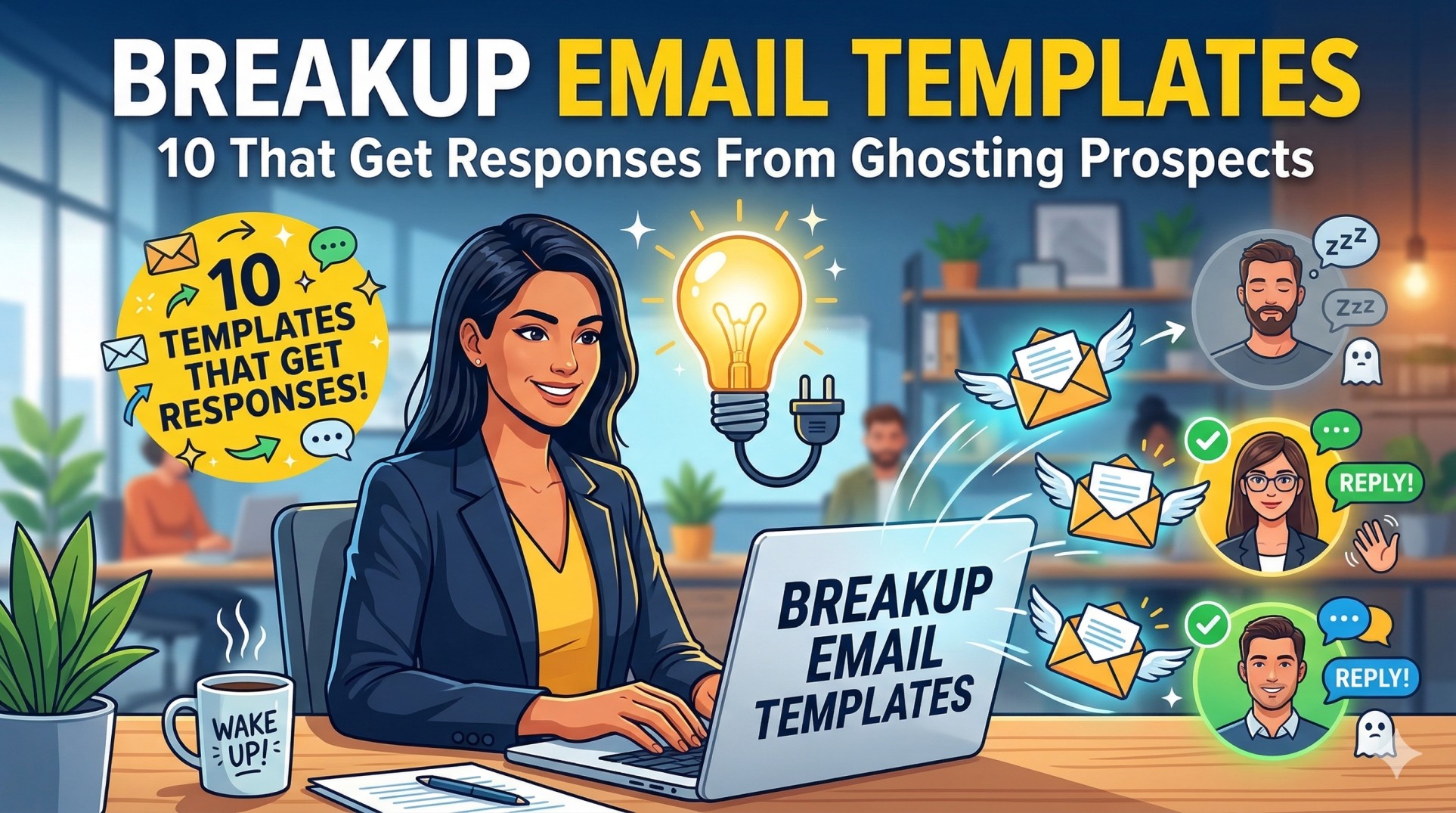
The fix: Build sequences that run the full arc: initial email, light bump, value-add, pivot, and breakup. Each email is another chance to land at the right moment, with the right framing, when the prospect is finally ready to engage. The breakup email alone — warmly signaling that you are removing them from your outreach — routinely generates replies from prospects who have been silent through the entire sequence.
A single follow-up can increase your response rate by over 20%. Five to seven polite follow-ups lift response rates by 27%.
The Cold Email Mistakes Audit: A Quick Self-Diagnostic
Before your next campaign goes out, run your emails through this checklist. Every "yes" answer is a reply rate problem waiting to happen.
Question If Yes → Fix Does my opening line mention my company or my name? Rewrite it to be about the prospect Is my email longer than 150 words? Cut to 100–125 words Am I sending from a brand-new or unwarmed domain? Warm the domain first — at least 3 weeks Do I have more than one link in the email? Remove all but the most essential one Am I asking more than one question? Replace with a single, soft CTA Is my subject line longer than 6 words? Shorten to 2–4 words Am I sending without a follow-up sequence? Build a 4–5 email sequence Is my credibility claim missing a specific number or name? Add a real proof point Does the email spend more time on "we" than "you"? Flip the ratio to 3:1 in favor of prospect Am I targeting people without budget authority? Refine your ICP targeting
Score yourself honestly. If you answered yes to five or more, you have found the source of your reply rate problem.
Frequently Asked Questions About Cold Email Mistakes
Why is my cold email open rate high but reply rate low?
A high open rate with a low reply rate is a clear signal that your subject line is working but your email body is not. The most common causes: a great subject line that does not match the email content (creating disappointment), an opening line about yourself rather than the prospect, a CTA that asks for too much too soon, or an email that is too long and loses the reader. Fix the body — specifically the opening line and the CTA — and your reply rate will climb.
What is the most common cold email mistake?
Not following up. Sending only 1–2 emails means missing out on 75% of potential responses, yet nearly half of all sales reps never send a single follow-up. After fixing your initial email, the highest-impact single change you can make is adding a structured follow-up sequence.
How many cold emails should I send to one prospect?
Between 4 and 7 emails spread over 20–30 days, with each email adding new value rather than repeating the same pitch. The first follow-up alone increases response rates by up to 50%. Beyond seven emails, the incremental gain rarely justifies the spam risk.
Why are my cold emails going to spam?
The most likely causes: missing or misconfigured SPF, DKIM, or DMARC authentication records; a domain that has not been properly warmed; a daily send volume exceeding your inbox's safe limits; or email content with too many links, spam trigger words, or heavy HTML formatting. Start by checking your authentication records and running your domain through a deliverability testing tool. Our full guide to email deliverability walks through every step of the diagnostic process.
How long should a cold email be?
Around 50–125 words correlates with higher response rates in large-scale analysis of cold email campaigns. Think of it this way: your cold email should be short enough to read in 20 seconds. One specific opening line, two to three sentences of relevant value, and a single soft CTA. That is the structure that produces the best results.
What is the average cold email reply rate in 2025?
Analysis of millions of emails shows an average response rate of 5.1% across B2B cold email campaigns in 2025. A reply rate of 5–10% is solid. 10–15% is excellent. Above 15% is exceptional and typically achieved through tight ICP targeting, strong trigger-based personalization, and multi-touch sequences. If you are below 2%, you almost certainly have a deliverability problem in addition to content issues.
The Bottom Line
Cold email mistakes are not random bad luck. They are predictable, identifiable, and fixable patterns that show up in the same places across thousands of campaigns.
The 15 mistakes in this guide account for the vast majority of the gap between a 2% reply rate and a 10%+ reply rate. Fix the targeting. Fix the opening line. Fix the follow-up sequence. Fix the deliverability. Fix the CTA. Do all five and your results will not just improve — they will compound, because every improvement makes the next campaign smarter.
Your prospects are not ignoring you because they do not need what you offer. Most of them are ignoring you because something in your email is telling them not to bother. Find that thing. Fix it. And send the next email better than the last.
Want to go deeper? Build a complete system with our cold email strategy guide, write subject lines that earn opens with our cold email subject lines guide, turn silence into replies with our follow-up sequences guide, and make sure your emails reach the inbox with our email deliverability guide. Or start sending smarter at mailfra.com.
Comments(0)
Loading comments...