
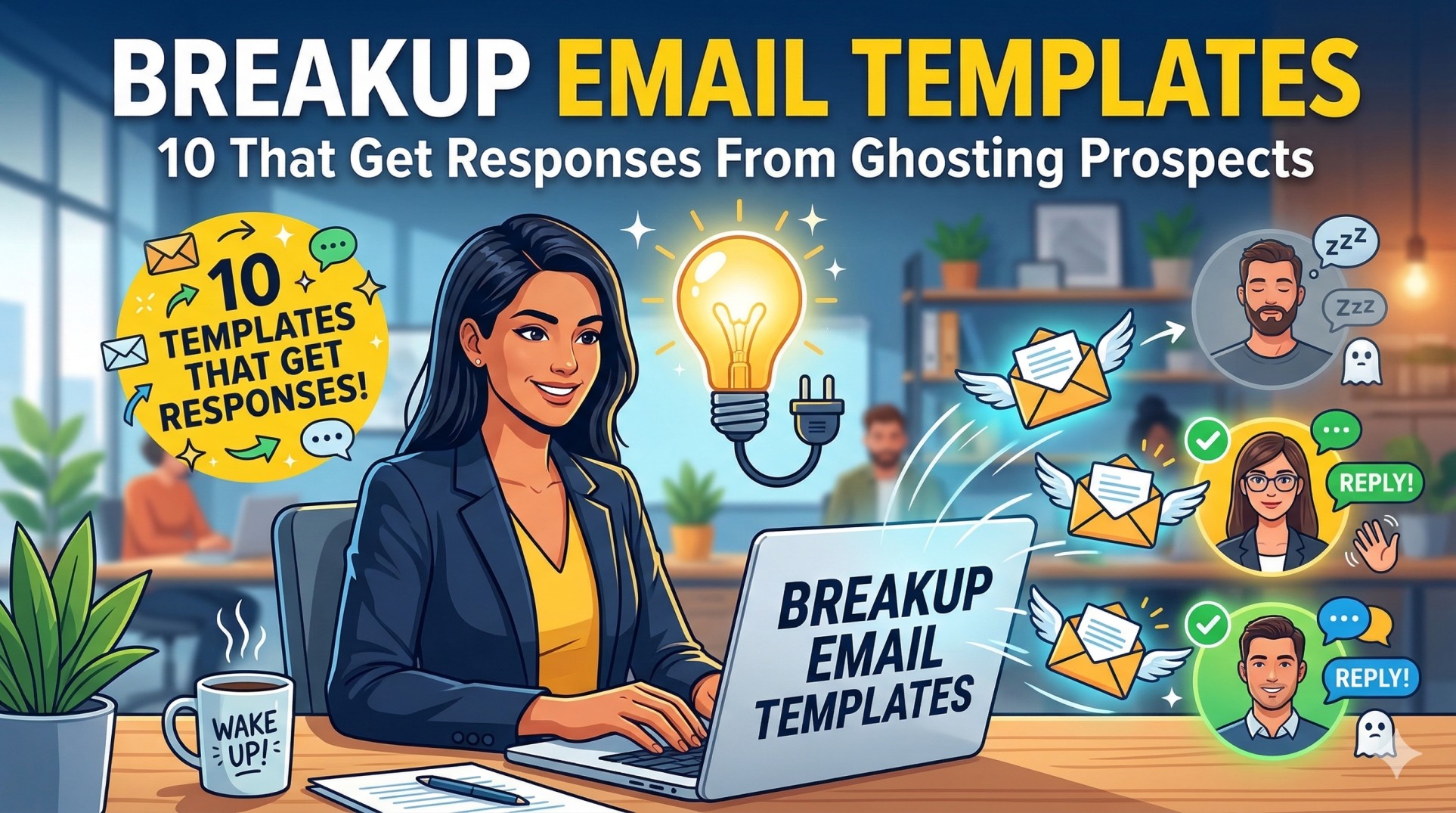
Here is the most counterintuitive truth in cold email: your final email — the one that says you are leaving — is often your highest-performing email in the entire sequence.
Standard cold email breakup emails generate a 5–10% response rate baseline. Post-demo breakup emails hit 10–15%. Psychology-optimized breakup emails achieve up to 76% response rates. That is not a typo. A well-crafted breakup email consistently outperforms every other email in a sequence — because it is the only email that uses loss aversion, the most powerful psychological trigger available to a salesperson, correctly.
The psychology is simple and human: people do not know they want something until they are about to lose access to it. The prospect who ignored your first four emails has been telling themselves "I'll deal with this later." Your breakup email forces a decision. Later is now. And a meaningful percentage of those prospects — the ones who were genuinely interested but never quite got around to replying — respond immediately.
30–40% of breakup email responses advance to scheduled calls. That means the email that signals you are done is producing qualified pipeline. Not just replies — meetings.
This guide gives you everything: the psychology behind why breakup emails work, 10 proven templates across every scenario, the multiple-choice format that generates 10% baseline responses regardless of relationship stage, the subject lines with the highest open rates, the timing rules, what to do after a prospect replies, and the breakup email mistakes that turn a warm farewell into a cold burn.
Why Breakup Emails Work: The Psychology
Before the templates, the mechanism. Understanding why breakup emails work is what allows you to write ones that genuinely convert — rather than just going through the motions of "one last email."
Loss Aversion: The Primary Driver
Loss aversion — the principle that people feel the pain of losing something roughly twice as strongly as the pleasure of gaining something equivalent — is the most powerful psychological lever in a breakup email.
When your breakup email arrives, it changes the mental framing for the prospect. Previously, not replying was the path of least resistance. Your emails were something to deal with "later." The breakup email removes "later" as an option: it signals that this window is closing now. The prospect must actively decide to let the opportunity go — or respond.
For the prospects who were genuinely interested but procrastinating, this is the catalyst they needed. For the prospects who were never interested, it provides clean closure without ongoing friction. Both outcomes are valuable: you either book a meeting or stop spending time on an account that was never going to convert.
The Paradox of Permission
The breakup email does something unique: it gives the prospect explicit permission to say no — and that permission paradoxically makes them more likely to say yes.
High-friction sales environments where every email is a pitch, every follow-up is a reminder, and every interaction is pressure-filled create resistance. The breakup email breaks that pattern completely. It says "I respect your time and your decision." That respect is so rare in sales outreach that it creates genuine goodwill — and goodwill converts.
Giving people an easy out ("If not, no worries") increases response rates by reducing pressure. The paradox: the email that makes it easiest to say no produces the most yeses.
Closure Seeking
The human brain does not like open loops. An unresolved sequence — emails that arrived, were not replied to, and keep coming — creates a low-level cognitive irritation. The breakup email resolves the loop, which creates a psychological sense of completion.
For many prospects, replying to the breakup email is as much about achieving that closure as it is about the actual business conversation. They reply because the email made it easy, because they feel slightly guilty, and because the loop needs to close.
The Breakup Email Performance Data
Breakup Email Type Response Rate Source Standard breakup (generic) 5–10% GrowLeads Dec 2025 Post-demo breakup 10–15% GrowLeads Dec 2025 Multiple-choice format ~10% baseline GrowLeads Dec 2025 Psychology-optimized breakup Up to 76% GrowLeads Dec 2025 Breakup responses → scheduled calls 30–40% GrowLeads Dec 2025 Sequences with breakup vs without Significantly higher total reply rate Saleshandy 2026 Campaigns with 3–5 follow-ups (including breakup) 8.3% reply rate vs 4.1% without Saleshandy 100M emails
The performance gap between a standard breakup email and a psychology-optimized one — 5–10% versus 76% — is the largest performance gap between two versions of the same email type in cold email research. The variables that explain it: warmth of tone, specificity of the let-go, use of loss framing without guilt-tripping, low-friction CTA, and absence of a final pitch.
Timing: When to Send Your Breakup Email
Timing matters more for breakup emails than for any other email in your sequence because it determines the emotional context in which the email lands.
When in the Sequence
Send your breakup email as the final touch in your sequence — after all other follow-ups have been exhausted. A typical sequence structure:
Touch Day Email Type 1 Day 0 Initial outreach 2 Day 3–4 Light bump 3 Day 8–9 Value-add 4 Day 13–15 Pivot / different angle 5 Day 20–25 Breakup email
Wait 3–4 days between the previous touch and the breakup send. Gaps under 48 hours appear desperate. Delays beyond 96 hours cause prospects to forget the context of earlier emails — and the breakup loses its reference point.
Best Day and Time
Send Tuesday through Thursday, 10 AM to 12 PM in the prospect's local time zone. Monday inboxes overflow with weekend backlog. Friday afternoons see lowest engagement as prospects mentally check out. Mid-week, mid-morning timing captures prospects during their highest decision-making capacity windows.
Avoid Mondays (chaotic inboxes) and Fridays (low engagement). Breakup emails are final touches — timing should align with when prospects are most mentally available and most likely to take a moment to decide.
The 10 Breakup Email Templates That Get Responses
Template 1: The Classic Warm Farewell (Most Used, Most Trusted)
Best for: Standard cold prospecting where no prior conversation has occurred Response rate: 5–10% baseline, up to 15% with strong ICP targeting
Subject: Closing the loop
Hi {{First Name}},
I've reached out a few times without hearing back — which usually means one of two things: the timing isn't right, or this isn't relevant for {{Company}} right now. Both are completely fair.
I'll stop reaching out after this. But if [specific challenge you solve] ever becomes a priority, I'd genuinely welcome a conversation.
Wishing you a strong quarter ahead.
[Name]
Why it works: Warmth without pressure. Acknowledges the silence without guilt-tripping. Leaves a door open without begging.
Template 2: The Feedback Request (Highest Information Value)
Best for: Understanding why a prospect went cold — valuable intelligence for improving your ICP and messaging Response rate: Consistently 3–5 percentage points higher than the direct withdrawal template
Template 2 (Feedback Request) consistently outperforms Template 1 (Direct Withdrawal) by 3–5 percentage points because it asks opinion, not commitment.
Subject: One quick question before I go
Hi {{First Name}},
I'm going to stop reaching out after this — but before I do, I'd genuinely appreciate one honest answer:
What was the main reason this didn't seem relevant? Even a one-word reply would help me understand whether it's timing, fit, or something else entirely.
No pitch. Just trying to learn.
[Name]
Why it works: Shifts from a sales ask to a genuine learning ask. Low commitment (one word is enough). Intellectual honesty about seeking feedback rather than another meeting.
Template 3: The Multiple-Choice Breakup (Best Closing Rate)
Best for: High-volume sequences where you want maximum replies with minimum friction Response rate: ~10% baseline regardless of relationship stage
Binary choices force micro-commitments. Even "stop here" responses provide closure and prevent wasted follow-up bandwidth.
Subject: Quick multiple choice, {{First Name}}
Hi {{First Name}},
Since I haven't heard back, I'm going to assume one of these applies — just reply with the letter that fits:
A) Not the right time — check back in [X months] B) Not the right fit — [Company]'s needs are different C) Interested but buried — let's find a time D) Wrong person — forward this to [role] instead
Whatever your answer, I'll act on it. Promise.
[Name]
Why it works: Removes the cognitive effort of composing a reply. Every option is easy to choose and easy to send. Option D often generates warm referrals to the right contact. Option C generates immediate meetings. Options A and B provide intelligence for future re-engagement.
Template 4: The Pivot-then-Leave
Best for: When you want one final attempt at a different angle before closing Response rate: 7–12%
Subject: Last thought before I stop, {{First Name}}
Hi {{First Name}},
One more thought before I stop reaching out — I've been approaching this from a [original angle] perspective. But thinking about it more, the bigger challenge at {{Company}}'s stage might actually be [different pain point].
If that second framing is more relevant, I'm happy to share what we've seen from teams in your exact position. If not, no problem at all — I'll close this out.
[Name]
Why it works: Tries a genuinely different angle rather than repeating the original pitch. If the first framing was wrong, this gives the prospect a new reason to engage. If both are wrong, the "no problem" close still generates goodwill.
Template 5: The Post-Demo Breakup (Highest Stakes)
Best for: Prospects who attended a demo or discovery call but went silent afterward Response rate: 10–15% baseline
The post-demo breakup carries more weight than a cold prospecting breakup because there is an established relationship to reference. Use that context.
Subject: Closing the loop on our conversation
Hi {{First Name}},
It's been a few weeks since our call, and I don't want to keep cluttering your inbox if the timing isn't right.
Based on what you shared about [specific challenge from the call], I still think there's a strong fit here — but I also know priorities shift fast at your stage.
If you'd like to revisit this when things settle, I'll be here. If not, I genuinely wish {{Company}} well with [specific goal they mentioned].
[Name]
Why it works: References the specific call rather than a generic relationship. Demonstrates that you paid attention. The personalized good wish for their specific goal creates genuine warmth.
Template 6: The "Last Chance" Without Pressure
Best for: Sequences for time-sensitive offers or limited availability Response rate: 8–14%
Subject: Final note from me
Hi {{First Name}},
This is genuinely my last email — I don't believe in wearing out a welcome.
If [specific value proposition] is something {{Company}} might revisit in Q[X], feel free to reach back out at [email]. I'll be here and the conversation will still be relevant.
If the timing was never right, no hard feelings — I appreciate you having read this far.
[Name]
Why it works: The explicit "I don't believe in wearing out a welcome" is a self-aware acknowledgment that creates instant rapport. Specific quarter reference gives a concrete re-engagement window. The "appreciate you having read this far" humanizes the close.
Template 7: The Achievement Acknowledgment Breakup
Best for: Prospects who have had a notable win, achievement, or announcement during your outreach sequence Response rate: 10–18%
Subject: Congrats and goodbye
Hi {{First Name}},
I saw [specific recent achievement — funding, award, expansion, product launch]. Genuinely impressive — [one specific, real observation about why it matters].
I've been reaching out about [topic] and haven't heard back — which I'll take as a signal that now isn't the right moment. I'll stop here.
But wanted to acknowledge the milestone before I did. Best of luck with what comes next.
[Name]
Why it works: Leads with genuine recognition rather than a sales point. The juxtaposition of "congratulations" and "goodbye" is unexpected and memorable. Ends with warmth that makes future outreach feel less cold.
Template 8: The Short, Punchy Close
Best for: C-suite and founder prospects who prize brevity above everything else Response rate: 8–15%
Subject: Last one
Hi {{First Name}},
Last email from me.
If [specific challenge] becomes a priority at {{Company}}, I'd love to hear from you: [email].
[Name]
Why it works: Executives respond to brevity. Five words is enough. The directness signals confidence and respect for their time. The personal email address creates a lower-friction path to re-engagement than a calendar link.
Template 9: The Value-First Goodbye
Best for: When you want to give one last piece of genuine value before closing Response rate: 7–13%
Subject: Something useful before I go
Hi {{First Name}},
One last thing before I stop reaching out — [one specific, genuinely useful piece of information: a data point, a case study finding, or an insight relevant to their situation]. Thought it might be useful regardless of whether we ever work together.
[Link or 2-sentence summary of the resource]
I'll leave it there. Good luck with [specific goal or challenge].
[Name]
Why it works: Delivers value in the final email rather than extracting it. Changes the last impression from "sales person gave up" to "generous professional who kept adding value to the end."
Template 10: The Playful Breakup (Use With Caution)
Best for: Informal industries, creative agencies, early-stage startup contacts — situations where a lighter tone fits the relationship Response rate: Variable — test on 10–20 prospects before scaling
Humor works if self-deprecating or lightly playful, not at prospect's expense. Risk: Can appear not to take prospect seriously.
Subject: It's not you, it's my CRM
Hi {{First Name}},
My CRM is telling me to close this out — and honestly, I'm inclined to agree at this point.
If [specific challenge] becomes a real priority at {{Company}}, I genuinely think there's something worth exploring. But I'll stop being the person in your inbox you keep meaning to respond to.
Take care of yourselves over there.
[Name]
Why it works: Self-deprecating humor about the sales process itself creates unexpected warmth. "The person in your inbox you keep meaning to respond to" names the experience the prospect is having without blame. The casual "yourselves" (addressing the team rather than just the individual) adds a friendly human touch.
Breakup Email Subject Lines: What the Data Shows
The subject line of your breakup email is the highest-stakes subject line in your entire sequence. The prospect has already ignored 3–4 of your emails. Your breakup subject line must create enough curiosity or relevance to earn one final open.
Subject Lines Ranked by Performance
Subject Line Why It Works Best For Closing the loop Simple, professional, implies finality Standard prospecting Last one Ultra-short — curiosity-inducing C-suite, founders Quick multiple choice, {{First Name}} Novelty — signals something different High volume sequences One quick question before I go Curiosity + low commitment signal Feedback request template Last thought before I stop, {{First Name}} Conversational — feels personal Pivot-then-leave It's not you, it's my CRM Pattern interrupt — humor Informal industries Closing the loop on our conversation References prior relationship Post-demo Congrats and goodbye Unexpected contrast — intriguing Achievement acknowledgment Something useful before I go Value signal in subject Value-first goodbye Final note from me Direct, finality signal Last chance
What to avoid in breakup subject lines:
"Last chance!!!" — artificial urgency, spam signal
"I'm giving up on you" — guilt-tripping, generates hostility
"You haven't responded to my emails" — accusatory, creates resentment
"RE: RE: RE: RE:" — makes the chain look unmanageable
"FINAL NOTICE" — sounds like a debt collector
For the complete cold email subject line framework with 60 proven examples, read our cold email subject lines guide.
What to Do When a Prospect Replies to Your Breakup Email
30–40% of breakup email responses advance to scheduled calls. But the way you handle the reply determines whether that happens.
Reply Type 1: Positive — "Let's Talk"
Respond within 60 minutes. Do not send a standard follow-up sequence email. Write a personalized, warm response that acknowledges the long gap without making it awkward:
"Really glad to hear back — let's make this easy. Here's my calendar link: [Calendly]. Pick whatever time works for you and I'll come prepared with [specific relevant content based on their situation]."
Speed matters: the first vendor to respond captures 35–50% of sales. Responding quickly to a breakup reply is especially critical because the prospect's decision to engage was often impulsive — act before they reconsider.
Reply Type 2: "Not Now — Check Back in X"
Log the date they specified in your CRM and set a task for two weeks before that date. When you reach back out, reference the original conversation: "You mentioned [month] would be a better time — wanted to follow through as promised." This specific, promise-kept follow-up converts at dramatically higher rates than generic re-engagement.
Reply Type 3: "Not the Right Fit"
Thank them genuinely, ask one clarifying question about why (for ICP intelligence), and move on. Log what they shared — it informs your targeting for future campaigns. Do not try to re-pitch immediately; you will undo the goodwill the breakup email created.
Reply Type 4: "Wrong Person — Try X"
Act on the referral immediately. Reach out to the recommended contact within 24 hours, referencing the original contact by name. This warm referral — even from a cold prospect — converts at much higher rates than a purely cold first touch.
Reply Type 5: No Reply
Move the prospect to a "low-touch nurture" list — a monthly or quarterly newsletter, relevant content shares, and occasional LinkedIn engagement. Do not re-add them to an active cold sequence without a genuine new trigger event (new job, new funding, new product launch).
The 5 Breakup Email Mistakes That Kill Your Goodwill
Mistake 1: Guilt-Tripping the Prospect
"I've reached out 5 times and haven't heard back" is a guilt trip masquerading as an observation. It creates defensiveness and resentment. The prospect who feels guilty does not reply with enthusiasm — they either ignore it (same as before) or reply apologetically with no genuine interest. Never guilt-trip. Never mention how many times you've reached out. The warm farewell works precisely because it does not make the prospect feel bad.
Mistake 2: Sneaking in One Last Pitch
The breakup email that includes "but before I go, I just wanted to mention one more feature that might be relevant" has broken its own contract. The prospect opened the email expecting closure. Finding another pitch reactivates resistance. The breakup email is not an opportunity for a final sales push. It is a genuine farewell — anything else undermines the psychological mechanism that makes it work.
Mistake 3: Sending Too Early
A breakup email sent after two touches is not a breakup email — it is an impatient follow-up. Campaigns with 3–5 follow-up steps consistently hit 8.3% reply rates compared to 4.1% for sequences without follow-ups. Earn the breakup by building a complete sequence first. The breakup email only works as the final chapter of a story. It cannot be the second paragraph.
Mistake 4: Not Including a Re-Engagement Path
The best breakup emails always include a clear, low-friction path for future contact. A personal email address, a simple instruction ("feel free to reach back out at [email]"), or a mention of when to re-engage ("if this becomes a priority in Q3"). Without a re-engagement path, the door closes entirely. With one, you are creating a pipeline of future prospects who will self-select when the timing is right.
Mistake 5: High-Friction CTAs
"Can we schedule a call?" in a breakup email kills performance. The prospect who was on the fence about whether to reply now has to add "calendar coordination" to the decision. Low-friction CTAs achieve 30% response rates by removing decision complexity: "Would you like to learn more?" beats "Can we schedule?" in every A/B test. The easier you make it to respond, the more responses you get. A single-word reply instruction ("just reply A, B, C, or D") is the lowest-friction CTA available.
For the complete list of cold email mistakes that kill reply rates at every stage, read our cold email mistakes guide.
Breakup Emails in Different Sequence Contexts
Not all breakup emails are written from the same starting point. Here is how the approach adapts based on context:
Context Key Difference Best Template Cold prospecting (no prior conversation) Reference is minimal — keep it warm and brief Template 1 or 8 After demo or discovery call Reference the specific call content Template 5 After proposal sent Address the specific proposal directly Template 4 (pivot then leave) Long sequence (5+ emails) Acknowledge the extended outreach without guilt Template 1 with explicit "I know I've been persistent" Warm prospect who went cold Reference the warmth that existed Template 7 (achievement acknowledgment) Agency or creative industry Lighter tone is appropriate Template 10 (playful) C-suite or executive Brevity wins above all Template 8 (short punchy) High-volume campaigns Maximum response rate from minimum effort Template 3 (multiple choice)
Frequently Asked Questions About Breakup Emails
What is a breakup email in sales?
A breakup email is the final email in a cold email or follow-up sequence — sent to a prospect who has not responded to any previous outreach. It signals that the sender is ending active outreach, typically with warmth and without pressure. Despite being the "last" email, breakup emails often generate the highest response rates in a sequence: standard breakup emails achieve 5–10% response rates, post-demo breakups hit 10–15%, and psychology-optimized formats can reach up to 76% response rates. The counterintuitive performance of breakup emails is driven by loss aversion — prospects become motivated to respond precisely because the window of access is closing.
How do you write a breakup email that gets a response?
Write a breakup email that gets a response by following five principles: (1) Be genuinely warm — not passive-aggressive, not guilt-tripping; (2) Keep it short — 50–80 words maximum; (3) Use a low-friction CTA — "reply with a letter" or "feel free to reach back out" rather than "can we schedule a call"; (4) Include a genuine re-engagement path for future contact; (5) Make it easy to say no — paradoxically, giving explicit permission to decline increases yes rates. The multiple-choice format (Template 3 in this guide) is the highest-reliability breakup email format because it removes all friction from replying.
When should you send a breakup email?
Send a breakup email as the final touch in your sequence, after all other follow-ups have been exhausted — typically Day 20–25 of a 5-touch sequence. Wait 3–4 days between the previous follow-up and the breakup send: gaps under 48 hours feel desperate, and delays beyond 96 hours cause prospects to lose context. Send Tuesday through Thursday between 10 AM and 12 PM in the prospect's local time zone for maximum open and response rates.
What should you never say in a breakup email?
Never say: "I've reached out X times and you haven't responded" (guilt-tripping), "This is your last chance" (artificial pressure), "I'm disappointed you didn't reply" (resentment), or include any form of a sales pitch in the closing paragraph (contradicts the breakup premise). Never use aggressive urgency language, exclamation marks, or anything that creates pressure rather than closure. The breakup email works because it removes pressure — any element that reintroduces pressure undermines its effectiveness.
How long should a breakup email be?
50–80 words maximum. The breakup email should be noticeably shorter than every other email in your sequence — brevity itself signals that you respect the prospect's time and are making a genuine, low-pressure final gesture. The multiple-choice format can be even shorter: a 40-word breakup email with four reply options is one of the highest-performing formats available precisely because it asks so little of the reader. If your breakup email is over 100 words, cut it.
What do you do after a prospect replies to a breakup email?
Respond within 60 minutes — speed matters more for breakup email replies than for any other email type because the prospect's engagement was often impulsive. 30–40% of breakup email responses advance to scheduled calls. For positive replies, respond warmly, skip the sales script, and make it easy to book time. For "not now" replies, log the specified timeframe in your CRM and follow through precisely as promised. For "wrong person" replies, act on the referral within 24 hours using the original contact's name as a warm reference.
The Bottom Line
The breakup email is not a sign of failure. It is the most psychologically sophisticated email in your entire sequence.
It works because it uses loss aversion, the most powerful motivator in human decision-making, in service of a genuine and respectful farewell. It gives permission to say no — and that permission makes people more likely to say yes. It creates closure — and the prospect who needs to close the loop will reply to do so.
Standard breakup emails produce 5–10% responses. Psychology-optimized ones reach 76%. 30–40% of those replies turn into calls.
The prospect you have been trying to reach for three weeks is one well-crafted goodbye email away from becoming your next customer.
Write it warmly. Keep it short. Make it easy to reply. And always leave a door open.
Complete your cold email system: build the complete cold email follow-up sequences that lead to your breakup email, use our cold email templates for every stage before the farewell, write subject lines that earn every open including the final one, master cold email personalization that makes even your goodbye feel individual, understand your cold email response rate benchmarks to know when your sequence needs a breakup email, avoid the cold email mistakes that make breakup emails necessary too early, build your full cold email strategy from first touch to farewell, and add cold email to your complete B2B lead generation strategy. Send smarter at mailfra.com.
Comments(0)
Loading comments...