
Here is the hard truth about cold email templates: most of them do not work.
Not because templates are a bad idea — they are not. But because 95% of the templates floating around the internet are the same recycled formats that every prospect has seen hundreds of times. They are generic. They are selfish. And they telegraph "mass blast" from the very first sentence.
The templates in this guide are different. Each one is built around a specific psychological trigger, a specific use case, and the 2025 data that explains why it works. Advanced personalization drives reply rates of up to 18% compared to just 9% for generic emails — more than double. These templates are designed to be that 18%.
You will find 25 ready-to-use cold email templates organized by use case and industry — for SaaS, agencies, recruiting, real estate, follow-ups, and more — plus the framework for personalizing each one so it never looks like a template.
Let's get into them.
What Makes a Cold Email Template Actually Work in 2025?
Before the templates, a quick baseline on what the data says. Because using a template without understanding why it works means you will never be able to adapt it when it stops working.
Campaigns with advanced personalization see reply rates of up to 18%, compared to 9% for generic emails. That is not a marginal difference — it is the gap between a campaign that fills your pipeline and one that wastes your list.
The average B2B cold email response rate is 4.0% in 2025, but exceptional campaigns achieve 10% or higher through meticulous execution — specifically through precise targeting, deep personalization, and concise emails under 125 words with a clear, low-friction call to action.
Top-quartile performers routinely achieve 15–25% reply rates through hook optimization, tight ICP targeting, and strategic follow-up sequencing.
Every template below is engineered to hit those top-quartile numbers. Here is what they all have in common:
A specific, research-based opening line — not "I hope this finds you well"
One clear value proposition — not a feature list
One credibility signal — a real name, a real number, or a real outcome
One soft, low-friction CTA — not a request for a 45-minute demo
Under 125 words — short enough to read in 20 seconds on mobile
Use these as starting points. The {{variables}} are your personalization triggers — fill them in with real research, not guesswork. For the full breakdown of what makes cold emails succeed and fail, read our guide on cold email mistakes.
Category 1: SaaS Cold Email Templates
SaaS prospects are flooded with cold email. The bar is high. What cuts through: extreme specificity about their stage, their stack, and their current growth challenges.
Template 1: The Trigger-Based SaaS Opener
Best for: Reaching SaaS founders or sales leaders after a funding event or major hire.
Subject: Idea for {{Company}}'s next 90 days
Hi {{First Name}},
Congrats on the {{funding round}} — scaling a revenue org that fast while keeping CAC under control is genuinely hard, and it's exactly where most teams at your stage hit friction.
We help Series {{A/B}} SaaS companies build outbound systems that deliver qualified pipeline before the new headcount fully ramps. {{Similar Company}} went from 4 SDRs with no system to a structured outbound engine in 6 weeks.
Worth 15 minutes to see if the approach fits where {{Company}} is headed?
{{Your name}}
Why it works: The funding trigger is timely and researched. The pain point (scaling revenue org, CAC pressure) is specific to their stage. The social proof mirrors their exact situation.
Template 2: The Job Posting Trigger
Best for: Reaching out to companies that just posted SDR or sales roles — a clear signal they are investing in outbound.
Subject: {{Company}}'s SDR hiring — a thought
Hi {{First Name}},
Noticed {{Company}} is hiring {{number}} SDRs right now. That usually means outbound is about to scale fast — and new rep ramp time becomes the silent killer before most teams see it coming.
We cut average SDR ramp time from 4 months to 6 weeks for {{Similar Company}} last quarter. Happy to share the exact playbook if it's useful.
Does that seem worth a quick call?
{{Your name}}
Why it works: Job postings are public intent signals. The email shows research without being invasive, identifies the downstream pain before the prospect has named it, and delivers social proof with a specific, believable timeframe.
Template 3: The Competitor Angle
Best for: Prospects who are likely using or evaluating a competitor.
Subject: How {{Company}} compares to {{Competitor}}
Hi {{First Name}},
A lot of the {{industry}} teams I talk to have tried {{Competitor}} and hit the same wall — {{specific limitation, e.g. deliverability drops at scale / lack of personalization depth / pricing jumps at 1k contacts}}.
We built {{Your Product}} specifically to solve that. Teams switching from {{Competitor}} typically see reply rates jump from {{X}}% to {{Y}}% within the first month.
Would it make sense to do a quick comparison call?
{{Your name}}
Why it works: Names a shared frustration without disparaging the competitor. Positions your product as the informed upgrade, not just another option.
Template 4: The Metric-Led SaaS Email
Best for: Data-driven buyers — RevOps, VP of Sales, or growth-stage founders.
Subject: {{Company}}'s outbound numbers
Hi {{First Name}},
Quick question — are your SDRs hitting meetings booked targets but those meetings aren't converting downstream?
That gap between activity metrics and pipeline quality is the most common problem we see at {{Company's stage}}. We helped {{Similar Company}} close it by rebuilding their sequence structure and ICP targeting — pipeline quality went up 40% in one quarter with the same headcount.
Worth 15 minutes to run the same diagnostic on {{Company}}'s outbound?
{{Your name}}
Why it works: Opens with a diagnostic question that either resonates hard (they reply immediately) or reveals misalignment (they say no, saving everyone time). The specific metric — pipeline quality, not just activity — speaks the language of a data-driven buyer.
Category 2: Agency Cold Email Templates
Agencies face a unique challenge: every prospect is also being pitched by dozens of other agencies. Standing out requires a level of specificity that feels almost uncomfortable.
Template 5: The Audit Opener
Best for: Offering a specific, low-commitment first step.
Subject: Quick audit of {{Company}}'s {{channel}}
Hi {{First Name}},
I spent 10 minutes looking at {{Company}}'s {{paid ads / SEO / email strategy}} and noticed {{one specific, real observation — e.g., your top 3 pages are leaving significant conversion value on the table because they have no clear CTA above the fold}}.
We do this for a living — {{Agency Name}} has helped {{X}} companies in {{their industry}} fix exactly this. Happy to do a full free audit and share the findings, no pitch attached.
Interested?
{{Your name}}
Why it works: Doing genuine upfront work — even 10 minutes of real research — is a form of value delivery before the ask. The "no pitch attached" line disarms defensiveness.
Template 6: The Results-First Agency Email
Best for: Direct outreach to business owners or marketing directors.
Subject: {{Specific result}} for {{Industry}} companies
Hi {{First Name}},
We just wrapped a campaign for {{Similar Company in their industry}} — {{specific result, e.g., 312 inbound leads in 60 days from organic content, zero ad spend}}.
They were in a very similar position to {{Company}} — {{one-sentence description of their situation before working with you}}.
I think we can replicate it. Would you be open to a 20-minute call to walk through how?
{{Your name}}
Why it works: Leads with the outcome, not the service. The "similar position" framing makes the social proof feel directly relevant rather than generic.
Template 7: The Referral Name-Drop
Best for: When you have a mutual connection — even a thin one.
Subject: {{Mutual contact}} suggested I reach out
Hi {{First Name}},
{{Mutual contact}} mentioned you're looking at scaling {{Company}}'s {{specific function}} this quarter and thought we might be a good fit to talk.
We've helped {{2–3 companies in their space}} with exactly that. Happy to share what worked and what didn't — no agenda beyond seeing if there's a fit.
Do you have 15 minutes this week or next?
{{Your name}}
Why it works: Only 5% of senders personalize every email, and those who do get 2–3x better results. A mutual connection reference is the strongest personalization signal possible — it converts a cold email into a warm one.
Category 3: Recruiting Cold Email Templates
Recruiting cold email has one job: make the opportunity irresistible to the specific person receiving it. Generic "exciting opportunity" emails are deleted without a second thought.
Template 8: The Career Trajectory Email
Best for: Reaching passive candidates who are not actively job hunting.
Subject: Your next move, {{First Name}}
Hi {{First Name}},
Your work building {{Company}}'s {{specific function or achievement}} caught my attention — specifically {{one specific thing you noticed about their career or recent work}}.
I'm working with {{Hiring Company}} on a {{Role}} search. The opportunity is specifically designed for someone who has done what you've done and wants to {{what this role lets them do next — e.g., build the function from scratch / take it to a global stage / move into a VP track}}.
I know you're probably not actively looking — but would it be worth 20 minutes to hear the details?
{{Your name}}
Why it works: Acknowledges they are not looking (which is honest and respectful), appeals to the natural curiosity about what is possible, and ties the opportunity directly to where their career appears to be headed.
Template 9: The Peer Reference Email
Best for: Technical roles where community credibility matters.
Subject: {{Peer name}} thought you'd be worth talking to
Hi {{First Name}},
{{Peer name}} — who you may know from {{Company / community / GitHub / conference}} — suggested I reach out. They thought you'd be a great fit for something I'm working on.
{{Hiring Company}} is looking for a {{Role}} to {{one-sentence description of the core challenge}}. It's a {{remote / hybrid}} role with {{one compelling detail — equity, team, mission, or growth path}}.
Worth a quick call to hear more?
{{Your name}}
Template 10: The Mission-Led Email
Best for: Candidates who are motivated by impact over compensation.
Subject: Building something worth working on
Hi {{First Name}},
I've been following your work on {{specific project or area}} — the {{specific thing you admire}} is the kind of thinking we're trying to bring into {{Hiring Company}}.
We're at an early and genuinely important stage: {{one honest sentence about what makes the mission compelling}}. It's the kind of problem that could use someone who {{mirrors back something specific about their experience}}.
Is this worth 20 minutes of your time?
{{Your name}}
Category 4: Real Estate Cold Email Templates
Real estate cold email is about timing and local relevance above everything else. Hyper-local specificity converts; generic market commentary does not.
Template 11: The Off-Market Property Email
Best for: Reaching buyers who may be interested in a specific listing.
Subject: Off-market {{property type}} in {{neighborhood}}
Hi {{First Name}},
I have a {{property description}} in {{neighborhood}} that is coming to market in the next two weeks — before it goes live publicly.
Based on {{what they have purchased / shown interest in before}}, I thought you would want to hear about it first. It checks {{specific criteria that match their history}}.
Can I send you the details?
{{Your name}}
Template 12: The Market Insight Email
Best for: Opening a conversation with investors or landlords.
Subject: {{Neighborhood}} market — something you should know
Hi {{First Name}},
{{One specific, hyperlocal market insight — e.g., cap rates in [area] have compressed 40 basis points in the last 90 days as three large operators have exited the market}}.
Given your portfolio in {{area}}, that creates an interesting window in the next 60–90 days before the market reprices.
Worth a 15-minute call to talk through what we're seeing?
{{Your name}}
Category 5: Follow-Up Templates
The most underused templates in cold email are follow-up templates. 70% of outreach reps stop sending emails after not getting a response from the first email — which means following up consistently is itself a competitive advantage.
For a full structured system, read our complete guide to cold email follow-up sequences.
Template 13: The Light Bump (Follow-Up #1)
Send: 3 days after initial email. Keep it to 2–3 sentences maximum.
Subject: Re: {{original subject line}}
Hi {{First Name}},
Just wanted to resurface this in case it got buried — no worries if the timing is off.
Still think there's a relevant angle for {{Company}} if you have a few minutes this week.
{{Your name}}
Template 14: The Value-Add Follow-Up (Follow-Up #2)
Send: 7–9 days after initial email. Bring something new — never repeat the original pitch.
Subject: Something relevant to {{Company}}
Hi {{First Name}},
Thought this might be useful regardless of whether we end up working together — {{one specific insight, data point, or short case study directly relevant to a challenge they are likely facing}}.
{{One sentence connecting the insight to what you offer, lightly.}}
Happy to share more if it's relevant.
{{Your name}}
Template 15: The Pivot Follow-Up (Follow-Up #3)
Send: 13–16 days after initial email. Try a completely different angle.
Subject: Different angle on this, {{First Name}}
Hi {{First Name}},
I've been approaching this from a {{original angle}} angle — thinking about it more, the more pressing challenge at {{Company}}'s stage might actually be {{different pain point}}.
{{One sentence connecting the new angle to what you offer.}}
Does that resonate more?
{{Your name}}
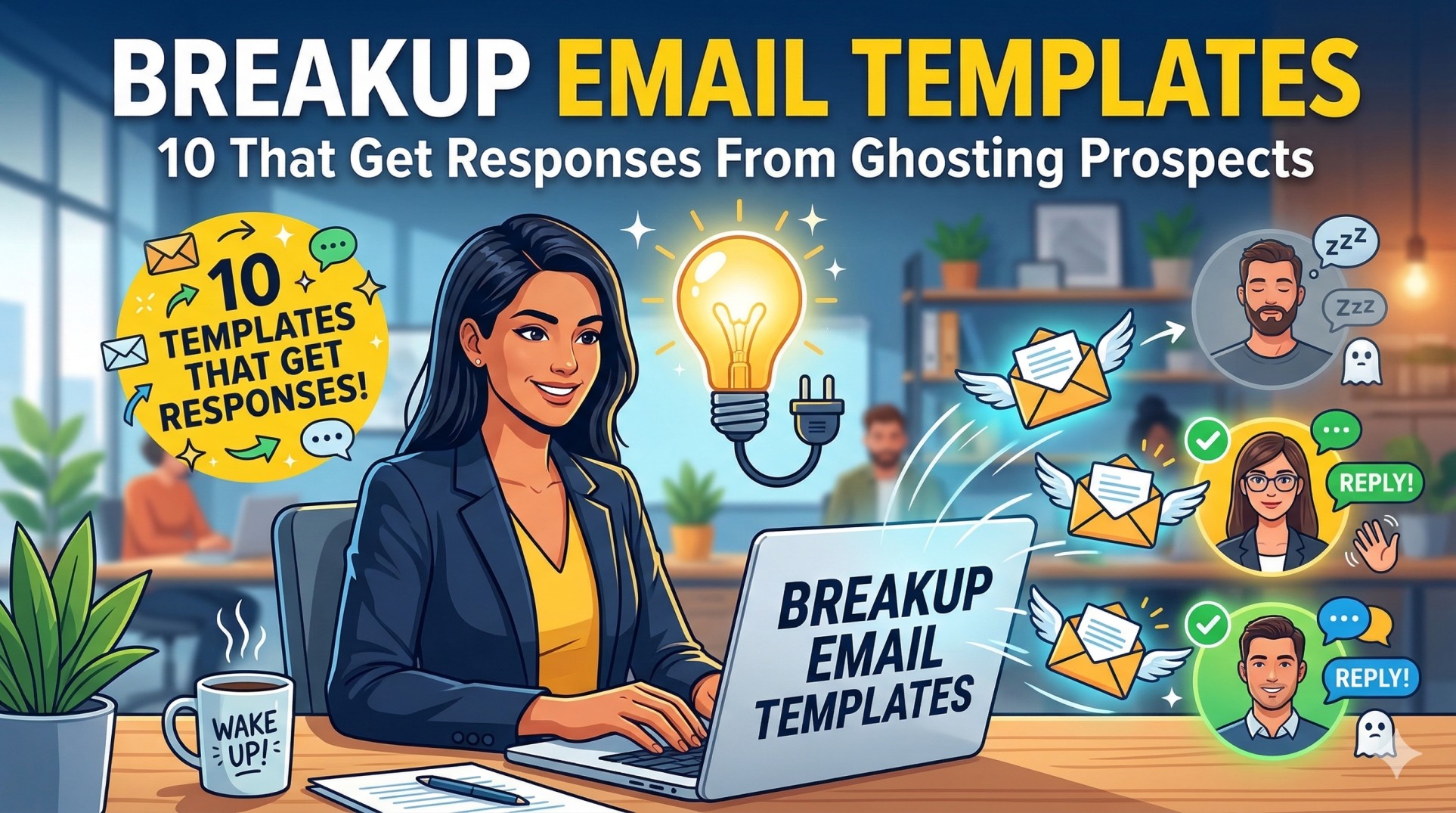
Template 16: The Breakup Email (Follow-Up #4)
Send: 20–25 days after initial email. Warm, genuine, no guilt trips.
Subject: Closing the loop
Hi {{First Name}},
I've reached out a few times without hearing back — which usually means the timing isn't right or this isn't relevant, and both are completely fair.
I'll stop reaching out after this. But if {{specific challenge}} ever becomes a priority at {{Company}}, I'd genuinely welcome a conversation.
Wishing you a strong quarter.
{{Your name}}
Category 6: High-Converting Specialty Templates
These templates target specific high-intent scenarios — situations where the prospect is highly likely to be in a buying window right now.
Template 17: The New Executive Email
Best for: Reaching a VP or C-level who has just started a new role in the last 90 days.
Subject: New to {{Company}}, {{First Name}}?
Hi {{First Name}},
Congrats on the new role — the first 90 days as {{Title}} at a company like {{Company}} usually involves an honest audit of what's working and what needs to change.
One area a lot of incoming {{titles}} find underbuilt is {{specific area relevant to your product}}. We helped {{Similar Company}}'s new {{Title}} get it to a strong place within the first quarter.
Would it be worth a quick call to compare notes?
{{Your name}}
Template 18: The Conference Follow-Up Email
Best for: Reaching out after an industry event, even without meeting them directly.
Subject: Following up from {{Conference Name}}
Hi {{First Name}},
I caught your talk / panel at {{Conference}} on {{topic}} — {{one specific, genuine observation about something they said}}.
It connected directly to something we have been working on for {{type of company}} — specifically {{brief relevant description}}.
Would you be open to a short call to continue the conversation?
{{Your name}}
Template 19: The Content-Led Email
Best for: Reaching a prospect who has recently published content you can genuinely reference.
Subject: Your post on {{topic}}, {{First Name}}
Hi {{First Name}},
Your {{article / LinkedIn post / podcast appearance}} on {{topic}} was one of the clearest takes I've read on {{subject}} — especially {{one specific point that resonated}}.
It maps almost exactly to what we've been hearing from {{type of companies}} — and what we built {{Product / Service}} to solve.
Worth a 15-minute conversation?
{{Your name}}
Template 20: The Problem-First Email
Best for: Prospects in industries with well-known, universal pain points.
Subject: {{Industry}}'s {{specific problem}} — a thought
Hi {{First Name}},
Most {{job titles}} I talk to in {{industry}} right now are dealing with the same thing: {{one specific, well-articulated pain point}}.
{{One sentence on your solution and why it is specifically suited to this problem.}} We have seen {{specific outcome}} for teams in exactly your position.
Is this on your radar at {{Company}}?
{{Your name}}
Template 21: The Short, Ultra-Direct Email
Best for: Senior decision-makers — C-suite, founders, VPs — who respond to brevity and directness above all else.
Subject: {{Company}} + {{Your Company}}
Hi {{First Name}},
{{One sentence on what you do and who you do it for.}}
We helped {{recognizable company or close analogue}} achieve {{specific result}} in {{timeframe}}.
Worth 15 minutes?
{{Your name}}
Why it works: Senior leaders in a company are 23% more inclined to respond to unsolicited B2B emails than their subordinates. They are also the busiest — brevity signals respect.
Template 22: The Social Proof-Led Email
Best for: Competitive markets where credibility needs to be established fast.
Subject: What {{Well-Known Company}} does for {{specific result}}
Hi {{First Name}},
{{Well-Known Company}} — which runs a very similar {{operation / team / process}} to {{Company}} — used {{your approach}} to achieve {{specific result}} in {{timeframe}}.
The key was {{one-sentence description of the specific mechanism}} — something most teams in your space are not doing yet.
I think there's a direct application for {{Company}}. Worth a quick call to explore?
{{Your name}}
Template 23: The "One Question" Email
Best for: Re-engaging cold or previously unresponsive prospects with minimal friction.
Subject: Quick question, {{First Name}}
Hi {{First Name}},
Is {{specific pain point or challenge}} something {{Company}} is actively thinking about right now?
{{Your name}}
Why it works: Emails containing between one and three questions are 50% more likely to receive a response than those without any. A single, direct, yes-or-no question is the easiest email in the world to reply to — and it opens the door to the real conversation.
Template 24: The Industry Insight Email
Best for: Positioning yourself as a trusted expert rather than a vendor.
Subject: What we're seeing in {{industry}} this quarter
Hi {{First Name}},
We work with a lot of {{type of companies}} in {{industry}}, and the pattern we've seen consistently over the last 90 days is {{one specific, non-obvious insight about a challenge or shift in their market}}.
Most teams are handling it by {{common approach}}, but the ones seeing the best results are {{different approach — something you enable or facilitate}}.
Thought it might be useful context given what {{Company}} is building. Happy to share more if relevant.
{{Your name}}
Template 25: The Video Email
Best for: High-value accounts where a personalized video justifies the extra 5–10 minutes of effort.
Subject: 90 seconds for {{First Name}} at {{Company}}
Hi {{First Name}},
Recorded a quick video specifically for you and the {{Company}} team — {{link to Loom / Vidyard with personalized thumbnail showing their name or website}}.
It covers {{one specific observation about their business}} and why I think there's a relevant connection to what we do.
Worth a watch?
{{Your name}}
Why it works: Personalized video in sales outreach can increase response rates by up to 80%. The thumbnail with their name or website is impossible to mistake for a mass blast — it proves the effort before they even click play.
How to Personalize Any Template in 3 Minutes
Templates are a starting point, not a final product. The difference between a template that converts and one that gets deleted is personalization — specifically, a researched first line that could only have been written for this specific person.
Here is a 3-minute research process for any prospect:
Minute 1 — LinkedIn: Check their profile for a recent post, a career update, a skills section that reveals what they care about, or a company milestone they celebrated. One genuine detail from here is worth more than any template variable.
Minute 2 — Company: Check their website's news or blog section, their LinkedIn company page, their job postings, and Google News for the company name. Look for funding, launches, executive hires, or expansion signals.
Minute 3 — Write the opening line: Take the most interesting thing you found and turn it into an opening sentence that shows you noticed it. It does not need to be clever. It just needs to be specific and real.
The rest of the template can stay largely as-is. One genuinely researched detail at the top is what transforms a template into a cold email that gets opened, read, and replied to.
For the full framework on writing opening lines that pull people in, see our guide to cold email strategy. For subject lines that earn the open in the first place, our cold email subject lines guide has 60 proven examples across every category.
Cold Email Template Mistakes to Avoid
Even the best template can be undermined by common execution errors. Here is what to watch for:
Sending templates without personalizing the opening line. The first sentence is the only sentence most recipients read before deciding to continue or delete. A generic opener — "I hope this finds you well" or "My name is..." — immediately signals template, and templates get deleted.
Using the same template for every industry. A template that works for SaaS founders will feel tone-deaf to a manufacturing executive. Segment your templates by industry, company stage, and persona before sending.
Treating the template as the final product. Templates are frameworks. Every send should involve a human reviewing the email and asking: "Does this make sense for this specific person right now?" If the answer is no, rewrite before sending.
Forgetting the follow-up. 70% of outreach reps stop sending emails after not getting a response from the first email. Your best template will not save a one-and-done campaign. Build a sequence. Use the follow-up templates in this guide.
For a complete breakdown of every mistake that undermines cold email performance, read our guide to cold email mistakes. And before any of this can work, make sure your emails are actually reaching the inbox — our email deliverability guide covers everything you need.
Frequently Asked Questions About Cold Email Templates
What is the best cold email template for B2B?
The best B2B cold email template is one that opens with a specific, research-based observation about the recipient, delivers a clear and relevant value proposition in one to two sentences, includes one credibility-building proof point, and ends with a single, soft call to action. No single template works for every situation — the 25 templates in this guide are organized by use case precisely because context determines what converts.
How long should a cold email template be?
Achieving a high response rate depends on sending concise emails of under 125 words. Think of it as short enough to read in 20 seconds on mobile. One personalized opening line, two to three sentences of value, one proof point, and one CTA. That is the structure.
Should I use the same template for every prospect?
Never. Templates are frameworks, not finished products. The opening line of every cold email should be customized based on at least one specific, researched detail about the recipient. The rest of the template can remain consistent within a given segment, but the personalized first line is what separates emails that get read from emails that get deleted.
How do I know if my cold email template is working?
Track your open rate and reply rate separately. A strong open rate with a low reply rate means your subject line works but your body copy does not. A low open rate means your subject line or deliverability needs work. A strong reply rate — above 5% — means your template is performing. Above 10% is excellent. If you are below 2%, the template needs a fundamental rethink, starting with the opening line and the CTA.
How many cold email templates should I have?
At minimum, one core template per major ICP segment. Practically, that means one for each industry you target, one for each seniority level you reach (founder vs. VP vs. manager), and one for each trigger event you use (funding, new hire, job posting, content). Start with three to five and test before expanding your library. Quality and variation matter more than volume.
Are cold email templates legal?
Yes — when used correctly. In the US, CAN-SPAM allows B2B cold email provided you include a physical address, an opt-out mechanism, and honest subject lines. In the EU, GDPR requires a "legitimate interest" basis for B2B cold outreach. The templates in this guide are designed for compliant use — personalized, relevant, and non-deceptive. For a full breakdown of cold email legality by jurisdiction, see our sales prospecting techniques guide.
The Bottom Line
The cold email templates that get replies in 2025 are not clever. They are not flashy. They are not filled with psychological manipulation tricks.
They are specific. They are relevant. They are short. They demonstrate that a real human being took three minutes to learn something real about the person they are writing to — and then wrote an email that only makes sense for that person.
Use the 25 templates in this guide as your foundation. Personalize the opening line of every email before it goes out. Build follow-up sequences so your best template gets more than one chance to land at the right moment.
Then measure, test, and improve. Because the best cold email template is the one you wrote based on what you learned from the last one.
Build your complete cold email system: start with the cold email strategy guide, optimize your opens with our cold email subject lines guide, maximize your reply rates with our follow-up sequences guide, and fix what's broken with our cold email mistakes guide. Or start sending smarter today at mailfra.com.
Comments(0)
Loading comments...