
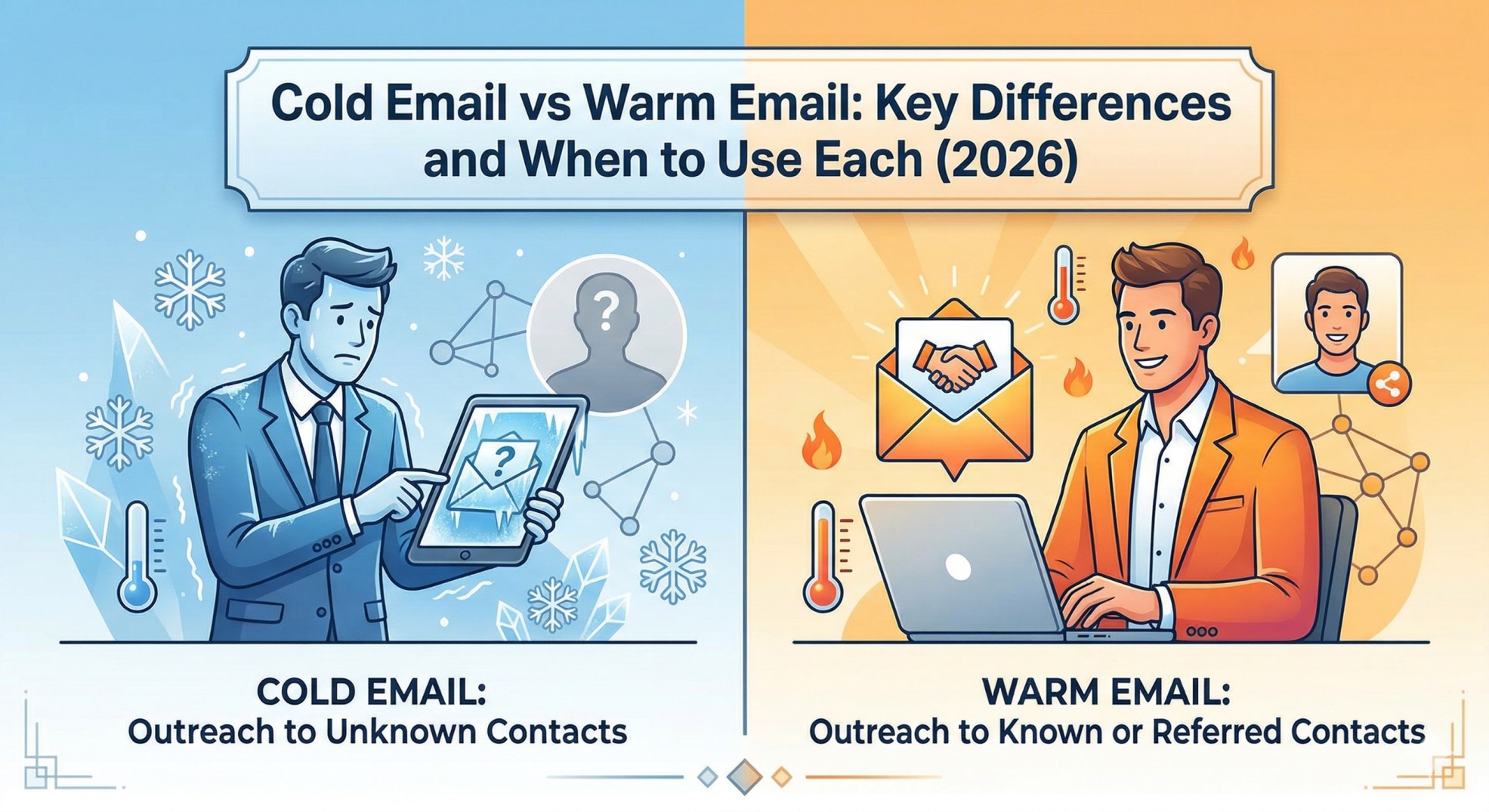
Every email you send falls into one of two categories. Cold or warm. And choosing the wrong approach for the wrong audience is one of the fastest ways to destroy your conversion rate before your message is even read.
Cold email goes to complete strangers — people who have never heard of you, never engaged with your brand, and never asked to hear from you. Warm email goes to people who already know you exist — they downloaded your content, visited your pricing page, attended your webinar, or replied to a previous email.
The difference sounds simple. The implications are anything but.
Cold email campaigns average 1–5% response rates while warm outreach reaches 10–34%, with conversion efficiency 5–10 times higher for warm because trust is already established. That performance gap is not a reason to abandon cold email — it is a reason to understand precisely when to use each approach and how to transition prospects from cold to warm as fast as possible.
This guide gives you the complete comparison: the definitions, the psychology, the conversion data, the tactical differences, the hybrid strategy that top B2B teams use in 2026, and the tool that powers both approaches from a single platform.
The Core Definition: What Separates Cold from Warm
The cold vs warm email distinction boils down to one simple question: does your recipient know you exist? Cold emails go to complete strangers who have never interacted with your brand. Warm emails reach people who have already raised their hand — they have visited your website, downloaded your content, or engaged with your company somehow.
Think of it like the difference between introducing yourself to someone at a networking event versus following up with someone you met last week. Same medium, completely different relationship context — and that context changes everything about how you write, what you say, and what you can reasonably ask for.
The Temperature Spectrum
Most B2B relationships do not jump instantly from cold to warm. They move through a spectrum:
Temperature Relationship Stage Conversion Rate Best Approach Ice cold Never heard of you 0.5–2% Pure value, no ask Cold No relationship but fits ICP 1–5% Personalized first touch Lukewarm Indirect signal (mutual connection, engaged with content) 5–12% Reference the connection Warm Direct engagement (downloaded content, visited pricing page, attended webinar) 10–34% Reference their behavior Hot Expressed intent (requested demo, replied to outreach) 30–60%+ Direct, urgent, CTA-forward
The goal of cold email is not to close deals. It is to move people from ice cold to warm as efficiently as possible — and then let warm email sequences convert them.
The Psychology: Why Warm Emails Convert 5–10x Better
The performance gap between cold and warm email is not random. It is the direct output of five psychological forces that warm relationships activate and cold outreach must work against.
1. Familiarity and Trust
The mere exposure effect — the psychological tendency to develop preference for things we have encountered before — means a prospect who has seen your brand name, read your content, or heard your name from a mutual contact is measurably more likely to open, read, and respond to your email. Cold email has to earn trust from zero. Warm email inherits it.
2. Relevance and Timing
Cold emails personalize based on educated guesses — job title, company news, industry trends. Warm emails reference actual behaviors and interactions. "Since you downloaded our pricing guide" is a fundamentally different opening than "I noticed you work in SaaS" — one demonstrates you know exactly where this person is in their journey, the other demonstrates only that you have a database.
3. Reciprocity
When someone has consumed your content, attended your event, or engaged with your brand, there is a natural psychological reciprocity at play. They have received something from you — information, entertainment, education. Your email represents an invitation to continue that exchange, not an interruption of their day.
4. Reduced Cognitive Load
Even objection handling changes. Cold emails cannot address every objection upfront. Warm emails can tackle specific concerns because you know the prospect's journey. A warm prospect who visited your pricing page is thinking about price. A warm email that addresses pricing concerns directly removes the primary barrier to conversion. A cold email cannot do this because it does not know what barriers exist.
5. Shorter Decision Cycle
Warm email converts faster because trust is already there. Cold email starts conversations faster — you can send it right now — but the sales cycle is longer. A warm lead who is already educated about your product needs fewer touches to close. A cold lead needs to be educated, nurtured, qualified, and then converted — a process that takes weeks or months regardless of how well the cold email is written.
The Performance Data: Cold vs Warm in 2026
Metric Cold Email Warm Email / Nurture Average open rate 27.7–36% 42–55% Average reply/response rate 1–5% (3.43% overall average) 10–34% Conversion rate (to meeting) 0.5–2% 5–15% Sales cycle length Long (weeks–months) Shorter (days–weeks) Cost per lead $20–$100 $5–$30 (after content investment) Trust level at first contact Zero — must be built Established — must be deepened Personalization basis Research-based (external signals) Behavior-based (actual interactions) Volume needed Higher — 306 emails per B2B lead on average Lower — significantly fewer touches needed Speed to pipeline Fast (days) Slower (months of content/SEO investment) Scalability Very high — can send thousands immediately Constrained by inbound volume
You need to send about 306 cold emails to get one B2B lead on average. But cold email remains one of the fastest ways to fill your pipeline — B2B cold emails have an average open rate of 36%, and emails with tailored subject lines get opened 10% more often than generic ones.
The cold email volume requirement sounds discouraging until you do the math: at $0.05 per email (tool cost), 306 emails costs $15.30 per lead. Compare that to paid social ($80–$200 CPL) or Google Ads ($100–$400 CPL) and cold email is still the most cost-efficient outbound channel available.
Tactical Differences: How to Write Each Type
The same copywriting instincts that make a warm email convert will make a cold email feel presumptuous. The same restraint that makes a cold email appropriate will make a warm email feel distant. Here is exactly how the approach changes:
Subject Lines
Element Cold Email Warm Email Reference Trigger event, observation, curiosity Their specific behavior ("You downloaded X") Tone Conversational, peer-to-peer More direct — they know you Length 2–6 words ideal Can be slightly longer Example "{{Company}}'s Q2 pipeline" "Your free trial ends Friday"
Opening Line
Cold email: Must establish relevance from scratch. Research-based, specific, about the recipient's world.
"Saw {{Company}} just posted three new SDR roles — usually means Q3 pipeline targets are aggressive."
Warm email: Can reference their actual behavior. No need to prove relevance — it already exists.
"You downloaded our cold email ROI calculator last week — here's what most teams do next with those numbers."
Social Proof
Social proof works very differently in each context. Cold emails need to borrow credibility from recognizable names or impressive statistics. Warm emails can reference the recipient's own behavior.
Cold email proof: "We helped [Recognizable Company] cut their SDR ramp time by 40%." Warm email proof: "Teams who use our ROI calculator and then implement our recommended sequence structure typically see results within 30 days."
Call to Action
Cold email: Soft, low-commitment, conversational.
"Worth 15 minutes to see if this applies to {{Company}}?"
Warm email: More direct — the prospect has already expressed interest.
"Book your demo now — slots this week are limited."
When to Use Cold Email vs Warm Email
Situation Use Why Entering a new market Cold No existing audience to nurture Launching a new product to existing customers Warm Relationship already exists Reaching a specific named account Cold Target is specific, not from inbound Following up on a webinar attendee Warm They engaged with your brand Building pipeline fast (days, not months) Cold Can start immediately Converting trial users to paid Warm They are already in your product Re-engaging a churned customer Warm Prior relationship exists Reaching a prospect who visited pricing page Warm (triggered) High intent signal — act on it Outreach to conference attendees Lukewarm Shared context from event Expanding to new personas at existing accounts Cold-to-warm No relationship with new persona yet
The Hybrid Strategy: How Top B2B Teams Use Both in 2026
The most efficient B2B marketing teams synthesize the best of both worlds: they employ cold emailing campaigns to increase their reach and use warm outreach to establish quicker, more profound engagements. Never stop launching new cold email sequences to open up fresh doors. Work interested leads into warm sequences to deepen conversations.
The hybrid strategy treats cold and warm email not as competing approaches but as sequential stages in the same pipeline:
STAGE 1: COLD OUTREACH (Discovery)
Target: ICP-matched strangers
Goal: Generate a first reply or engagement
Tool: Personalized cold email sequence
Metric: Reply rate (target 5–10%)
         ↓
STAGE 2: WARM TRANSITION (Nurture)
Trigger: Any positive engagement (reply, click, demo request)
Goal: Build trust, deliver value, advance toward purchase
Tool: Behavioral email sequences, content nurture
Metric: Engagement rate, MQL conversion
         ↓
STAGE 3: HOT CONVERSION (Close)
Trigger: High-intent signals (pricing page, trial signup, proposal request)
Goal: Convert to customer
Tool: Direct sales email, demo, proposal
Metric: Close rate
Over 70% of B2B companies now use intent data to identify and target potential buyers — and in 2026, the best cold outreach is powered by more than a contact list. The most effective teams use AI, intent signals, and specialized tools to pinpoint buyers who are actively signaling interest.
The practical implementation: when a cold prospect replies positively, they move from the cold sequence into a warm nurture track. They receive content relevant to their specific situation, case studies matched to their industry, and follow-up that references their engagement rather than treating them as a cold contact. The handoff from cold to warm is automatic — and the conversion rate from warm sequences is dramatically higher than continued cold outreach.
For the complete cold email system that feeds your warm nurture pipeline, read our cold email strategy guide. For templates that bridge the cold-to-warm transition, see our cold email templates guide.
Common Mistakes: Mixing Up Cold and Warm Approaches
Mistake 1: Treating Warm Leads Like Cold Ones
A prospect who just filled out your demo request form and receives a cold prospecting email feels unseen and undervalued. Warm leads need recognition — "Thanks for requesting a demo" — not a hook about a problem they might have. A warm lead needs recognition. A cold lead needs a hook. Mixing them up kills conversion.
Mistake 2: Treating Cold Leads Like Warm Ones
A fully branded, image-heavy marketing newsletter sent to a cold prospect goes straight to spam — and destroys your sender reputation in the process. The fundamental difference: cold email targets who you want to reach; email marketing engages who wants to hear from you. Send a beautifully designed newsletter to a cold prospect? You are probably heading straight to the spam folder.
Mistake 3: Not Having a Warm Sequence Ready
The most common hybrid strategy failure: teams invest in cold email campaigns, generate replies, and then have no systematic warm nurture sequence to put those interested prospects into. The reply comes in. The rep follows up manually once or twice. The deal goes cold again. Build your warm sequence before you scale your cold outreach.
Mistake 4: Skipping the Cold-to-Warm Trigger
The transition from cold to warm should be triggered by behavior, not by time. A prospect who replies is warm. A prospect who just received their fourth email but hasn't replied is still cold — do not suddenly shift to warm nurture tone without a behavioral trigger.
Why Smart Teams Use Mailfra for Both Cold and Warm Email
Most cold email tools handle one half of this equation. They send cold sequences — but the moment a prospect shows interest and needs a warm follow-up experience, you are switching to a different tool, a different dashboard, and a different workflow.
Mailfra handles both from a single platform — under $30/month.
Here is what makes Mailfra the obvious choice for teams running the complete cold-to-warm pipeline:
Cold outreach engine — automated sequences, inbox rotation, built-in warmup, and verified deliverability that ensures your cold emails actually reach the inbox
Built-in prospect research — find, research, and qualify your ICP without leaving the platform. No separate database subscription required.
AI sequence auto-generation — describe your ICP and Mailfra writes your complete cold email sequence. Not just subject line suggestions — full multi-step campaigns.
AI personalization at scale — generates genuinely researched, trigger-based first lines for every prospect automatically. The kind of personalization that drives 142% higher reply rates.
Seamless cold-to-warm transition — when a prospect replies, Mailfra's workflow routes them directly into your warm sequence. No manual switching, no lost leads.
Better analytics — see exactly which sequence step, which subject line, and which persona is generating replies and meetings — across both cold and warm campaigns.
All-in-one, under $30/month — database + outreach + warmup + sequences + analytics in one platform. No stacked subscriptions.
Teams that previously used Instantly for cold email and a separate marketing automation tool for warm nurture are consolidating to Mailfra — getting both workflows under one roof at a fraction of the combined cost.
Start your free trial at mailfra.com →
Frequently Asked Questions About Cold vs Warm Email
What is the difference between cold email and warm email?
Cold email is sent to people who have no prior relationship with the sender — complete strangers who have never interacted with your brand. Warm email is sent to people who have already engaged with your brand in some way — downloaded content, visited your pricing page, attended a webinar, or replied to a previous email. Cold email must earn trust from zero. Warm email inherits existing trust and builds on it. Cold email averages 1–5% response rates; warm outreach reaches 10–34% with 5–10x higher conversion efficiency.
Which is better — cold email or warm email?
Neither is universally better — they serve different purposes at different stages of the pipeline. Cold email is faster to launch (you can start today), infinitely scalable, and essential for reaching new markets and specific target accounts. Warm email converts at higher rates but requires an existing audience built through content, events, or inbound marketing. The most effective B2B teams use both in sequence: cold email generates first engagement, warm email converts engaged prospects into customers. A hybrid strategy consistently outperforms either approach alone.
What is a warm email in sales?
A warm email in sales is an email sent to a prospect who has already had some form of engagement with your brand — they are not complete strangers. This includes prospects who replied to a previous cold email, downloaded a content offer, attended a webinar, visited your pricing page, or were introduced through a mutual connection. Warm emails can reference that prior engagement directly ("Since you downloaded our guide..."), which immediately increases relevance, trust, and conversion probability compared to cold outreach.
How do you turn a cold lead into a warm one?
You turn a cold lead into a warm one by generating a first engagement — any positive interaction that shifts the relationship from "stranger" to "aware and interested." The most common cold-to-warm transitions: a reply to a cold email, a click on a link in your sequence, attendance at a webinar or event you promoted, a content download triggered by cold email, or a connection on LinkedIn following your cold outreach. Once any of these triggers occur, the prospect moves from your cold sequence into a behavioral warm nurture track with higher-conversion, relationship-deepening content.
What response rate should I expect from cold email vs warm email?
Cold email averages 3.43% overall across the industry in 2026, with top performers achieving 8–15% through tight ICP targeting and genuine personalization. Warm outreach achieves 10–34% response rates because trust is already established. The gap reflects the fundamental difference in relationship context — not a difference in email quality. A well-written cold email to a cold prospect will almost always convert at a lower rate than a well-written warm email to an engaged prospect, regardless of copy quality.
The Bottom Line
The battle of cold email vs warm email is not about which one is "better." Cold email is your hunter — it goes out into the wild to find new opportunities. Warm email is your gatherer — it nurtures what you have found and brings it home. A healthy sales funnel requires both working in tandem.
In 2026, the teams generating the most consistent pipeline are not choosing between cold and warm — they are building systems where cold email creates the first touch and warm sequences convert the interest that cold email generates.
Master both. Build the system. Let each do what it does best.
Build your complete cold and warm email system: start with what is cold email if you are new to outreach, master the full cold email strategy from infrastructure to sequence, use proven cold email templates as your starting framework, master cold email personalization at scale, build follow-up sequences that bridge cold to warm, track your cold email open rates and response rate against real benchmarks, and integrate both into your complete B2B lead generation strategy. Run your entire cold-to-warm pipeline from one platform at mailfra.com.
Comments(0)
Loading comments...