
Getting someone to open your cold email is one challenge. Getting them to reply is another one entirely.
Open rates tell you whether your subject line and deliverability are working. Response rates tell you whether your email is actually worth someone's time — whether it is relevant enough, compelling enough, and respectful enough of their attention to earn a reply from a stranger who had no obligation to give you one.
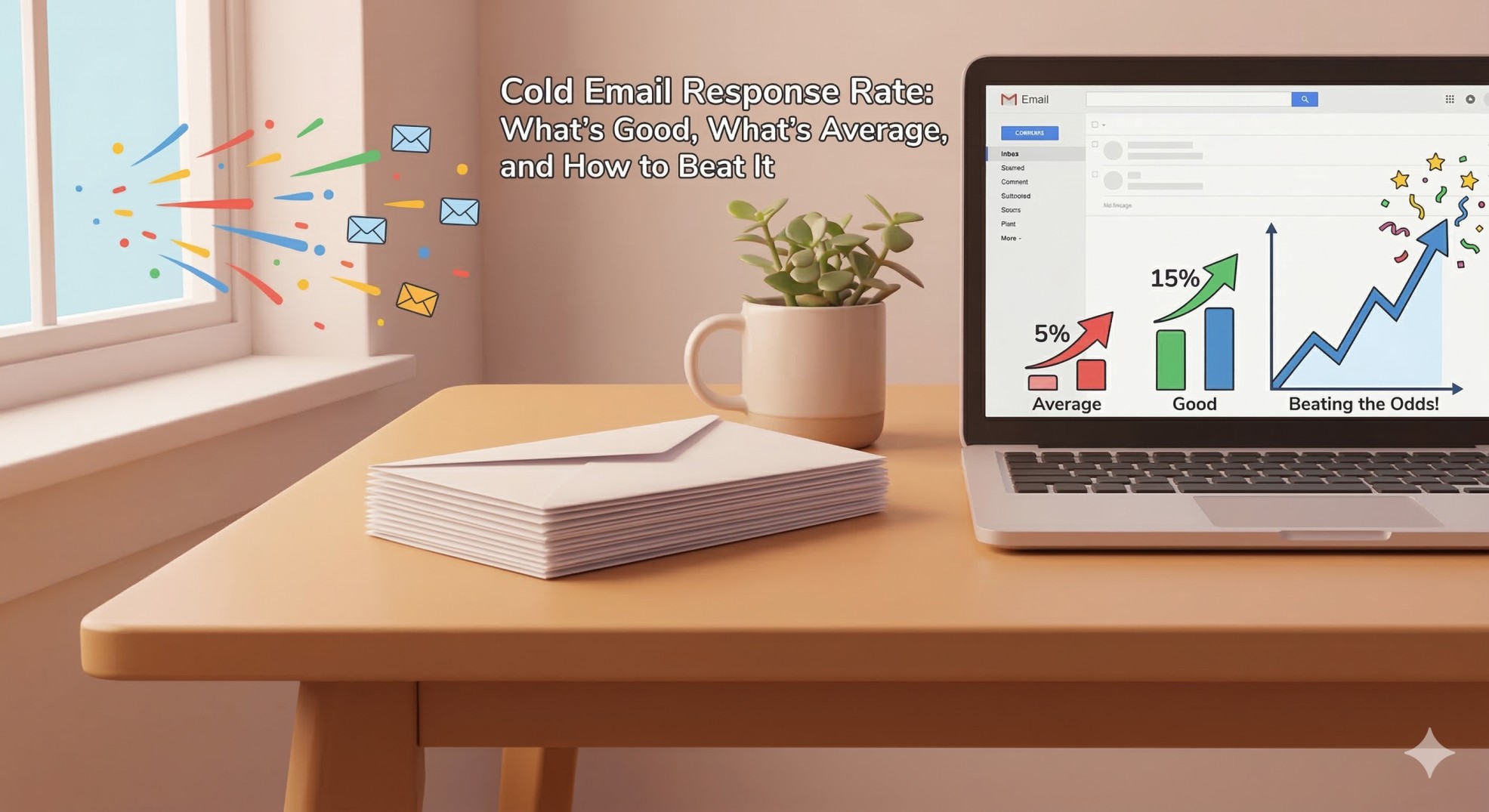
And in 2025, the average cold email response rate sits at just 3.4% to 5.1% depending on the study — meaning roughly 94 to 97 out of every 100 cold emails sent receive no reply whatsoever.
But here is what that average number hides: the top 10% of cold email campaigns consistently achieve reply rates of 10–15% or higher. Some tightly targeted, intent-driven campaigns hit 20%+. The gap between average and exceptional is not luck or industry — it is a specific set of decisions that this guide will break down in full.
You will find 2025 benchmarks by industry, by hook type, by sequence stage, and by company size — plus ten specific, data-backed tactics for moving your response rate from where it is to where it could be.
The State of Cold Email Response Rates in 2025: What the Data Shows
Cold email response rates have been declining for years, and 2025 has continued that trend. The average response rate dropped from 8.5% in 2019 to 7% in 2023, declining further to around 5% in 2025. Increasingly sophisticated spam filters, inbox saturation, and buyer fatigue from undifferentiated outreach are the driving forces behind this trend.
But declining averages mask a critical insight: the gap between average senders and top performers has never been wider. Analysis of 14.3 billion cold email sends from Smartlead's platform found that top-performing campaigns exceed a 10% reply rate, top-quartile campaigns achieve 5.5%, and the platform-wide average sits at 3.43%.
Separately, Backlinko's analysis of 11 million emails found an average response rate near 8.5%. Belkins' 2025 benchmark report — analyzing 16.5 million cold emails sent across 93 business domains — reports reply rates clustering around the mid single digits, with the best campaigns achieving significantly more.
The discrepancy between studies reflects a fundamental truth: cold email response rates are not a fixed number. They are an output of specific decisions — targeting precision, personalization depth, hook type, sequence structure, and deliverability quality. Change those inputs and the output changes dramatically.
The 2025 response rate landscape at a glance:
Performance Tier Reply Rate What It Takes Below average Below 1% Generic copy, poor targeting, deliverability problems Average 1–5% Decent targeting, basic personalization, limited follow-up Good 5–10% Solid ICP, personalized outreach, structured sequences Excellent 10–15% Tight segmentation, strong hooks, multi-touch follow-up Elite (top 10%) 15–25%+ Intent data, hyper-personalization, multi-channel sequences
Cold Email Response Rate Benchmarks by Industry (2025)
Industry is one of the strongest predictors of cold email response rate — with a variance of more than 10 percentage points between the highest and lowest-performing verticals.
Several sectors consistently deliver reply rates of 6.3% or higher, placing them at the top of the engagement leaderboard. Others — financial services, IT, large enterprise technology — sit consistently below the average, driven by aggressive spam filtering, compliance environments, and high volume of competing outreach.
Industry Average Reply Rate Top Performer Rate Notes Non-profit & Education 15%+ 20%+ Highest of any vertical — recipients are receptive to mission-driven outreach Manufacturing & Logistics 6.1% 10–12% Lower inbox competition; outreach still relatively novel Construction & Real Estate 5.8–6.5% 10–14% High relevance sensitivity; local specificity converts well Marketing & Agencies 5.5–6.3% 9–13% Responds well to creative, specific outreach Professional Services 5.2–6.0% 8–12% Decision-makers are accessible; trust signals matter Healthcare 5.2% 8–11% Compliance sensitivity increases filtering; clear relevance is critical B2B SaaS & Technology 3.5–7.8% 8–12% Wide range driven by personalization depth and ICP precision Financial Services 3.1–4.5% 6–9% Aggressive spam filtering; strict content requirements Enterprise (2,000+ employees) 2–4% 5–8% Multiple layers of email security; longer decision chains
The most important takeaway: your industry benchmark is the floor, not the ceiling. One client increased response rates from 2% to 11% simply by narrowing their ICP from "all SaaS companies" to "Series B SaaS companies using Salesforce with 50–200 employees." Precision of targeting — not industry — is the primary driver of response rate within any vertical.
Response Rate Benchmarks by Hook Type: The 2025 Game-Changer
One of the most significant findings in 2025 cold email research concerns the impact of email hook type — the framing structure used to open the email and present the value proposition.
Analysis across four hook types (problem-statement, social proof, numbers-based, and timeline-based) reveals a performance gap that dwarfs any other single variable tested:
Hook Type Average Reply Rate Meeting Booking Rate Notes Timeline-based 9.91–10.67% 2.34% 2.3× higher reply rate than problem hooks Numbers-based 7.2–8.4% 1.8% Specific metrics and quantified outcomes perform strongly Social proof 6.1–7.3% 1.5% Works best when the proof is highly relevant to the recipient Problem-statement 3.90–4.77% 0.69% The most common hook type — and the worst performer
The timeline hook — structured around compressed achievement windows and specific metric progression — consistently delivers top-quartile results across all industries and buyer profiles analyzed. A timeline hook sounds like: "We helped [Company] go from [Point A] to [Point B] in [Timeframe]." It is specific, credible, and creates a vivid mental image of the result.
The problem-statement hook — the most widely used format in cold email — is also the worst performer, achieving reply rates nearly 2.3x lower than timeline hooks. Emails that open with "Are you struggling with X?" or "Most companies in your space face the challenge of Y" have been so overused that they have become invisible to most prospects.
This finding directly challenges conventional cold email wisdom and has immediate, actionable implications: if you are using problem-statement hooks (and most senders are), switching to timeline or numbers-based hooks is the single highest-leverage change you can make to your reply rate today.
For ready-to-use templates built around all four hook types, see our cold email templates guide.
Response Rate Benchmarks by Sequence Stage
Understanding where in your sequence replies actually come from is essential for building sequences that capture maximum response.
Analysis of billions of cold email interactions from Instantly's 2025/2026 benchmark report reveals a clear pattern: 58% of all replies arrive on the first email (Step 1), but the remaining steps collectively contribute another 42% of total replies — meaning that stopping after one email means leaving 42% of your potential responses on the table.
Sequence Step Share of Total Replies Cumulative Replies Captured Step 1 (Initial email) 58% 58% Step 2 (First follow-up) ~20% ~78% Step 3 (Second follow-up) ~9% ~87% Step 4 (Third follow-up) ~4% ~91% Step 5–7 ~9% combined ~100%
The practical implication is stark: a one-email campaign captures only 58% of the replies it could have generated. A three-email sequence captures roughly 87%. A five-to-seven email sequence captures nearly everything available.
The sweet spot for sequence length is 4–7 touchpoints — under four gives up too early, and beyond seven, diminishing returns set in unless each touch genuinely adds new value.
For the complete system of structuring each follow-up email in your sequence — including templates for every stage — read our guide to cold email follow-up sequences.
Response Rate by Company Size and Volume
Personalization depth and sending volume have an inverse relationship with response rate — and the data makes this explicit.
Smaller teams often hyper-segment and hand-craft emails, yielding top-end results: some under-10k senders hit around 60% opens and 8–10% replies. By contrast, enterprises blasting 200k+ commonly see 30–40% opens and only 1–3% replies.
Sending Volume Average Reply Rate Average Open Rate Typical Approach Under 10k/month 8–10% 50–60% Hyper-personalized, hand-crafted 10k–50k/month 5–8% 40–50% Segmented templates with personalized first lines 50k–200k/month 3–5% 30–40% Template-driven with variable personalization 200k+/month 1–3% 25–35% Largely generic; high volume compensates for low rate
The data does not mean that high volume is wrong. It means that volume without precision is inefficient — and that the teams achieving the best reply rates at scale are those who have figured out how to maintain personalization quality as they grow, not those who sacrifice quality for volume.
What Is a Good Cold Email Response Rate in 2025?
Here is the definitive benchmark framework — pair it with your industry table above for a complete picture of where you stand:
Reply Rate Assessment Diagnosis Below 1% 🔴 Critical Fundamental problems with targeting, copy, or deliverability — needs complete restructuring 1–3% 🟡 Below average Generic copy or broad ICP targeting holding you back 3–5% 🟢 Average Baseline performance — optimization will produce meaningful gains 5–10% 🟢 Good to excellent Strong targeting and personalization; room to push further 10–15% 🏆 Top quartile Elite execution — tight ICP, strong hooks, multi-touch follow-up 15%+ 🏆 Elite Intent data, hyper-personalization, multi-channel coordination
Zero replies after 100+ emails is a bright red flag that requires immediate diagnosis. The most common causes: emails landing in spam (deliverability problem), wrong persona targeted (ICP problem), or copy that is entirely about you rather than the prospect (content problem). For the full diagnostic process, see our cold email mistakes guide.
Open Rate vs. Response Rate: Understanding the Difference
Open rate and response rate measure entirely different things — and diagnosing which one is underperforming tells you exactly where to focus.
High open rate + low response rate means your subject line is working but your email body is not. The prospect opened it, read it, and decided it was not worth replying to. The fix is in your body copy — specifically your opening line, value proposition, and call to action.
Low open rate + low response rate means you have problems at every layer, starting with deliverability and subject lines. Fix these first — your body copy cannot do its job if the email never gets opened. See our companion post on cold email open rates for the full benchmark breakdown and diagnostic framework.
Low open rate + high response rate is rare but valuable. It means your content is strong but only reaching a fraction of your intended audience — a pure deliverability and subject line problem.
The most important rule: always track both metrics separately and together. A single number tells you something. The relationship between the two numbers tells you everything.
10 Proven Ways to Improve Your Cold Email Response Rate
These ten tactics are ranked by impact — from the changes most likely to produce an immediate, measurable improvement to the marginal-but-compounding optimizations worth implementing once the fundamentals are right.
1. Switch From Problem Hooks to Timeline Hooks
The single highest-leverage change most senders can make. Timeline hooks achieve reply rates of 9.91–10.67% compared to 3.90–4.77% for problem hooks — a 2.3x improvement from changing the framing of your email without changing anything else.
Instead of opening with "Are you struggling with [pain point]?", open with "We helped [Similar Company] go from [Point A] to [Point B] in [Timeframe]." Specific, credible, visual, and impossible to dismiss as generic.
2. Tighten Your ICP Until It Hurts
Poor targeting is the most common cause of below-average response rates. A 2% reply rate on a broad ICP and an 11% reply rate on a narrow one can represent the same total number of positive replies — but the narrow campaign gets there with a tenth of the volume, a tenth of the deliverability risk, and ten times the personalization quality.
Narrow your ICP to the point where you can write a genuinely specific opening line for every prospect on your list without guessing. If you cannot, your ICP is still too broad.
3. Personalize Beyond the First Name
Hunter.io's analysis of 11 million emails confirms that personalization depth — not just merge tags — drives 52% higher reply rates. The senders hitting 15%+ reply rates are not just inserting {{First Name}} — they are referencing specific, researched details about each prospect's company, role, recent activity, or trigger event.
One genuinely researched opening line per email is the minimum standard for competitive cold outreach in 2025.
4. Build and Execute a 4–7 Touch Follow-Up Sequence
Stopping after one email means losing 42% of potential replies. First follow-up messages increase responses by up to 50% — yet nearly half of all sales reps never send one.
Build a sequence where each email adds something new: a fresh angle, a relevant case study, a different framing of your value, or a warm breakup that invites future contact. The 3-7-7 follow-up cadence (Day 0 → Day 3 → Day 10 → Day 17) captures 93% of total replies by day 17, after which additional follow-ups produce marginal returns.
5. Write Shorter Emails
Studies correlate higher response with short emails in the 50–125 word range. Most struggling cold emails are 200–400 words — two to four times the optimal length. Every additional sentence is an additional opportunity for the reader to lose interest.
Write your draft, then cut it in half. If the core message still comes through, you have found your ideal length. If it does not, your value proposition is not yet clear enough to compress.
6. Use One Soft CTA — Not Multiple Questions
Emails containing one to three questions are 50% more likely to receive a response than those with no questions — but emails with multiple questions, multiple CTAs, or complex asks dramatically underperform. "Worth 15 minutes?" outperforms "Can we schedule a call next week to discuss your current challenges and explore whether our solution might be a fit?" by a wide margin every time.
One ask. One sentence. Make it easy to say yes.
7. Leverage Intent Data for Trigger-Based Outreach
Prospects showing buying signals respond at 20%+ rates. Without intent data, you are reaching out to everyone in your ICP equally — regardless of whether they are in an active evaluation, just finished a contract with a competitor, or are not thinking about your category at all.
Tools like G2 Buyer Intent, Bombora, and Crunchbase's funding alerts give you real-time signals of which companies are in a window of relevance right now. Trigger-based outreach sent to high-intent prospects produces the highest response rates of any cold email approach — not because the copy is better, but because the timing is.
8. Add Personalized Video for High-Value Accounts
Adding personalized Loom videos increases response rates by 2–3x. A 60-second video with the prospect's name on a whiteboard, or a screen recording of their own website, is virtually impossible to mistake for a mass blast — and that proof of effort generates replies that text alone cannot.
Reserve video prospecting for your top 20–30 accounts per month where the deal size justifies the extra time investment.
9. Fix Deliverability Before Optimizing Copy
Generic AI-written emails see 90% lower response rates — but even a brilliantly written, deeply personalized cold email achieves a 0% effective response rate if it lands in the spam folder. Inbox placement is governed by engagement signals — and engagement signals start with deliverability.
Before optimizing any element of your copy, verify that your authentication records are correctly configured, your inboxes are properly warmed, and your daily send volumes are within safe limits. Our full email deliverability guide walks through every diagnostic step. And use our cold email open rates guide to verify your open rates are in a healthy range before concluding that your body copy is the problem.
10. Test Your Subject Lines Continuously
Your subject line determines whether your email gets opened — and if it does not get opened, the response rate conversation is moot. Custom subject lines boost replies by 30%+ when incorporating recipient names and business details. A/B testing cold emails before outreach increases reply rates by 15%.
The best-performing CTA of 2025, according to Instantly's benchmark report, was: "Would you have a couple minutes to chat about this over the next few days?" — conversational, specific, low-friction, and time-bounded without being pushy. Test variations of your subject line and CTA on every campaign and document what wins. For the full subject line framework, read our guide to cold email subject lines.
Cold Email Response Rate vs. Other Metrics: What to Track Together
Response rate does not exist in isolation. To diagnose your campaign health accurately and improve systematically, track these metrics as a system:
Metric What It Measures Healthy Benchmark Open rate Deliverability + subject line effectiveness 35–55% (B2B average) Response rate Copy quality + targeting + relevance 5–10% (good); 10%+ (excellent) Positive response rate Genuine interest (excludes unsubscribes, OOOs) 3–7% of total sends Meeting booked rate Full-funnel conversion 0.5–2.2% of total sends Bounce rate List quality Below 3% Spam complaint rate Deliverability health Below 0.1%
Track each metric weekly by campaign, sequence step, industry segment, and persona. Patterns across these dimensions reveal the specific layer where your performance is breaking down — and point directly at the fix.
Frequently Asked Questions About Cold Email Response Rates
What is a good cold email response rate in 2025?
A good cold email response rate in 2025 is 5–10% — solidly above the average and achievable with strong targeting, genuine personalization, and a structured follow-up sequence. A reply rate of 10–15% is excellent, and 15%+ is elite performance typically achieved through intent data, hyper-personalization, and multi-channel outreach. Below 1% indicates fundamental problems with targeting, copy, or deliverability that need immediate attention.
What is the average cold email response rate?
Multiple large-scale studies from 2025 report average B2B cold email response rates between 3.4% and 5.1%. Backlinko's study of 11 million emails found an average near 8.5%, while Instantly's platform-wide data (14.3 billion emails) shows 3.43%. The wide range reflects differences in methodology — but the consistent finding across all studies is that average performance is low, and top-quartile performance is dramatically higher.
Why is my cold email response rate so low?
The most common causes of a below-average response rate, in order of frequency: broad or misaligned ICP targeting (wrong people receiving the email); problem-statement hooks that are too generic to stand out; no follow-up sequence (stopping after one email loses 42% of potential replies); emails that are too long and lose the reader before the CTA; and deliverability problems routing emails to spam. Diagnose in this order — targeting first, then hook type, then follow-up, then copy, then deliverability.
Does follow-up really improve cold email response rates?
Dramatically. 58% of all replies come from the first email, but the remaining 42% come from follow-ups — meaning a one-email campaign leaves nearly half of its potential replies on the table. The first follow-up alone increases response rates by up to 50%. The optimal sequence length is 4–7 touches, with the 3-7-7 cadence (Day 0, Day 3, Day 10, Day 17) capturing 93% of total available replies by day 17.
How does personalization affect cold email response rates?
Significantly — personalization depth drives 52% higher reply rates according to Hunter.io's analysis of 11 million emails. Campaigns with advanced personalization see reply rates of up to 18%, compared to just 9% for generic emails. But the type of personalization matters: first-name tokens alone produce minimal lift. Research-based personalization — referencing a specific post, company event, trigger, or career detail — produces the substantial improvements the data describes.
What hook type gets the best cold email response rate?
Timeline-based hooks — structured around compressed achievement windows and specific metric progression — achieve the highest reply rates (9.91–10.67%) of any hook type tested in 2025, performing 2.3x better than the more commonly used problem-statement hook (3.90–4.77%). If you are currently using problem-statement hooks, switching to a timeline hook is the single highest-leverage change you can make to your reply rate without changing any other element of your campaign.
How do I calculate my cold email response rate?
Cold email response rate = (Number of replies received ÷ Number of emails delivered) × 100. Use delivered emails as the denominator rather than sent emails, to account for bounces. Track positive replies (genuine interest) separately from all replies (which include unsubscribes and out-of-office responses) — positive reply rate is the metric that most directly correlates to pipeline generation.
The Bottom Line
Cold email response rates in 2025 tell a story of sharp stratification: average senders are getting average results, and exceptional senders — the ones who have mastered targeting, hook type, personalization, and follow-up — are outperforming the average by 3x, 5x, or more.
The data in this guide gives you the context to know exactly where you stand. The ten tactics give you the specific changes most likely to move your numbers. And the most important insight from all of it is this: the gap between a 3% reply rate and a 10% reply rate is not about sending more emails. It is about sending smarter ones — to the right people, with the right hook, followed up with the right sequence, at the right moment.
Close the day knowing exactly what to fix first. Then go fix it.
Build your complete cold email system: understand your cold email open rates to diagnose what is happening before the reply, write subject lines that earn the open, use proven cold email templates to build your hook, fix what is broken with our cold email mistakes guide, capture every available reply with our follow-up sequences guide, and ensure your emails reach the inbox with our email deliverability guide. Or start sending smarter today at mailfra.com.
Comments(0)
Loading comments...