
One number changes everything: 760%.
That is the revenue increase marketers have found from segmented email campaigns compared to non-segmented ones — according to Campaign Monitor's analysis of millions of campaigns. Not 76%. Not 7.6x. Seven hundred and sixty percent more revenue. From the same email list. Just organized differently.
Yet most email senders treat their list as a single, homogeneous group — sending the same message to the founder who just signed up yesterday, the power user who has been a customer for three years, the trial user who logged in once and disappeared, and the churned customer who left six months ago.
Every one of those people needs a fundamentally different message. When they receive the same one, most of them disengage, unsubscribe, or simply stop opening your emails — and your sender reputation degrades with every ignored send.
Segmented email campaigns receive 100.95% higher click rates than non-segmented ones. Behavioral trigger emails produce 10x greater revenue than generic marketing emails. Targeted and personalized emails drive 58% of all email revenue. And 90% of marketers report that segmentation improves email performance across every metric they track.
This guide gives you the complete 2026 system: the definition and types, the 10 most effective segmentation strategies ranked by revenue impact, the behavioral trigger framework that outperforms everything else, the B2B-specific playbook, the AI segmentation workflow, and the tool that makes all of it possible from a single platform.
What Is Email Segmentation?
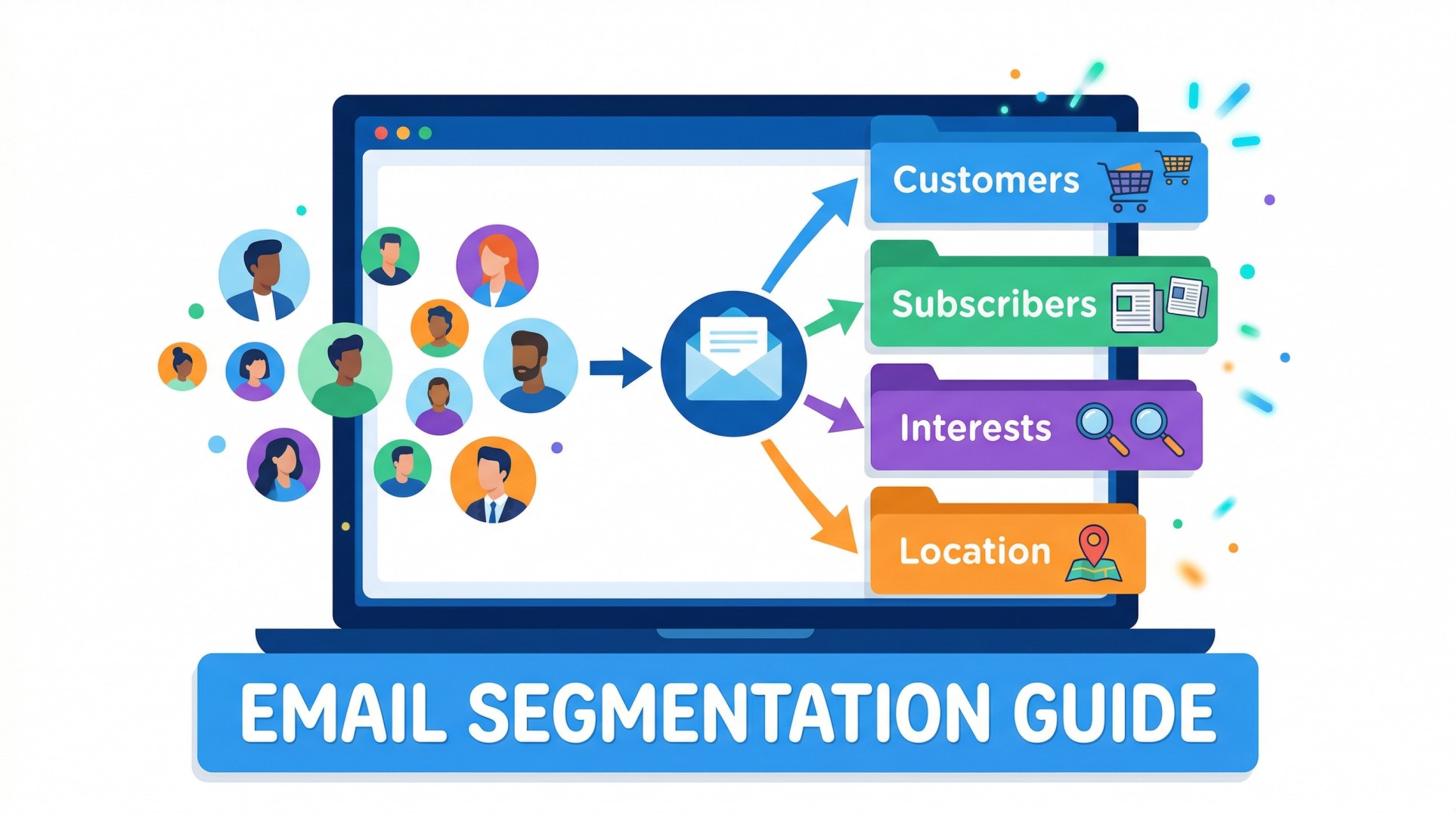
Email segmentation is the practice of dividing your email list into smaller, more targeted groups — called segments — based on shared characteristics, so you can send more relevant messages to each group.
Instead of sending one email to 10,000 people, you send 10 different emails to 1,000 people each — with messaging tailored to what each group actually cares about. The result: every email feels more personal, every offer feels more relevant, and every send performs better across every metric.
Email segmentation is dividing your email list into smaller groups based on shared characteristics — sending targeted messages to specific audiences instead of blasting everyone with the same content. The most effective segmentation strategies focus on criteria that reveal intent and readiness to act.
The types of data used to create segments fall into four categories:
Segmentation Data Type What It Covers Examples Demographic Who they are Age, location, job title, company size, industry Behavioral What they do Emails opened, links clicked, pages visited, purchases made Psychographic What they care about Interests, values, goals, pain points, motivations Lifecycle stage Where they are in the journey Lead, trial user, paying customer, at-risk, churned
Behavioral segmentation is the most powerful category in 2026 because it reflects actual intent rather than assumed characteristics. A contact who visited your pricing page three times this week is telling you something about their intent that no demographic data could reveal.
The 2026 Email Segmentation Data: Why You Cannot Afford Not to Segment
Metric Non-Segmented Segmented Lift Open rate Standard +30–46% higher Significant Click-through rate Standard +50–100.95% higher Very significant Revenue per email Standard +760% Game-changing Transaction rate Standard 6x higher Transformational Unsubscribe rate Standard -40% Critical for list health Spam complaints Standard Significantly lower Protects deliverability Revenue contribution Variable 58% of total email revenue Primary driver
The revenue numbers are not marketing claims. They are documented, multi-study findings from Campaign Monitor, DMA, and Mailchimp's analysis of millions of real campaigns. Marketers who segment email lists increase email marketing revenue by 760%. The mechanisms are straightforward: relevant content gets opened, clicked, and acted on. Irrelevant content gets ignored, unsubscribed from, or marked as spam — all of which harm future performance.
Email segmentation is considered one of the most effective email marketing tactics at 51% effectiveness — and importantly, least likely to be outsourced. This is your competitive advantage to build in-house.
The 10 Email Segmentation Strategies Ranked by Revenue Impact
Strategy 1: Behavioral Segmentation (Highest Revenue Impact)
Revenue lift: 10x vs generic emails Complexity: Medium-High Best for: SaaS, e-commerce, B2B companies with meaningful user data
Behavioral segmentation groups subscribers based on how they interact with your brand: pages visited, emails clicked, features used, purchases made, content downloaded. Because it reflects real behavior rather than assumed characteristics, behavioral data is the strongest predictor of near-term conversion.
The 5 most powerful behavioral segments:
Behavior What It Signals Message Visited pricing page 2+ times Active evaluation — high intent Objection-handling email + social proof Opened 5+ emails but never clicked Interested but not activated Re-engagement with strong single CTA Downloaded case study Mid-funnel consideration Follow-up with related case study Used a specific feature Power user behavior Upsell or expansion opportunity Has not logged in for 14 days At-risk of churning Re-engagement + value reminder
In 2026, behavioral segmentation is increasingly powered by AI, which can surface patterns and intent signals before a human marketer would notice them — making it possible to trigger personalized emails at the exact moment each subscriber is most ready to act.
Strategy 2: Lifecycle Stage Segmentation (Most Strategic)
Revenue lift: Drives 25% of overall email revenue for businesses using it strategically Complexity: Medium Best for: SaaS companies, subscription businesses, B2B sales funnels
Every subscriber is at a different stage of their relationship with your brand. Sending the same email to a brand-new lead and a three-year customer is like giving the same speech at a first date and a tenth anniversary.
The B2B lifecycle stages and corresponding email strategies:
Lifecycle Stage Who They Are Email Goal Key Message New lead (0–7 days) Just discovered you Educate + engage Welcome sequence, value delivery Prospect (active evaluation) Comparing options Convert Social proof, ROI data, case studies Trial user Testing your product Activate Onboarding, quick wins, feature discovery New customer (0–90 days) Just bought Retain + expand Success content, early win stories Active customer Regular user Expand + advocate Upsell opportunities, referral asks At-risk customer Declining engagement Win back Re-engagement, value reminder Churned customer Has left Re-acquire Win-back sequence, product updates
Strategy 3: Engagement Level Segmentation (Most Impactful for Deliverability)
Revenue lift: Protects deliverability — preserving 15–20% more inbox placement Complexity: Low Best for: Any email program with a large list
Segmenting by engagement level does two things simultaneously: it dramatically improves the relevance of your sends AND it protects your sender reputation by ensuring you are not regularly emailing people who never open your emails.
The 4 engagement tiers:
Tier Definition Send Frequency Strategy Champions Opened/clicked in last 30 days Full cadence All campaigns including promotional Warm Opened/clicked in last 90 days Normal cadence Educational + promotional content Cold Opened/clicked in 91–180 days Reduced cadence Re-engagement campaigns only Inactive No open/click in 180+ days Suppression + re-engagement Win-back sequence then sunset
74% of online consumers get frustrated when content is not aligned with their interests. Engagement segmentation solves this at the list level — ensuring your most engaged subscribers receive your most valuable content.
For the complete deliverability framework that makes engagement segmentation even more powerful, read our email deliverability guide.
Strategy 4: Firmographic Segmentation (Essential for B2B)
Revenue lift: 30% more opens + dramatically higher conversion for B2B Complexity: Low Best for: B2B companies, SaaS, professional services
For B2B email marketing, firmographic segmentation — dividing your list by company characteristics rather than individual ones — is often the most impactful single change you can make.
Key firmographic segments for B2B:
Firmographic Factor Why It Matters Example Message Difference Company size Budget authority, complexity needs, decision process Solo founder email vs enterprise team email Industry vertical Pain points, language, compliance requirements Fintech email vs healthcare email Growth stage Seed vs Series A vs enterprise buying behavior Feature needs and budget cycles differ completely Annual revenue ACV alignment, upsell potential Premium feature promotion vs standard Geography Regulatory requirements, business culture GDPR-compliant messaging for EU; CAN-SPAM for US
A SaaS company that sends the same email to a 5-person startup and a 500-person enterprise is fundamentally misunderstanding both audiences. The startup needs ROI justification and simple setup. The enterprise needs security documentation, multi-user features, and procurement guidance.
Strategy 5: Purchase History Segmentation (Highest E-commerce Impact)
Revenue lift: Abandoned cart emails achieve 40-45% open rates and 3.33% conversion rates Complexity: Medium Best for: E-commerce, SaaS with multiple products/tiers
Key purchase-based segments:
Segment Definition Email Strategy High-value customers Top 20% by LTV VIP treatment, early access, exclusive offers Recent purchasers Bought in last 30 days Onboarding, cross-sell, review request Repeat buyers 3+ purchases Loyalty recognition, subscription upsell One-time buyers Single purchase only Win-back, related product promotion Abandoned cart Added to cart, didn't buy Recover with urgency + objection handling Category browsers Viewed but didn't buy Relevant product follow-up
Businesses also earn an average of $3.45 in revenue per abandoned cart email recipient — making it one of the highest-ROI email segments available to any e-commerce business.
Strategy 6: Geographic Segmentation
Revenue lift: 10–20% open rate improvement for location-specific content Complexity: Low Best for: Multi-region businesses, local offers, time-sensitive campaigns
Geographic segmentation lets you send time-zone-appropriate emails, location-specific offers, and regionally relevant content. Beyond simple time-zone scheduling, geography also determines regulatory requirements — EU recipients require GDPR compliance, Canadian recipients require CASL compliance.
Practical geographic segments:
Time zone groups (ensures emails arrive at 9 AM locally, not 3 AM)
Country/region for compliance and currency
Local events and offers (product launches, in-person events)
Language-based segments for multilingual audiences
Strategy 7: Survey and Preference Segmentation
Revenue lift: 15–25% engagement improvement from preference-based content Complexity: Medium Best for: Newsletter publishers, content creators, B2B thought leadership
Asking subscribers what they want — and then sending it — sounds obvious. It is also one of the most underused segmentation strategies available. A simple 2-question preference survey after signup segments your list more accurately than any firmographic data because subscribers self-identify their interests.
The 2-question preference survey that segments your list:
"What is your primary role?" (Sales / Marketing / Operations / Founder)
"What would you most like to learn about?" (Cold email / Deliverability / Sequences / Tools)
Two answers per subscriber = four segments that receive genuinely different content based on what they explicitly asked for.
Strategy 8: Lead Source Segmentation
Revenue lift: 20–30% better qualification rates when messaging matches lead source Complexity: Low Best for: Multi-channel acquisition businesses
People who found you through different channels have different expectations, different awareness levels, and different relationships with your brand.
Lead Source Awareness Level Best First Email Organic search High intent — searched for solution Solution-focused, comparison content Content download Problem-aware Educational nurture sequence Cold email Brand-unaware — just introduced Low-friction value delivery, no hard ask Referral Warm — referred by trusted source Social proof + fast path to value Paid ad Low brand awareness Trust-building content first Event/webinar Engaged — met you in context Follow-up referencing the event
Strategy 9: Product Usage Segmentation (SaaS-Specific)
Revenue lift: Directly reduces churn by 20–30% when at-risk users are identified early Complexity: High (requires product data integration) Best for: SaaS products with meaningful in-app behavior
The product usage segments that matter most for SaaS:
Usage Pattern Segment Email Strategy Heavy daily user Power user Expansion/upgrade email Regular but underusing key feature Under-activated Feature education email Login frequency dropping At-risk Proactive outreach + success content No login in 7+ days (trial) Trial abandoner Rescue sequence with quick win Uses basic tier heavily Upgrade candidate Premium feature showcase High usage near plan limits Upgrade ready Proactive upgrade conversation
Strategy 10: AI-Powered Dynamic Segmentation (The 2026 Edge)
Revenue lift: 18x revenue vs generic emails for dynamic content Complexity: High (requires AI tools) Best for: Any email program ready to scale beyond manual segmentation
AI transforms segmentation from a static exercise into a living system. Instead of manually building segments and checking them quarterly, AI continuously updates segments based on real-time behavior — predicting propensity to buy, churn likelihood, timing, and cohort behavior with better accuracy than manual filters.
87% of AI users are utilizing it to enhance their email marketing in 2026. 39% believe AI-driven hyper-personalization will be the most impactful automation trend going forward. Dynamic content emails generate 18x more revenue than generic emails.
AI segmentation capabilities in 2026:
Predictive churn scoring (identify at-risk customers before they know they are at risk)
Purchase propensity modeling (who is most likely to upgrade in the next 30 days?)
Send-time optimization (what time is this specific subscriber most likely to open?)
Content preference prediction (what type of email is this person most likely to engage with?)
The B2B Email Segmentation Playbook
B2B email segmentation differs fundamentally from B2C in three ways that change everything about your strategy:
1. Multiple decision-makers per account. A B2B company does not have one subscriber — it has a buying committee. Your VP of Sales, your Head of RevOps, and your CFO are all subscribed, and they all need fundamentally different emails even though they are at the same company.
2. Longer, more complex buying cycles. B2B deals take weeks or months to close. Your segmentation strategy needs to nurture contacts through a longer journey with content appropriate to each stage.
3. Company-level and person-level data both matter. B2B segmentation works best when you combine firmographic data (company industry, size, stage) with behavioral data (what this specific person has done).
The B2B segmentation matrix:
Segment Firmographic Behavioral Message Focus Enterprise evaluator 500+ employees Visited security/compliance pages Security documentation, enterprise case studies SMB decision-maker Under 50 employees Pricing page visit, free trial ROI, quick setup, self-serve Active champion Any size High engagement, feature usage Advocacy ask, expansion content Dormant contact Any size No engagement in 90 days Re-engagement with fresh value Conference lead Any size Recently met at event Event follow-up, relationship building
The Behavioral Trigger Framework: Most Powerful Segmentation in 2026
If you implement only one segmentation strategy from this guide, make it behavioral triggers. Behavioral trigger emails produce 10x greater revenue than generic marketing emails — and automated triggered emails generate 320% more revenue than non-automated campaigns.
A behavioral trigger email is sent automatically when a subscriber takes a specific action. It arrives at the exact moment the subscriber is most engaged with your brand — turning behavioral data into immediate, contextually relevant communication.
The 10 highest-revenue behavioral triggers:
Trigger Timing Revenue Impact Example Email Pricing page visit Within 2 hours Very High "Saw you were checking out our pricing — any questions?" Free trial signup Immediately Very High Welcome + quick win sequence Feature not used (trial) Day 3 of trial High Feature tutorial + why it matters Plan limit reached Real-time Very High Upgrade email with specific benefit Product inactivity 7 days High Re-engagement with single CTA Case study download Within 24 hours High Related case study + demo offer Webinar attended Within 1 hour High Follow-up + related resources Abandoned cart Within 1 hour Very High Recovery email + objection handling Referral made Immediately Medium Thank you + bonus offer Anniversary (1 year) Day of Medium Loyalty recognition + upgrade
Email opens peak early — 21% of all opens happen within the first hour. Triggered emails that fire immediately after the behavior are dramatically more effective than those sent in the next day's batch.
Why Mailfra Makes Email Segmentation Effortless
Most email segmentation tools require you to manually build and maintain segments — creating filters, writing rules, checking data sources, and updating everything quarterly as your list evolves. That process consumes hours of marketing time and still produces static segments that are out of date the moment behavior changes.
Mailfra's segmentation engine is built differently — and at under $30/month, it replaces tools that cost 5x more.
Here is what Mailfra delivers for email segmentation that competitors do not:
AI-powered automatic segmentation — Mailfra's AI continuously analyzes engagement signals, behavioral data, and firmographic attributes to build and update segments in real time. No manual filter-building. No quarterly audits.
Built-in behavioral triggers — set up trigger-based sequences once and they fire automatically every time a subscriber takes the defined action. Pricing page visit, feature usage, trial inactivity — all automated.
Prospect research built in — Mailfra enriches contact profiles with firmographic data so you can segment by company size, industry, and growth stage without a separate enrichment tool.
AI sequence auto-generation per segment — describe your segment and Mailfra generates a complete, multi-step email sequence tailored to that group's specific situation. Not templates — genuinely segment-specific copy.
Better analytics per segment — see open rates, click rates, reply rates, and revenue contribution broken down by segment so you know which segments are driving results and which need work.
All of this under $30/month — a marketing automation platform + CRM + segmentation engine + sequence builder + analytics dashboard. Everything your B2B email program needs in one place.
Teams that previously paid separately for a CRM (HubSpot ~$800/month), a marketing automation tool (Klaviyo ~$500/month), and a cold email tool (Instantly ~$97/month) are consolidating to Mailfra — getting more sophisticated segmentation and automation for a fraction of the combined cost.
Start your free trial at mailfra.com →
Getting Started: Your 30-Day Email Segmentation Plan
If you are starting from an unsegmented list, here is the implementation sequence that produces results fastest:
Week 1: Implement engagement segmentation Split your list into Active (opened in 90 days) and Inactive (not opened in 90 days). Stop sending promotional emails to Inactive. Send a re-engagement sequence to Inactive. This single change will improve your deliverability and open rates within 7 days.
Week 2: Add lifecycle stage segmentation Tag every subscriber by their stage: lead, trial, customer, churned. Send stage-appropriate emails: onboarding sequence for new trials, expansion email for active customers, win-back for churned.
Week 3: Layer in behavioral triggers Set up the three highest-impact behavioral triggers for your business: pricing page visit (for SaaS), abandoned cart (for e-commerce), or feature non-usage (for product-led growth). These three alone will generate significant additional revenue from your existing list.
Week 4: Implement firmographic segmentation For B2B: add company size and industry tags to every contact. Create industry-specific versions of your core email templates. Your open and conversion rates will improve immediately.
After 30 days: audit your results by segment. Double down on the segments producing the best returns. Sunset the segments that are not moving the needle.
Frequently Asked Questions About Email Segmentation
What is email segmentation?
Email segmentation is the practice of dividing your email list into smaller, more targeted groups based on shared characteristics — so you can send more relevant messages to each group instead of sending one generic message to everyone. Segments can be based on demographic data (age, location, job title), behavioral data (pages visited, emails opened, purchases made), lifecycle stage (new lead, active customer, churned), or psychographic data (interests, goals, pain points). Segmented email campaigns generate 760% more revenue than non-segmented ones, making it the single highest-impact email marketing practice available.
How does email segmentation increase revenue?
Email segmentation increases revenue through three mechanisms: (1) higher engagement — segmented campaigns receive 100.95% higher click rates and 30–46% higher open rates because the content is relevant to each recipient; (2) better timing — behavioral triggers reach subscribers at the exact moment they are most ready to act, producing 10x the revenue of generic emails; (3) healthier lists — segmented programs have 40% lower unsubscribe rates because relevant content keeps subscribers engaged longer, increasing each contact's lifetime value. Targeted and personalized emails drive 58% of all email revenue for companies using segmentation strategically.
What are the most effective email segmentation strategies?
Ranked by revenue impact: (1) Behavioral segmentation — grouping by actions taken, not assumed characteristics; (2) Lifecycle stage segmentation — matching content to where someone is in their journey; (3) Engagement level segmentation — protecting deliverability while improving relevance; (4) Firmographic segmentation (B2B) — tailoring by company size, industry, and stage; (5) Purchase history segmentation — targeting by what someone has and has not bought; (6) AI-powered dynamic segmentation — continuously updated segments based on real-time signals. Each produces meaningful lift; combining multiple strategies produces compounding improvement.
How do I start segmenting my email list?
Start with engagement segmentation — it is the lowest-effort, highest-impact first step. Split your list into Active (opened in last 90 days) and Inactive (not opened in 90 days). Stop sending promotional emails to Inactive subscribers and start a re-engagement sequence instead. This single change will improve your deliverability, open rates, and click rates within two weeks. Then layer in lifecycle stage segmentation (lead vs trial vs customer) and behavioral triggers (pricing page visit, cart abandonment, product inactivity). Each additional layer produces incremental improvement on top of the foundation.
What is behavioral email segmentation?
Behavioral email segmentation groups subscribers based on their actual actions rather than assumed characteristics. Instead of segmenting by age or job title, you segment by what someone actually does: pages they visited, emails they clicked, features they used, content they downloaded, or purchases they made. Behavioral data reveals intent far more accurately than static profile data. Behavioral trigger emails — sent automatically when a subscriber takes a specific action — produce 10x greater revenue than generic marketing emails, making behavioral segmentation the highest-impact strategy available in 2026.
How often should I update my email segments?
Static segments should be reviewed quarterly. Behavioral and engagement segments should update automatically in real-time as subscriber actions change. A contact who was "inactive" for 90 days and suddenly opens three emails in a week should automatically move to the "warming up" segment. AI-powered segmentation tools update continuously — making quarterly manual audits obsolete for behavioral data. At minimum, update your segments before any major campaign to ensure you are working with current data.
The Bottom Line
Email segmentation is not a nice-to-have feature you will get to eventually. It is the engine behind email profitability in 2026.
The 760% revenue increase from segmentation represents a genuine, documented, multi-study finding. The 10x revenue from behavioral triggers is real. The 100.95% click rate improvement is measurable. These numbers exist because segmentation does the one thing that every other optimization only approximates: it makes every email genuinely relevant to the specific person receiving it.
74% of people hate irrelevant content. When people receive relevant emails — content that reflects where they are, what they have done, and what they actually care about — they open them, click them, and buy from them.
Segment your list. Target your messages. And watch your numbers move.
Build your complete email system on top of smart segmentation: master cold email personalization at the individual level, track your cold email open rates and response rate benchmarks by segment, build follow-up sequences tailored to each segment's stage, protect your email deliverability with engagement-based suppression, integrate segmentation into your complete B2B lead generation strategy, launch your full cold email strategy with segment-specific sequences, and run everything from one platform at mailfra.com.