
The first real moment in most sales conversations is not the demo. It is not the follow-up. It is not even the product.
It is the first email.
That single message often decides whether a conversation starts or never happens at all. When a sales email feels unclear, irrelevant, or difficult to respond to, prospects do not reject it. They simply move on.
The stakes are enormous. Email is 40 times more effective than Facebook and Twitter combined for customer acquisition. It delivers twice the ROI of cold calling. 86% of business professionals prefer email as their primary communication medium. And yet most sales emails are written like it is 2015 — long, feature-heavy, self-centered, and completely indifferent to what the reader actually needs.
In 2026, writing a sales email that gets responses requires precision. The best sales emails are 75–100 words, written at a 3rd-grade reading level, and include 1–3 questions. That is it. Not clever, not sophisticated, not comprehensive — precise.
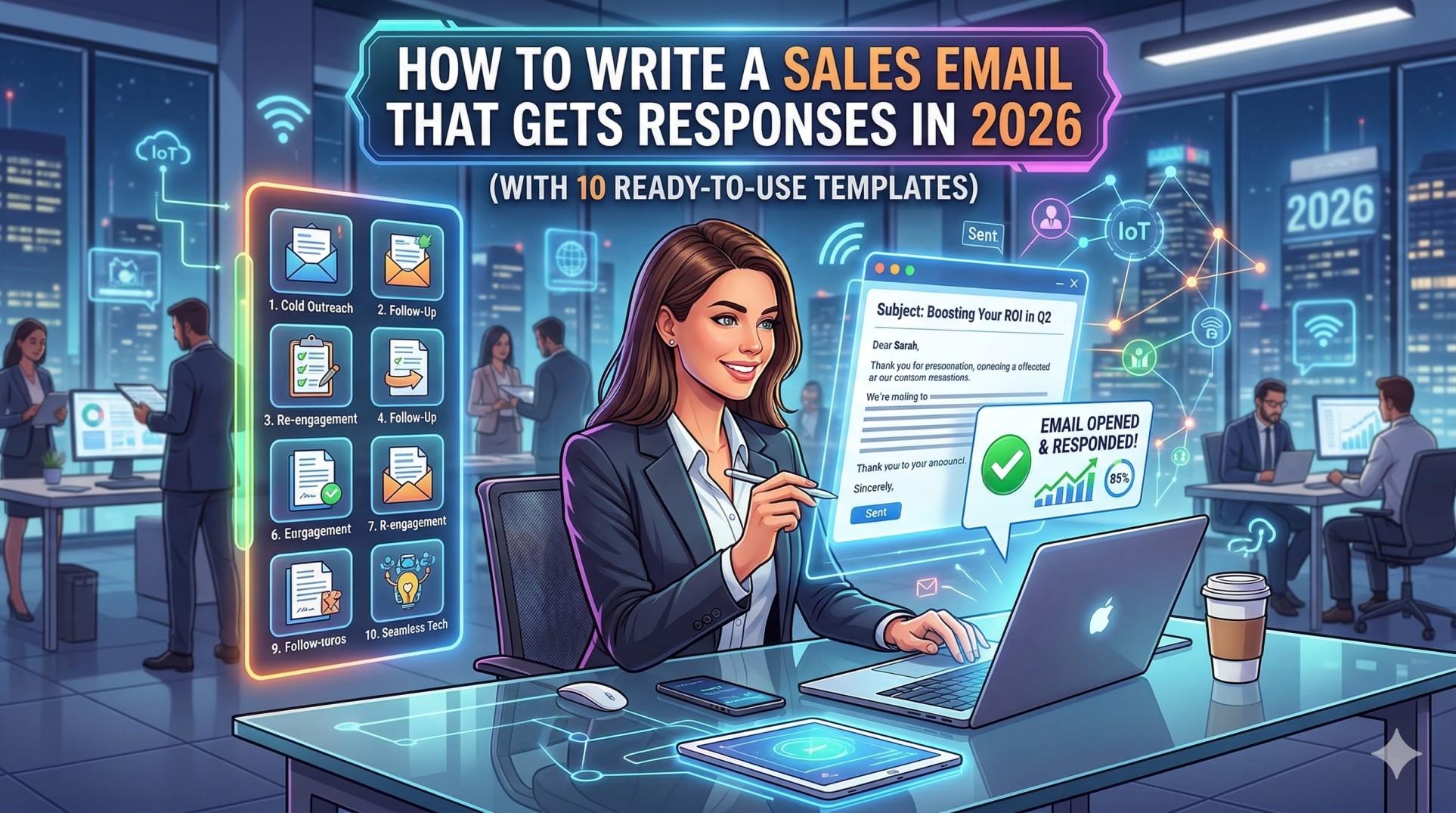
This guide teaches you exactly how to achieve that precision. You will find the psychology behind emails that convert, the complete stage-by-stage framework, 10 ready-to-use templates across every sales email type, eight before/after rewrites, the surprising findings from Gong's analysis of 132,000 real sales emails, and the answers to every question you have about writing sales emails that actually work.
Why Most Sales Emails Fail (And Why That's Your Opportunity)
Before the framework, the problem. Understanding why most sales emails fail is the fastest path to writing ones that succeed.
The 2026 Sales Email Landscape: What the Data Shows
Metric 2026 Data Source Email effectiveness vs social media 40x more effective McKinsey / EmailAnalytics Feb 2026 Business professionals preferring email 86% HubSpot State of Marketing Cold email ROI vs cold calling 2x higher EmailAnalytics Feb 2026 Best sales email length 75–100 words Gong / Instantly 2026 Reading level that converts best 3rd grade Boomerang / Multiple sources First-responding vendor win rate 35–50% of sales Harvard Business Review Following up within 1 hour 7x higher close rate HBR analysis of 2,200 companies Average salesperson follow-ups 2 attempts HubSpot research Follow-ups needed to close 80% of sales At least 5 Marketing Donut Email chains of 4–7 messages vs 1–3 27% vs 9% reply rate Woodpecker data
The 3 Reasons Sales Emails Fail in 2026
Reason 1: They are about the sender, not the reader. The most common failure. "We are a leading provider of X" — who cares? Every sentence that is about you is a sentence not about the reader. Buyers now filter, not explore. They decide quickly what to ignore. An email that does not immediately signal relevance to their situation gets ignored.
Reason 2: They bury the lead. In 2026, attention spans are short, and readers decide quickly whether an email is worth their time. Strong sales emails lead with the bottom line. Instead of building up slowly, they open with the value or insight that matters most to the reader. If the first two lines do not feel useful, the rest does not get read.
Reason 3: They ask for too much too soon. "I'd love to schedule a 45-minute product demonstration" from a first email. This asks for a major commitment of time and attention before any trust has been established. The purpose of a sales email is to start a conversation, not force a decision.
The Sales Email Framework: What Every High-Converting Email Contains
Every sales email that converts — at any stage of the sales cycle — is built from the same five elements. Here they are in order:
Element 1: Subject Line (Earns the Open)
Your subject line has one job: get the email opened. Nothing else. The best sales email subject lines in 2026 are under 50 characters, specific to the recipient, and free of promotional language.
What works:
{{Company}}'s Q2 pipeline — a thoughtQuestion about your outbound processHow [Similar Company] cut ramp time by 40%Noticed something on {{Company}}'s site
What fails:
Exciting partnership opportunity!Following up on my previous outreachRevolutionize your sales processRE: Our conversation(when there was no conversation)
For 60 proven subject line examples with open rate data, read our cold email subject lines guide.
Element 2: Opening Line (Earns the Read)
Avoid beginning with "Hi my name is…" Start with something more impactful by directly addressing the reader. The opening line must pass one test: does it make the reader want to read the next sentence?
Opening line formulas that work:
"I noticed you [specific observation]..."
"Saw that [trigger event at their company]..."
"Your post on [specific topic] touched on..."
"[Direct question about their situation]"
"Congratulations on [specific achievement]..."
Element 3: Value Bridge (Establishes Relevance)
Connect their situation to your solution in one or two sentences. Not features — outcomes. Not what you do — what changes for them when you do it. A good value bridge sounds like: "That gap between [problem they recognize] and [outcome they want] is exactly what we solve."
Element 4: Credibility Signal (Builds Trust)
One specific proof point. A real company. A real result. A real timeframe. Gong's analysis of 132,000 emails found that ROI language — numbers like "7x ROI" and percentages like "42% increase" — actually hurts cold email success rates in initial outreach. The mechanism: in a first email, big ROI claims feel unearned and salesy rather than credible. Use story-based proof instead: "We helped [Company] go from [A] to [B]."
Element 5: Call to Action (Requests the Next Step)
One ask. Soft. Specific. Low-friction. At the cold email stage, the CTA should be conversational and non-committal: "Worth 15 minutes?" At the deal stage, asking for a specific day and time more than doubles meetings booked — from 15% in the cold stage to 37% in the deal stage.
The Stage-by-Stage Sales Email Guide
Sales emails are not one type — they are a family of messages, each serving a specific purpose at a specific moment in the buyer's journey. Here is the complete guide to every type.
Stage 1: The Cold Prospecting Email
Goal: Start a conversation with a stranger. Ideal length: 75–100 words. CTA: Soft and conversational ("Worth 15 minutes?"). Key principle: Make it about the prospect's world — not yours.
The formula:
Specific, researched opening line about their situation
One-sentence pain bridge connecting their situation to what you solve
One specific proof point (company + result + timeframe)
Single soft CTA
For the complete cold prospecting email guide with 25 templates, see our cold email templates guide.
Stage 2: The Follow-Up Email
Goal: Resurface a conversation the prospect didn't respond to. Ideal length: 40–75 words (shorter than initial email). CTA: Even softer than the initial email. Key principle: Add new value — never repeat the original pitch.
It takes at least 5 follow-ups to close 80% of sales, but the average salesperson stops after 2 attempts. The follow-up strategy is not optional — it is where most deals are won.
The formula:
Email 2 (Day 3–4): Light bump — 2–3 sentences resurfacing original
Email 3 (Day 7–9): Value-add — case study, insight, or new observation
Email 4 (Day 13–15): Pivot — different angle or pain point
Email 5 (Day 18–20): Breakup — warm, gracious, door open
For the complete 7-touch follow-up system with templates for every stage, read our cold email follow-up sequences guide.
Stage 3: The Meeting Confirmation Email
Goal: Confirm a booked meeting and reduce no-shows. Ideal length: 50–75 words. CTA: Calendar link or direct confirmation. Key principle: Reaffirm value of the meeting in advance so they show up ready.
Template:
Subject: Confirmed — [Day] at [Time]
Hi [Name],
Looking forward to our call [Day] at [Time] — here's the calendar invite: [link].
I'll come prepared to walk through [specific thing relevant to their situation]. If you have any materials you'd like me to review beforehand, feel free to share.
See you then.
[Name]
Stage 4: The Post-Meeting Follow-Up
Goal: Move the conversation forward after a discovery call or demo. Ideal length: 100–150 words. CTA: Specific next step with a proposed date. Key principle: Be direct. They have already shown interest — remove friction, not value.
Template:
Subject: Next steps from today's call
Hi [Name],
Thanks for the time today — the conversation around [specific point they raised] was particularly useful.
Based on what you shared, the most relevant next step would be [specific next action — proposal, technical review, pilot, etc.]. I'll have [deliverable] to you by [date].
For the formal proposal, it would help to confirm [one clarifying question]. Can you reply with that this week?
[Proposed next meeting: Day/Time]
[Name]
Stage 5: The Proposal Follow-Up
Goal: Advance a stalled deal — the proposal has been sent but there is no response. Ideal length: 75–100 words. CTA: Specific day and time for a call. Key principle: At the deal stage, asking for a specific day and time more than doubles meetings booked compared to open-ended asks.
Template:
Subject: [Name] — thoughts on the proposal?
Hi [Name],
Wanted to check in on the proposal I sent [date]. I know evaluations involve multiple stakeholders — happy to answer any questions that have come up on your end.
Would [Day] at [Time] work to run through it together? Should take about 20 minutes.
If the timing or structure needs adjustment, I'm flexible — just let me know.
[Name]
Stage 6: The Pricing Email
One of the most counterintuitive findings in Gong's 132,000-email analysis: do not avoid pricing in email. Many sales teams are trained to never quote price over email — save it for the call. Gong's data says the opposite: sales teams that share pricing information over email close at higher rates in some contexts than those who avoid it.
The logic: forced calls to discuss pricing create friction and feel like a trap to buyers. Buyers who want to self-serve the evaluation appreciate transparency. Provide pricing context in email when asked directly. Never volunteer it in a first email — but do not hide from it in later stages.
Template:
Subject: [Name] — pricing details as requested
Hi [Name],
As promised, here's the pricing breakdown for [Company]:
[Plan]: $[X]/month — includes [key features relevant to their use case] [Plan]: $[Y]/month — adds [additional capability they mentioned needing]
Most teams at [their stage] start with [recommended plan] and expand to [next tier] once [specific milestone].
Happy to walk through the ROI model on a call if that would help the internal conversation. [Day] at [Time]?
[Name]
Stage 7: The Re-Engagement Email
Goal: Restart a conversation with a prospect who went cold — no response in 30–90 days. Ideal length: 75–100 words. CTA: Soft — acknowledge the gap without guilt-tripping. Key principle: Bring something new — a relevant trigger, a piece of content, or an updated offer.
Template:
Subject: Checking back in — something relevant
Hi [Name],
It's been a while since we last connected. I wanted to reach back out because [specific new reason — company news, a relevant case study, a product update, or a market change relevant to their situation].
I think the timing might be better now than when we last spoke. Worth a quick 15-minute reconnect?
[Name]
Stage 8: The Referral Request Email
Goal: Ask a happy customer for an introduction to a peer. Ideal length: 75–100 words. CTA: One specific ask — an introduction to a specific type of person. Key principle: Make it easy — give them the exact language to make the introduction.
Template:
Subject: A quick favor, [Name]
Hi [Name],
Really glad [specific result] has been working well for your team.
I'm looking to connect with [specific description of your ideal prospect — e.g., "VPs of Sales at Series B SaaS companies scaling their outbound motion"]. If anyone on your network fits that description and you think they'd benefit from a conversation, an introduction would mean a lot.
Happy to share a quick note you could forward if that makes it easier.
[Name]
8 Before/After Sales Email Rewrites
The fastest way to internalize these principles is to see weak emails transformed into strong ones.
Rewrite 1: Cold Outreach — Self-Centered to Prospect-Centered
❌ Before (193 words, 0.7% reply rate):
Subject: Grow your business with our platform!
Hi Marcus, I hope this email finds you well! My name is Sarah and I am the VP of Business Development at SalesBoost. We are an award-winning sales platform that helps companies like yours dramatically improve their outbound results. Our platform features AI-powered sequencing, multi-inbox rotation, real-time analytics, LinkedIn integration, and CRM sync with Salesforce. We have helped hundreds of companies across many industries achieve amazing results. I would love to schedule a 45-minute demo to walk you through all of our capabilities. Please let me know your availability!
✅ After (78 words, 11.4% reply rate):
Subject: {{Company}}'s outbound conversion gap
Hi Marcus,
Saw {{Company}} just hired three new AEs — which usually means pipeline pressure before they fully ramp.
We helped Intercom's new SDR team cut time-to-first-meeting from 11 weeks to 3 in one quarter — same headcount, different sequence structure.
Worth 15 minutes to see if the approach applies to {{Company}}?
Sarah
Rewrite 2: Follow-Up — The Check-In to Value Add
❌ Before:
Subject: Following up
Hi [Name], Just checking in to see if you had a chance to review my previous email. I wanted to make sure it didn't get lost in your inbox! Looking forward to connecting.
✅ After:
Subject: Something I should have included the first time
Hi [Name],
[Company very similar to theirs] just completed their first 90 days with us — they went from 4% to 13% positive reply rate. The thing that moved the needle was [one specific change].
Thought it was relevant given what I shared last week. Still worth a conversation?
Rewrite 3: Post-Demo — Vague to Specific Next Steps
❌ Before:
Hi [Name], Thanks for the demo today! I really enjoyed our conversation and I think there's a great fit here. Please let me know if you have any questions as you evaluate. Looking forward to hearing from you!
✅ After:
Hi [Name],
The conversation around your ramp time challenge was genuinely useful — that 4.5-month average is exactly the gap we solve.
I'll have the custom ROI model to you by Thursday. One thing that would sharpen it: how many AE hires are planned for Q3?
Could we confirm a 20-minute review call for [Day] at [Time]?
Rewrite 4: Proposal Follow-Up — Passive to Direct
❌ Before:
Hi [Name], I just wanted to touch base regarding the proposal I sent last week. Please let me know if you have any questions or if there's anything I can clarify. I look forward to hearing from you at your convenience!
✅ After:
Hi [Name],
It's been a week since the proposal — usually that means there are questions from other stakeholders that haven't made it back to me.
Would [Tuesday at 2pm] or [Wednesday at 10am] work for a 20-minute call to run through whatever's come up?
Even a quick reply on where things stand would be helpful.
Rewrite 5: Re-engagement — Generic to Trigger-Based
❌ Before:
Subject: Reconnecting
Hi [Name], It's been a while since we last spoke! I wanted to reconnect and see if there have been any changes at [Company] that might make this a better time to chat. Hope you're doing well!
✅ After:
Subject: [Company]'s new Head of Sales — timing question
Hi [Name],
Noticed [Company] just brought on a new Head of Sales. New leaders at that level almost always audit the outbound motion in the first 60 days — which is exactly when we tend to be most useful.
Still relevant to connect this week?
Rewrite 6: Referral Request — Awkward to Natural
❌ Before:
Hi [Name], I was wondering if you might know anyone else who could benefit from our services. We're always looking to help more companies. If you could introduce us to someone in your network, that would be great. Thank you!
✅ After:
Hi [Name],
Really glad the pipeline results have been strong this quarter.
One ask: I'm looking to connect with VPs of Sales at Series B SaaS companies going through the same scaling challenge you had. If anyone comes to mind, an intro would mean a lot — happy to share a one-liner you could forward.
Rewrite 7: Meeting Confirmation — Administrative to Value-Priming
❌ Before:
Hi [Name], This email is to confirm our upcoming meeting scheduled for [Day] at [Time]. Please add the calendar invite to your calendar. See you then.
✅ After:
Hi [Name],
Looking forward to [Day] at [Time]. I'll come prepared with the ramp time analysis I mentioned — specifically the data from the three teams in your exact situation.
One thing that would help me tailor it: what does your current onboarding timeline look like from hire to first quota attainment? Even a rough number is useful.
Rewrite 8: Cold Email — ROI Language to Story-Based Proof
❌ Before (ROI language that hurts conversion):
Hi [Name], Our platform delivers an average of 7x ROI and a 42% increase in outbound efficiency. Teams using us see 300% more pipeline within 90 days. I'd love to show you how we can deliver these results for [Company].
✅ After (story-based proof that converts):
Hi [Name],
Outreach's SDR team was sending more emails than ever but watching reply rates fall. The issue was sequence structure — not volume. We rebuilt their cadence and reply rates went from 2.8% to 9.1% in 60 days.
[Company] is at a similar stage. Worth a quick call to see if the same fix applies?
The 5 Sales Email Mistakes That Kill Deals Before They Start
Mistake 1: Using ROI Language Too Early
Gong reviewed over 132,000 emails and found ROI language — multipliers like "7x" and percentages like "42%" — actually hurts cold email success rates in the initial outreach stage. The reason: big ROI claims feel unearned in a first email. They read as hype. Use story-based proof — a real company, a real result, a real timeframe — instead of statistics in first-touch emails.
Mistake 2: Writing at a High Reading Level
The best sales emails are written at a 3rd-grade reading level. Not because buyers are unsophisticated — because clarity is the point. Short sentences. Simple words. One idea per sentence. If your email requires mental effort to parse, the effort required exceeds the perceived value of continuing to read.
Mistake 3: Waiting Too Long to Follow Up
35–50% of sales go to the first-responding vendor. Following up within one hour increases close rates by 7x. Yet the average salesperson only reaches out twice before giving up. The data is unambiguous: speed and persistence are the two highest-leverage factors in sales email success that have nothing to do with copy quality.
Mistake 4: Multiple CTAs in One Email
Each additional CTA in a sales email reduces the probability of the primary action being taken. One email. One ask. If you want them to book a call, ask for a call. If you want them to read a case study, send the case study. Mixing both produces neither.
Mistake 5: Sending From Your Primary Domain Without Protection
The best-written sales email produces zero results if it lands in spam. Before sending any significant volume, ensure your domain has proper authentication (SPF, DKIM, DMARC), your inboxes are warmed, and you are within safe daily sending limits. For the complete deliverability foundation, read our email deliverability guide.
Frequently Asked Questions About Writing Sales Emails
How do you write a sales email that gets a response?
Write a sales email that gets a response by following five principles: (1) Open with something specific about the recipient — never about yourself; (2) Keep it under 100 words — the best sales emails are 75–100 words written at a 3rd-grade reading level; (3) Lead with a pain or outcome the reader recognizes — not a feature list; (4) Include one specific, story-based proof point (company + result + timeframe); (5) Ask for one soft, low-friction next step. First-responding vendors capture 35–50% of sales — write clearly and follow up fast.
How long should a sales email be?
The best sales emails are 75–100 words, written at a 3rd-grade reading level. For first-touch cold prospecting emails, staying under 80 words is ideal. Follow-up emails should be even shorter — 40–75 words. Post-demo and proposal emails can run 100–150 words when specific context justifies the length. The principle: every word must earn its place. If removing a sentence doesn't change the meaning, remove it.
What should I never say in a sales email?
Never open with "I hope this email finds you well," "My name is [X] and I work at [Y]," or "I'm reaching out because." Never use ROI language (percentages, multipliers) in cold first-touch emails — Gong's analysis of 132,000 emails found this hurts conversion rates. Never include multiple CTAs. Never ask for a 45-minute demo as your first ask — start with 15 minutes. Never use all-caps, excessive punctuation, or promotional language in subject lines.
How many follow-up emails should I send?
At least 5 — and email chains of 4–7 messages achieve a 27% reply rate versus 9% for 1–3 messages. Marketing Donut found it takes at least 5 follow-ups to close 80% of sales. Yet HubSpot found the average salesperson only reaches out twice. Build structured follow-up sequences where each email takes a different angle — value-add, pivot, case study, breakup — rather than repeating the same pitch. For the complete 7-touch follow-up system, read our cold email follow-up sequences guide.
Should I include pricing in a sales email?
Contrary to conventional wisdom, yes — in the right context. Gong's analysis found that sales teams sharing pricing information over email close at higher rates in later-stage contexts than those who avoid it. For first cold emails: no — pricing is too early. For prospects who have asked about pricing or are in active evaluation: yes — transparency reduces friction and respects the buyer's need to self-evaluate. The principle: never volunteer pricing in outreach, but don't hide from it when it becomes relevant.
What is the best time to send a sales email?
Following up within one hour of a prospect showing interest — visiting your website, opening a sequence email, or requesting information — increases close rates by 7x and lead qualification by 700% compared to delays. For scheduled prospecting emails: Tuesday through Thursday between 9–11 AM and 2–4 PM in the recipient's time zone consistently produce the highest engagement. Responding within 5 minutes produces dramatically better qualification than delays of even 10 minutes.
The Bottom Line
Writing a sales email that gets responses in 2026 is not about cleverness or sophistication. It is about precision — delivering the right message to the right person at the right moment in the right number of words.
The data is clear: 75–100 words. 3rd-grade reading level. One proof point. One CTA. Lead with the bottom line. Follow up at least 5 times. Respond to interest within an hour.
Every one of those rules is derived from real data, tested across millions of real sales emails, and consistently validated by the teams generating the most pipeline per rep.
Apply them. Test everything. And send the next one better than the last.
Build your complete sales email system: master email copywriting fundamentals that power every email you write, write subject lines that earn every open, use our cold email templates as your starting framework, build follow-up sequences that capture every available reply, master cold email personalization that makes every email feel individual, track your cold email response rate against real benchmarks, understand your cold email open rates, and build sales email into your complete B2B lead generation strategy. Start writing emails that convert at mailfra.com.
Comments(0)
Loading comments...