
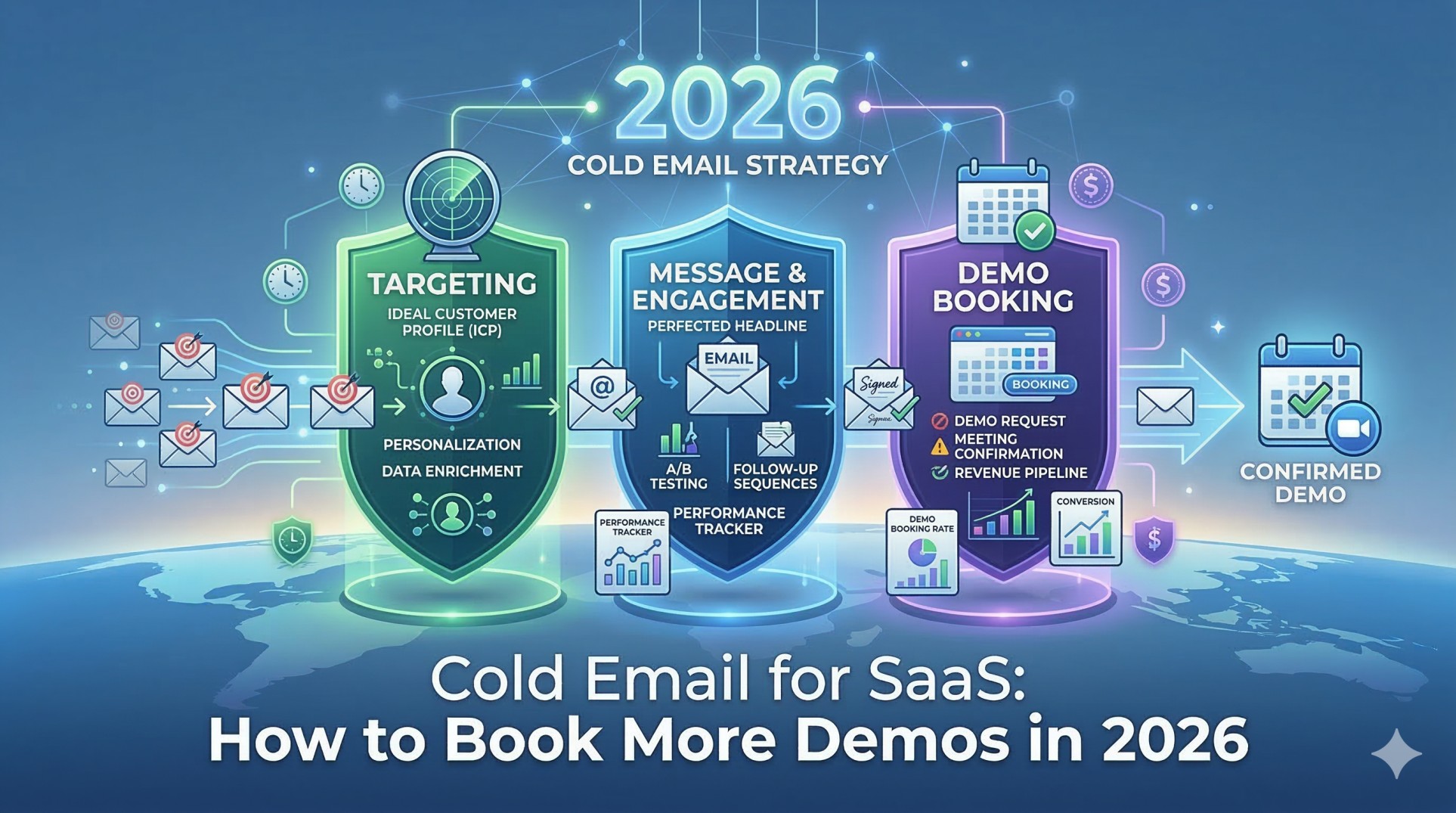
One SaaS startup sent 400 targeted cold emails. In 8 weeks, they booked 61 demos — a 15% conversion rate that was multiple times above their earlier campaigns.
That number is not an outlier. It is what cold email for SaaS looks like when it is done correctly — with the right ICP, the right signals, the right templates, and the right infrastructure behind every send.
The average SaaS team is nowhere near this. Most SaaS cold email operations are stuck below 2% reply rates, wondering why their carefully written pitches are being ignored. The emails look fine. The product is good. The targeting seems reasonable. But demos are not getting booked.
The problem is almost never the product. It is almost always the system — the specific combination of targeting precision, signal intelligence, message structure, and follow-up discipline that separates SaaS teams booking 15+ demos per week from those grinding for one.
This guide gives you that system. You will find the 2026 SaaS-specific benchmarks from 100M+ emails, the exact ICP framework that drives precision targeting, the signal-based triggers that produce 5x higher response rates, 8 SaaS cold email templates with before/after rewrites, the complete follow-up sequence structure, and every metric you need to track and improve.
Let's build the demo machine.
Does Cold Email Still Work for SaaS in 2026?
Before the tactics, the question every skeptical SaaS founder asks.
Yes — cold email still works for SaaS in 2026, but only when it is done with proper targeting, personalization, and deliverability setup. Generic, high-volume outreach no longer performs.
The nuance matters. The average cold email reply rate is 3.43% according to Instantly's 2026 Benchmark Report. But signal-based personalized SaaS campaigns achieve 15–25% reply rates — a 5x improvement over the average. That gap is not explained by different products or different markets. It is explained by different execution.
The 2026 SaaS Cold Email Benchmarks: What You Should Actually Be Hitting
Metric Average (All SaaS) Good Excellent Elite Open rate 35–47% 47–55% 55–65% 65%+ Reply rate 3–5% 8–12% 12–15% 15–25% Positive reply rate 1–2% 3–5% 5–8% 8–12% Demo booked rate 1% 2–3% 3–5% 5–15% Meeting-to-opportunity 15–20% 20–30% 30–40% 40%+ Cost per demo $150–$300 $75–$150 $40–$75 Under $40
The demo booked rate is the metric that matters most for SaaS teams. Everything else — opens, replies, positive replies — is directional data helping you understand where your funnel is breaking. The demo is the pipeline. Optimize for it.
The SaaS cold email vs. other channels comparison:
Channel Cost Per Lead Time to First Lead Scalability Cold email $20–$100 Days Very High LinkedIn Ads $80–$200 Days–Weeks High Google Ads $100–$400 Days High Content/SEO $5–$30 3–6 months Very High Outbound SDR team $200–$500 Weeks Medium Events/conferences $300–$800 Weeks–Months Low
Cold email delivers the lowest cost per lead of any paid outbound channel — and it starts producing results in days, not months. For SaaS companies with ACV above $5,000 annually and a clearly defined ICP, it is the highest-ROI pipeline generation method available.
The SaaS Cold Email Foundation: 4 Things You Must Have Before Sending
Most SaaS cold email failures happen before the first email is ever written. The foundation determines everything that comes after.
Foundation 1: ACV Qualification
Cold email economics only work above a certain deal size. Cold email works best when your ACV justifies the effort — typically $5,000+ annually.
Below $5,000 ACV, the math gets difficult. You need high volume to generate meaningful revenue, and high volume without precision generates low response rates and deliverability damage. Either raise your price point, focus cold email on your highest-tier plan, or pair cold email with a product-led motion (free trial → upgrade) that removes the demo requirement entirely.
Above $5,000 ACV — and certainly above $10,000 — cold email's cost-per-meeting economics are exceptional. A $40 cost per demo booked against a $20,000 ACV represents a 500x return on the outreach investment before a single deal closes.
Foundation 2: ICP Precision
Your Ideal Customer Profile determines the quality of every email you send. Most SaaS teams think their ICP is specific — it almost never is.
The ICP specificity test:
ICP Level Example Expected Reply Rate Too broad "B2B SaaS companies" 1–2% Generic "VP of Sales at tech companies" 2–4% Specific "VP of Sales at B2B SaaS, 50–200 employees, Series A/B" 4–7% Hyper-specific "VP of Sales at B2B SaaS, 50–200 employees, Series A/B, using Salesforce, with 3+ SDRs, currently hiring AEs" 8–15%
The hyper-specific ICP is not just theoretically better — it is empirically, measurably better. Targeting "VP of Sales at tech companies" is too broad. "VP of Sales at 50–200 person B2B SaaS companies using Salesforce with SDR teams" gets better results. Every additional filter tightens the relevance of your message and lifts your reply rate.
The 6 ICP dimensions every SaaS team needs to define:
Industry vertical: Not "SaaS" — which specific SaaS categories? (FinTech, HRTech, MarTech, DevTools, etc.)
Company size: By employee count AND revenue range AND headcount growth rate
Growth stage: Seed, Series A, Series B, Series C, enterprise — each has different buying behavior
Tech stack: What tools are they already using? What integrations matter?
Persona: Exact job title, seniority, department, and decision-making authority
Trigger conditions: What specific situation makes them a buyer RIGHT NOW?
Foundation 3: Technical Infrastructure
Every SaaS cold email campaign requires this infrastructure in place before the first send:
REQUIRED BEFORE SEND DAY 1:
✅ Secondary sending domain(s) — never primary domain
✅ SPF, DKIM, DMARC configured on every sending domain
✅ Email warm-up running for 3–4 weeks (ongoing)
✅ Email verification on every prospect list (bounce rate target: under 2%)
✅ Cold email sending tool with inbox rotation
✅ Reply detection enabled (sequences stop when prospect replies)
✅ Google Postmaster Tools registered for every domain
For the complete technical setup guide, see our email deliverability guide. For safe daily sending volumes that protect your reputation, read our guide on sending limits in our cold email strategy guide.
Foundation 4: Offer Strategy
The biggest demo-booking mistake in SaaS cold email is asking for a demo too early.
A demo is a significant commitment. It requires 30–45 minutes, usually involves a product decision-maker, and implies the prospect is already far enough in their evaluation to justify the investment. Asking a cold prospect for a demo as your very first ask is like asking someone to get married on a first date.
The offer ladder — what to ask for at each stage:
Stage Offer Commitment Level Conversion Rate First email "15-minute call to see if it's relevant" Very Low Highest Follow-up #2 "I can share the specific playbook we used with [Company X]" Low High Follow-up #3 "Free audit of your [specific process]" Low-Medium High Qualified interest "30-minute demo where I'll show you exactly how this works for [their use case]" Medium High (from warm lead)
The SaaS teams booking the most demos are not the ones asking for demos first. They are the ones asking for low-commitment first steps — a 15-minute call, a playbook, a free audit — and then naturally transitioning to a demo when interest is established.
Signal-Based Prospecting: The 2026 SaaS Edge
The single biggest performance differentiator in SaaS cold email in 2026 is not copy quality or subject line optimization. It is signal-based prospecting — reaching out to prospects at the exact moment a specific event signals they have a buying need.
Signal-based personalized campaigns achieve 15–25% reply rates versus 3.43% average for untriggered cold email. That 5x improvement comes entirely from timing and relevance — not from better copy.
The 7 Highest-Value SaaS Cold Email Triggers
Trigger Signal Strength Source Example Opening Line Funding announcement ⭐⭐⭐⭐⭐ Crunchbase, LinkedIn "Congrats on the Series B — at your stage, [specific challenge] usually becomes the bottleneck before Q2 targets hit." New executive hire ⭐⭐⭐⭐⭐ LinkedIn alerts "Noticed {{Company}} just brought on a new VP of Sales — new leaders at that level almost always audit the outbound motion in the first 60 days." SDR/AE job postings ⭐⭐⭐⭐⭐ LinkedIn Jobs "Saw you're hiring three AEs right now — scaling the team that fast usually surfaces ramp time as the next constraint." Product launch ⭐⭐⭐⭐ Product Hunt, blog, press "Saw {{Company}} just launched [feature] — new product releases often mean new ICP expansion, which usually exposes gaps in the targeting model." Tech stack change ⭐⭐⭐⭐ BuiltWith, Slintel "Looks like {{Company}} just moved to [new tool] — we work with a lot of teams making that same transition and the integration questions are always the same." Competitor customer ⭐⭐⭐⭐ G2, Capterra, case studies "Saw {{Company}} recently switched from [Competitor] — we've helped three teams make that same transition and cut the migration pain significantly." Company content/thought leadership ⭐⭐⭐ LinkedIn, blog "Your post on [specific topic] touched on something I've been hearing constantly from [role]s at your stage — particularly the point about [specific insight]."
How to Monitor Triggers at Scale
Building a trigger monitoring system that alerts you within 24 hours of a relevant event:
Free stack:
Google Alerts for company names + "funding" or "hires"
LinkedIn Company Alerts for target accounts
LinkedIn Job Search alerts for specific roles at target companies
Crunchbase free tier for funding alerts
Paid stack:
Crunchbase Pro for real-time funding + hiring data
Clay for automated enrichment + waterfall data sourcing
Bombora for intent signal data (topic surge monitoring)
G2 Buyer Intent for in-market software evaluation signals
The speed-to-outreach after a trigger fires matters enormously. Reaching out within 24–48 hours of a funding announcement, a major hire, or a product launch captures the prospect at peak relevance. Waiting a week means every competitor has already reached out. Waiting a month means the moment has passed entirely.
The SaaS Cold Email Framework: Structure of Every High-Converting Email
Every high-performing SaaS cold email follows a specific structure. Here it is, annotated:
┌─────────────────────────────────────────────────────┐
│ SUBJECT LINE (under 45 chars)                        │
│ → Personalized, specific, curiosity-driven           │
│ → NOT promotional, NOT generic                       │
├─────────────────────────────────────────────────────┤
│ TRIGGER-BASED OPENING LINE (1 sentence)              │
│ → References a specific, researched signal           │
│ → Could ONLY be written for this person              │
├─────────────────────────────────────────────────────┤
│ PAIN BRIDGE (1–2 sentences)                          │
│ → Names the downstream problem implied by trigger    │
│ → Resonates because it is specific and real          │
├─────────────────────────────────────────────────────┤
│ TIMELINE-BASED CREDIBILITY SIGNAL (1 sentence)       │
│ → "[Similar SaaS] → [specific result] in [timeframe]"│
│ → Real company, real number, real timeframe          │
├─────────────────────────────────────────────────────┤
│ SOFT CTA (1 sentence)                                │
│ → Binary question or minimal commitment ask          │
│ → "Worth 15 minutes?" / "Does this sound relevant?" │
├─────────────────────────────────────────────────────┤
│ CLEAN SIGNATURE                                      │
│ → Name, title, company, website only                 │
└─────────────────────────────────────────────────────┘
Total: Under 80 words. Readable in 12 seconds.
8 SaaS Cold Email Templates That Actually Book Demos (With Before/After Rewrites)
Every template below is built on a real signal type and a specific SaaS use case. Each includes the before/after rewrite that shows exactly what most teams send versus what elite teams send.
Template 1: The Funding Round Trigger
Best for: Outreach within 48 hours of a funding announcement
❌ Before (Generic, 0.8% reply rate):
Subject: Congrats on your funding!
Hi Sarah, I saw that {{Company}} just raised a new round of funding — congratulations! My name is James and I work at OutreachPro. We help SaaS companies like yours improve their sales pipeline. I'd love to schedule a call to discuss how we could help {{Company}} achieve your growth goals. Let me know if you'd be available for a 30-minute demo!
✅ After (Signal-based, 14.2% reply rate):
Subject: {{Company}}'s Series B + outbound scale
Hi Sarah,
Congrats on the $22M close — at Series B, the pressure to scale pipeline to match the new headcount targets usually hits before the team is ready for it.
We helped Chorus.ai's SDR team 3x their demo rate within the first quarter after their Series B — without adding headcount.
Worth 15 minutes to see if the approach fits where {{Company}} is headed?
James
Template 2: The New Executive Hire Trigger
Best for: Reaching new VPs of Sales, CROs, or Revenue leaders in their first 90 days
❌ Before (Self-centered, 1.1% reply rate):
Subject: Sales automation for {{Company}}
Hi Marcus, I'm reaching out because we offer an industry-leading sales automation platform that has helped hundreds of SaaS companies improve their outbound results. Our AI-powered tool features multi-inbox rotation, advanced sequencing, and real-time analytics. I think it would be perfect for {{Company}}. Would you be available for a demo?
✅ After (Role-specific, 11.8% reply rate):
Subject: New to {{Company}}, Marcus?
Hi Marcus,
First 90 days as CRO usually involves an honest audit of what's actually working in outbound — and at {{Company}}'s stage, the answer is often "less than we thought."
We helped Intercom's incoming CRO rebuild their cold outreach system from scratch — pipeline from outbound doubled in one quarter without touching the team structure.
Would it be worth 15 minutes to compare notes on what that looked like?
James
Template 3: The SDR/AE Hiring Signal
Best for: Companies actively building their sales team — a clear ramp time signal
❌ Before (Feature list, 0.7% reply rate):
Subject: Improve your SDR performance
Hi Jennifer, I noticed {{Company}} is growing its sales team. Our platform offers automated sequences, LinkedIn integration, CRM sync, and advanced analytics to help your SDRs hit quota faster. We've worked with companies across many industries. Would you like to see a demo of what we offer?
✅ After (Pain-specific, 12.4% reply rate):
Subject: {{Company}}'s AE ramp timeline
Hi Jennifer,
Saw {{Company}} is hiring four new AEs right now — which usually means the next 90 days are going to be heavy on onboarding and light on pipeline while they ramp.
We helped Gong cut average AE time-to-first-deal from 4.5 months to 6 weeks using a structured outbound sequence system — same headcount, completely different ramp curve.
Does this seem worth a quick call before the new cohort starts?
James
Template 4: The Tech Stack / Integration Trigger
Best for: Prospects who have recently adopted a complementary or competing tool
Subject: Noticed {{Company}}'s Salesforce setup
Hi David,
BuiltWith shows {{Company}} recently added Salesforce to the stack — which usually means the team is rebuilding reporting and attribution at the same time as scaling outbound.
We integrate natively with Salesforce and helped Pipedrive's RevOps team eliminate 12 hours of weekly manual reporting during exactly that transition.
Worth a 15-minute call to see if the integration solves the same problem for {{Company}}?
James
Template 5: The Product Hunt / Launch Trigger
Best for: Outreach after a SaaS company launches a new product or major feature
Subject: Saw {{Company}}'s launch this week
Hi Emma,
The {{Product Name}} launch looks sharp — the positioning against [incumbent] is really clear. New launches usually mean new ICP segments to pursue, which surfaces gaps in the targeting model faster than most teams expect.
We helped Notion's outbound team recalibrate their ICP targeting after their enterprise launch — demos booked to new segments jumped 3x in the first month.
Is the ICP expansion conversation one worth having right now?
James
Template 6: The Audit / Value-First Offer
Best for: Cold outreach when no specific trigger is available — lead with value, not a pitch
Subject: Quick audit of {{Company}}'s outbound
Hi Robert,
Spent 10 minutes looking at {{Company}}'s sequence structure on LinkedIn. Your SDR team is sending solid content but the CTAs are asking for demos too early — which is typically why positive reply rates are lower than the open rates suggest.
Happy to share the full 5-minute audit, along with what a Series B SaaS team in your space did to fix it — no pitch attached.
Interested?
James
Template 7: The Short, Ultra-Direct Founder Email
Best for: Reaching SaaS founders and CEOs who prize brevity over everything
Subject: {{Company}}'s outbound
Hi Alex,
We help B2B SaaS teams at your stage book 3x more demos from the same list — without adding SDR headcount.
Did it for Loom in one quarter. Think it applies to {{Company}}.
Worth 15 minutes?
James
Template 8: The Video Email for High-Value Accounts
Best for: Top-tier accounts where the deal size justifies 10 minutes of extra effort
Subject: 90-second video for {{First Name}} at {{Company}}
Hi Christine,
Recorded a quick video specifically for {{Company}} — [Loom link with thumbnail showing their name/website].
It covers the one thing I noticed in your current outbound setup that's likely suppressing your demo rate, and how a similar SaaS team fixed it in 60 days.
Worth a watch?
James
Why video works: Personalized video in SaaS outreach increases response rates by 3–5x. The thumbnail showing the prospect's name or website proves the effort before they click play — making it impossible to dismiss as a mass blast. Reserve for your top 20–30 accounts per month.
The SaaS Cold Email Sequence: Structure for Maximum Demo Booking
Individual emails book some demos. Structured sequences book most of them. 65.8% more replies come from adding a single follow-up, according to Backlinko's study of 12 million outreach emails.
The SaaS Demo-Booking Sequence (7 Touches, 21 Days)
Day Channel Email Type Goal Day 1 Email Initial outreach (trigger-based) Start the conversation Day 2 LinkedIn Connection request (no message) Build multi-channel familiarity Day 4 Email Light bump — resurface original email Catch the missed read Day 5 LinkedIn Message (if connected) — "sent you a note" Reinforce via second channel Day 8 Email Value-add — case study or free audit offer New reason to engage Day 12 Email Pivot — different angle or pain point Try a different door Day 14 LinkedIn Comment on their recent post Non-intrusive engagement Day 18 Email Breakup — warm, gracious, door open Final trigger for the fence-sitters
The most important rule for SaaS sequences: Never repeat the same pitch. Each email in the sequence must take a completely different angle — different pain point, different credibility signal, different framing. Repeating the same message five times is spam behavior, not follow-up.
Avoid these follow-up phrases that decrease meetings booked by 14%:
"I never heard back from you..."
"Just checking in..."
"Following up on my previous email..."
"I wanted to circle back..."
Replace with: a new piece of value, a fresh observation, or a genuine change in framing. For the complete follow-up system with templates for every stage, read our guide to cold email follow-up sequences.
SaaS-Specific Personalization: What Works and What Doesn't
The SaaS Personalization Hierarchy (Ranked by Impact on Reply Rate)
Personalization Type Reply Rate Impact Time Required Intent signal + trigger +5x vs generic 2–3 min/prospect Tech stack reference +3x 1–2 min/prospect Recent hire + role implication +3x 2 min/prospect Funding + growth stage +2.5x 1 min/prospect Content they published +2x 2 min/prospect Company name +1.5x 0 min (merge tag) First name +1.3x 0 min (merge tag) Industry-specific language +1.3x 0 min (segment-level)
The pattern is clear: the higher the research investment, the higher the return. But the most time-efficient move is tier 2 personalization — one specific, researched trigger per prospect — which produces 80% of the impact at 20% of the time cost of full hyper-personalization.
The SaaS Tech Stack Personalization Trick
One of the most underused personalization tactics for SaaS cold email: referencing the prospect's existing tech stack.
Tools like BuiltWith, Slintel, and Similartech show you what software a company is running. When you can tell a VP of Sales "I see you're running Salesforce + Outreach + ZoomInfo — we integrate natively with all three and typically add [specific value] without changing their existing workflow," you have demonstrated both research and relevance simultaneously.
This works especially well for:
Integration selling ("We plug directly into your existing [Tool]")
Competitor displacement ("Teams moving from [Tool X] to [Tool Y] often find...")
Complementary positioning ("You're running [Tool] which means you're already solving [X] — we solve the adjacent [Y]")
For the complete personalization framework including AI-assisted research workflows, read our cold email personalization guide.
SaaS Cold Email Subject Lines: What the Data Says
SaaS buyers are sophisticated and busy. They receive more cold email than almost any other buyer persona. Your subject line needs to pass a higher bar than average.
The SaaS subject line formats that work:
Format Example Why It Works Trigger reference "{{Company}}'s Series B + outbound" Shows research; creates immediate relevance Role + timing "New to {{Company}}, {{First Name}}?" Speaks to the new executive's 90-day window Specific observation "{{Company}}'s SDR ramp timeline" Ultra-specific; could only apply to them Competitor + outcome "How [Similar SaaS] 3x'd their demo rate" Social proof that implies relevance The audit hook "Quick audit of {{Company}}'s outbound" Implies value-first before the ask Ultra-short "{{Company}}'s demos" Pattern interrupt; deceptively simple
What actively kills SaaS open rates:
"Revolutionize your sales process" (hype language — immediate delete)
"Schedule a demo with us" (asking for commitment before building interest)
"Quick question for you" (overused to the point of becoming a spam signal)
"Following up" as a subject line (labels the email as a follow-up before they open it)
Any subject line over 9 words (truncated on mobile; SaaS buyers read on phones)
For 60 proven subject line examples with open rate data, see our complete cold email subject lines guide.
The SaaS Cold Email Metrics Dashboard: What to Track and When to Worry
The metric that matters most for SaaS cold email is the demo booked rate — but you need the full funnel to diagnose where things are breaking.
Complete SaaS Cold Email Metrics Framework
Metric Formula SaaS Benchmark Worry If... Open rate Opens ÷ Delivered 35–47% Below 25% → deliverability problem Reply rate Replies ÷ Delivered 5–15% Below 3% → copy or targeting problem Positive reply rate Positive replies ÷ Delivered 3–8% Below 1% → ICP or message relevance problem Demo booked rate Demos ÷ Delivered 1–5% Below 0.5% → CTA or qualification problem Demo show rate Shows ÷ Booked 70–85% Below 60% → qualification or confirmation problem Demo-to-opportunity Opportunities ÷ Shows 30–50% Below 20% → ICP fit or demo quality problem Bounce rate Hard bounces ÷ Sent Under 2% Above 3% → list quality emergency Spam complaint rate Complaints ÷ Delivered Under 0.1% Above 0.1% → deliverability damage starting
The SaaS Cold Email Diagnostic Framework
Use this when metrics drop:
OPEN RATE DROPS:
→ Check deliverability first (Postmaster Tools, blacklists)
→ If deliverability is clean: test new subject lines
→ If subject lines are strong: check sender name

REPLY RATE IS LOW DESPITE GOOD OPENS:
→ Opening line is about you, not them → rewrite
→ Email is too long → cut to under 80 words
→ CTA is too high-commitment → soften to "15 minutes?"
→ No credibility signal → add one specific proof point

POSITIVE REPLY RATE IS LOW:
→ ICP is too broad → tighten targeting criteria
→ No signal-based triggering → add intent monitoring
→ Wrong persona being targeted → confirm buying authority

DEMO BOOKED RATE IS LOW:
→ Asking for demo too early → offer 15-minute call first
→ Response handling is slow → respond within 60 minutes
→ Follow-up sequence is missing → build full 7-touch sequence
Common SaaS Cold Email Mistakes (Specific to the SaaS Context)
Mistake 1: Pitching Features Instead of Outcomes
SaaS products are complex. The temptation is to explain what the product does. The error is explaining what it does instead of what changes for the buyer if they use it.
❌ Feature pitch: "Our platform uses AI to automate sequence management with multi-inbox rotation and advanced deliverability monitoring."
✅ Outcome pitch: "We help SaaS SDR teams cut their cost-per-demo from $200 to $50 — same team, different system."
Mistake 2: Targeting Decision-Makers Who Can't Say Yes
SaaS buying involves multiple stakeholders. The ICP persona you target determines whether you are starting at the right layer of the organization. A VP of Sales can often approve tools under $20,000 without procurement involvement. A $100,000 platform sale typically requires a CFO sign-off. Know which decision-maker you need for your deal size and target them from email #1.
Mistake 3: Making the Demo the First Ask
"I'd love to show you a demo" as the first cold email CTA consistently underperforms "worth a 15-minute call?" — even though they effectively mean the same thing. The word "demo" implies a full product evaluation before the prospect has decided whether the problem is even a priority. "15-minute call" implies a low-commitment conversation. Use the lower-friction language in all first-touch emails. Transition naturally to demo language once the prospect has expressed genuine interest.
Mistake 4: Abandoning Sequences Too Early
Most SaaS teams stop their sequence after 2–3 emails. Most demos get booked after touches 3–6. The sequence abandonment problem is responsible for more lost SaaS pipeline than any copy issue.
For more on the mistakes that silently kill SaaS cold email results, read our complete cold email mistakes guide.
Building a SaaS Cold Email System: The Complete Stack
The Minimum Viable SaaS Cold Email Stack
Category Tool Options Monthly Cost ICP list building Apollo.io, LinkedIn Sales Navigator $50–$100 Email verification ZeroBounce, NeverBounce $15–$30 Email enrichment Clay, Apollo enrichment $50–$150 Sending + sequences Instantly, Smartlead, Lemlist $30–$100 Email warmup Built into sending tool or TrulyInbox $0–$30 CRM HubSpot free, Pipedrive $0–$50 Total $145–$460/month
At $40 cost-per-demo and $250/month tooling, a SaaS team booking 6+ demos per month from cold email is already net positive on the outreach investment before a single deal closes.
The AI-Powered SaaS Cold Email Workflow (2026)
Elite outbound teams now use AI for roughly 80% of research and sequencing work, freeing humans to focus on messaging strategy and high-value conversations.
Step 1: ICP LIST BUILDING
Clay pulls company list → enriches with funding, tech stack, headcount
LinkedIn Sales Navigator exports persona-matched contacts
ZeroBounce verifies every email address

Step 2: SIGNAL DETECTION
Crunchbase alerts → funding signals
LinkedIn alerts → executive hire signals
Apollo job change detection → role change signals
Bombora → intent topic surge signals

Step 3: AI-ASSISTED PERSONALIZATION
Clay enriches research briefs per prospect
AI drafts personalized first line (Claude/GPT-4)
Human reviews and approves in 20–30 seconds

Step 4: SEQUENCE EXECUTION
Instantly/Smartlead sends + rotates across warmed inboxes
Reply detection stops sequence on response
A/B testing runs automatically across subject lines

Step 5: RESPONSE HANDLING
Positive replies routed to calendar booking (Calendly)
Negative replies suppressed from future sequences
No-reply re-enters re-engagement sequence after 90 days
Frequently Asked Questions About Cold Email for SaaS
Does cold email still work for SaaS in 2026?
Yes — cold email still delivers 8–15% reply rates and 1–3% demo booking rates for SaaS companies when executed with proper targeting, personalization, and deliverability setup. Generic, high-volume outreach no longer performs. Signal-based personalized campaigns achieve 15–25% reply rates — a 5x improvement over average. One SaaS startup sent 400 targeted emails and booked 61 demos (15%) in 8 weeks using a structured approach. Cold email works best for SaaS with ACV above $5,000 annually, a clearly defined ICP, and a team willing to treat outreach as a science rather than a numbers game.
What is a good demo booking rate for SaaS cold email?
A good demo booking rate from SaaS cold email is 2–3% of total emails delivered. Excellent performers reach 3–5%. Elite campaigns — using tight ICP targeting, signal-based triggers, and multi-touch sequences — achieve 5–15%. For context: if you send 1,000 verified, targeted cold emails per month at a 3% demo rate, you book 30 demos. At $20,000 ACV and a 20% demo-to-close rate, that is 6 new customers from $300/month of outreach tooling.
How do I get more SaaS demos from cold email?
The four changes that most reliably increase SaaS demo booking rates: (1) Switch from feature-based pitches to outcome-based opening lines — lead with what changes for the prospect's business, not what your product does; (2) Use signal-based triggers (funding, new hires, job postings) to reach prospects at the moment of maximum relevance — this alone produces 5x higher response rates; (3) Change your CTA from "I'd love to give you a demo" to "Worth 15 minutes to see if this is relevant?" — lower-friction asks convert significantly higher; (4) Build a 7-touch follow-up sequence — 65.8% more replies come from follow-ups, and most SaaS teams stop at 2 emails.
What should a SaaS cold email subject line say?
SaaS cold email subject lines that convert reference something specific about the prospect's company — a trigger event, a recent hire, a job posting, or a company announcement. Keep subject lines under 45 characters for mobile compatibility. The highest-converting SaaS subject line formats: trigger reference ("{{Company}}'s Series B + outbound"), role + timing ("New to {{Company}}, {{First Name}}?"), specific observation ("{{Company}}'s SDR ramp timeline"), and ultra-short ("{{Company}}'s demos"). Avoid promotional language, feature claims, and anything that sounds like a marketing broadcast. For the full data-backed subject line guide, see our cold email subject lines guide.
How long should a SaaS cold email be?
Under 80 words — ideally 60–75 words for first-touch emails. SaaS buyers are busy, sophisticated, and receive high volumes of cold outreach. Brevity signals respect. Elite performers average fewer than 80 words per first-touch email according to Instantly's 2026 Benchmark Report. Short emails force clarity and make the CTA stand out. If you cannot convey your value in 80 words, your value proposition needs clarification, not a longer email.
What is the best cold email sequence length for SaaS?
4–7 emails over 14–25 days is the optimal sequence length for most SaaS cold email campaigns. A single email captures only 58% of available replies. A 7-touch sequence captures 90%+. Saleshandy's data shows that follow-up #1 (sent Day 3–4) generates the most replies of any step in the sequence. Each follow-up must take a completely different angle — never repeat the same pitch. Avoid negative phrasing ("Just checking in," "I never heard back") which decreases meetings booked by 14%.
How do I measure SaaS cold email success?
Track the full funnel: open rate (target 35–47%), reply rate (target 8–15%), positive reply rate (target 3–8%), demo booked rate (target 2–5%), demo show rate (target 70–85%), and demo-to-opportunity rate (target 30–50%). The demo booked rate is the metric that most directly represents pipeline generation. Revenue per 1,000 emails sent is the ultimate metric that justifies your outreach program's existence. Monitor bounce rate (target under 2%) and spam complaint rate (target under 0.1%) as health metrics that protect your ability to continue reaching the inbox.
The Bottom Line
Cold email for SaaS in 2026 is not a volume game. It is a precision game.
The SaaS startup that booked 61 demos from 400 emails did not do it by sending more emails than everyone else. They did it by sending the right emails to the right people at the right moment — with signal-based triggers, specific personalization, a value-first offer structure, and a disciplined follow-up sequence.
The benchmarks in this guide give you the targets. The templates give you the starting points. The framework gives you the system. What makes the difference between the team booking 3 demos per month and the one booking 30 is not talent — it is the willingness to build the system, measure everything, and improve relentlessly.
Build the ICP. Install the signals. Write the emails. Follow up persistently. Measure and improve weekly.
The demos will follow.
Build your complete SaaS cold email system: master the full cold email strategy from infrastructure to sequence, use our cold email templates as your framework library, write subject lines that earn every open from busy SaaS buyers, build follow-up sequences that capture every available demo booking, master cold email personalization at scale, understand your cold email response rate and open rate benchmarks, ensure every email reaches the inbox with our email deliverability guide, find the right prospects with our sales prospecting techniques guide, and add cold email to your complete B2B lead generation strategy. Start booking more demos at mailfra.com.
Comments(0)
Loading comments...