
Your top rep closes deals faster and more consistently than the team average. When you ask what they do differently, they shrug and say: "I just follow up consistently."
That is a sales cadence.
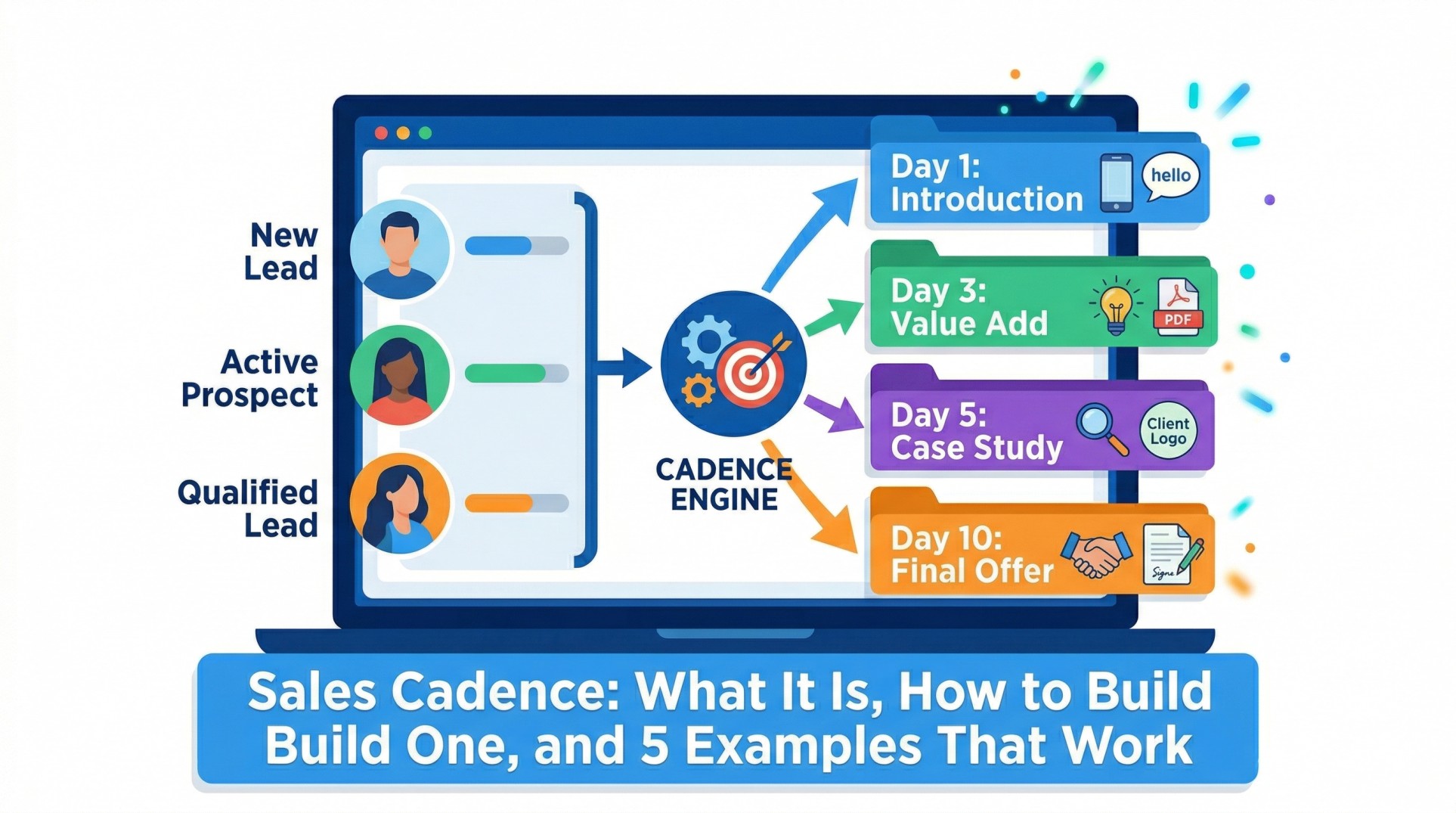
Not a personality trait. Not luck. Not some ineffable sales instinct. It is a structured, repeatable sequence of touchpoints — emails, calls, LinkedIn messages, and other outreach — planned at specific intervals, across specific channels, designed to move a specific type of prospect through a specific stage of your pipeline.
The difference between reps who consistently hit quota and those who do not is often not talent or product knowledge. It is cadence discipline. Most deals take more than seven attempts to reach a prospect while sales reps commonly give up after three or four attempts. That gap — between what it takes and what most reps do — is where pipeline goes to die.
In 2026, the cadence problem has intensified. Booking outbound meetings now takes 1,000–1,400 touchpoints per sourced opportunity — up from 200–400 just five years ago. Buyers are harder to reach, more skeptical, and doing more research on their own before engaging with a rep. The cadences that worked in 2020 need a complete rethink.
This guide gives you the complete 2026 sales cadence system: the precise definition, the research on what actually works, how to build a cadence from scratch in 5 steps, 5 proven cadence examples by scenario, the channel mix, the timing framework, the AI workflow, the metrics, and the tool that builds and automates your entire cadence from one platform.
What Is a Sales Cadence?
A sales cadence is a predefined sequence of sales activities and touchpoints spread out over set intervals that a salesperson uses to contact a prospect — creating a systematic, repeatable framework for outreach that replaces guesswork with structure.
A sales cadence typically includes:
When and how often to email prospects
When and how often to call
When and how to engage on LinkedIn
When to send direct mail, video messages, or other touches
How many total touchpoints to attempt before disengaging
How long the full sequence runs
The cadence determines the "when and how" — timing, frequency, and channel choice. It is distinct from a sales script, which determines the "what to say" — the specific content and messaging used during each interaction. Both matter. The cadence creates the framework; the script delivers the message within it.
Why Sales Cadences Work: The Research
A structured cadence works for four documented reasons:
1. Consistency beats talent. When every rep follows the same proven sequence, pipeline becomes measurable and forecasts become reliable. Omniplex Learning scaled from 5 to over 100 employees using centralized cadence execution — their forecast accuracy tightened to within 5%.
2. Persistence produces results. 80% of sales require at least 5 follow-ups, yet 44% of reps give up after one attempt. A cadence systematizes persistence — ensuring every prospect receives the full sequence rather than being abandoned after two touches.
3. Multi-channel outperforms single-channel. Research shows campaigns using three or more channels see a 14.6% increase in sales compared to single-channel approaches. A cadence coordinates those channels into a coherent experience rather than a disjointed series of random touches.
4. Timing is now a science. Smart timing beats frequency. Intent-based cadences that fire based on prospect behavior — pricing page visit, content download, job change — deliver up to 40% higher SDR productivity by ensuring reps contact the right prospect at the right moment.
The 2026 Sales Cadence Benchmarks
Metric 2026 Benchmark Source Optimal cadence length 17–21 days Cognism / Outreach 2026 Optimal number of touchpoints 8–12 Cognism / Morgan J Ingram Touchpoints needed per sourced opportunity 1,000–1,400 Kaspr Jan 2026 Reps giving up after 1–3 touches 44% RAIN Group Deals requiring 7+ attempts to reach Most deals DealHub / Pipedrive SDR productivity lift from intent signals +40% MarketBetter Feb 2026 Multi-channel vs single-channel lift +14.6% sales Persana AI / research Companies responding within 1 hour 7x more likely to qualify leads Harvard Business Review Minimum emails per variant for A/B validity 100 MarketBetter Feb 2026 Top-performing cadence touchpoint types Email + Phone + LinkedIn + Video Cognism / Highspot
The most striking benchmark: 1,000–1,400 touchpoints per sourced opportunity. That number is not about individual sequences — it is about the total volume of outreach activity required to generate one qualified meeting across a full prospecting operation. It reframes cadence building from "how many emails should I send?" to "what is the system that consistently generates enough activity to produce predictable pipeline?"
How to Build a Sales Cadence in 5 Steps
Step 1: Define the Scenario and Segment
No single cadence works for every situation. The first decision is which specific scenario this cadence is built for. Assigning specific cadences to various buyer personas within the ICP is one of the most important sales cadence best practices.
The 6 core cadence scenarios:
Scenario Who It Targets Key Difference Cold outbound ICP-matched strangers No prior relationship — must earn attention Inbound follow-up Leads who showed interest Already engaged — faster, more direct Post-demo Prospects who attended demo Decision being made — urgency appropriate Re-engagement Previously cold prospects Context from prior sequence — reference it Account expansion Existing customers Relationship exists — warmer tone Competitive displacement Competitor customers Specific competitive framing required
Morgan J Ingram recommends sticking to 3 cadence templates: a highly personalized cadence for top company targets, a persona-based cadence for top job title targets, and a standard template for gauging interest from new accounts. Never have more than 4–6 cadences max; as teams get bigger, they should be centrally controlled by management.
Step 2: Choose Your Channels
Today's successful sales teams use at least three channels — email, phone, and social media — to make their outreach work better. The channel mix should match where your specific prospect persona is most active and receptive:
Channel Best For Frequency in Cadence Email Universal — primary channel Every 3–5 days Phone Senior buyers, complex sales, relationships 2–3 times per sequence LinkedIn Social sellers, B2B professionals, warm-up Days 1 and 7 (blank connection first) Video High-value accounts, post-demo Once — specific, personalized Direct mail Enterprise ABM, highest-value accounts Once — package or gift
The blank LinkedIn connection request on Day 1 is a specific tactic worth noting: "Lead the cadence with a blank LinkedIn connection request. When I did that, my email and cold call responses increased." The connection creates ambient familiarity before the first email arrives — making the email feel slightly warm rather than fully cold.
Step 3: Set Your Timing
A well-laid-out cadence typically runs 17–21 days with 8–12 touchpoints. The 3-7-14 rule is a solid baseline: first follow-up after 3 days, second after 7 days, third after 14 days. Modern research suggests more touchpoints within shorter timeframes than the old "2-2-2 rule" (2 days, 2 weeks, 2 months) produces better results.
Timing principles:
Never contact the same prospect via two channels on the same day (feels like spam)
Space touches 2–4 days apart in the early sequence, extending to 5–7 days later
Mid-week sends (Tuesday–Thursday) outperform Monday and Friday
9–11 AM and 2–4 PM local time are the highest-engagement windows
APAC and EMEA markets respond better to fewer touchpoints; North American audiences often need more frequent contact
Step 4: Write Channel-Specific Content
Each touch in your cadence needs its own distinct content — never repeat the same message across channels or across emails in the sequence. Each touchpoint should add something new: a different angle, a relevant case study, a fresh insight, or a different framing of your value proposition.
The 4-phase content framework:
Phase 1 (Days 1–7): Introduction and initial engagement — earn attention with specificity
Phase 2 (Days 8–12): Additional value, social proof, objection handling
Phase 3 (Days 13–17): Continued engagement with relevant content and educational materials
Phase 4 (Days 18–21): Final push — breakup email with warm farewell and re-engagement path
For email content at every phase of your cadence, our cold email templates guide has templates for every stage. For the complete follow-up email system, see our cold email follow-up sequences guide.
Step 5: Build, Test, and Iterate
A sales cadence doesn't end when a prospect replies; in fact, that's when the most critical phase begins. A/B test constantly to improve your results. You need to test multiple things at once and do it often — not just one element like a subject line, and not just once. Don't declare a winner after 20 sends — aim for at least 100 emails per variant to ensure statistical significance.
Track both opens and replies separately: a catchy subject line might boost opens, but a clear, value-driven one might generate more replies. Set a recurring calendar event every quarter to review test results, implement winners, and plan the next round.
5 Proven Sales Cadence Examples for 2026
Cadence 1: The Cold Outbound Cadence (Standard B2B)
Scenario: Reaching ICP-matched prospects with no prior relationship Duration: 18 days | Touchpoints: 9 | Channels: Email + LinkedIn + Phone
Day Channel Action Content Type 1 LinkedIn Blank connection request No message — just connection 2 Email Initial outreach Trigger-based, personalized first line + proof point 4 Phone First call attempt Reference the email 5 LinkedIn Message (if connected) Short reference to the email — different angle 7 Email Follow-up #1 Light bump — 2–3 sentences 9 Email Follow-up #2 Value-add — case study or insight 11 Phone Second call attempt Reference previous touches 14 Email Follow-up #3 Pivot — different pain point or angle 18 Email Breakup email Warm farewell + re-engagement path
Performance benchmark: 5–10% positive reply rate with standard personalization; 10–15% with trigger-based opening lines.
Cadence 2: The Inbound Lead Cadence (High-Intent)
Scenario: Prospect filled out a form, downloaded content, or requested a demo Duration: 7 days | Touchpoints: 6 | Channels: Email + Phone
Inbound leads need speed above all else. Companies responding within an hour are nearly 7x more likely to qualify leads than those who waited longer. The inbound cadence starts immediately and moves fast.
Day Channel Action Content 0 (immediate) Email Thank you + next step Confirm what they requested + single CTA 0 (within 5 min) Phone First call "Following up on your [request]" 1 Email Value delivery Content they requested + related resource 2 Phone Second call attempt Reference the content shared 3 Email Case study Relevant to their industry/size 5 Email Direct ask Soft meeting request with specific times 7 Email Final follow-up Breakup if no response — keep door open
Performance benchmark: 25–40% conversion to meeting for well-qualified inbound leads.
Cadence 3: The Post-Demo Cadence (Decision Stage)
Scenario: Prospect attended a demo or discovery call — now in evaluation Duration: 14 days | Touchpoints: 7 | Channels: Email + Phone
At the post-demo stage, the relationship exists. The cadence becomes more direct, references specific content from the call, and asks for concrete next steps rather than soft conversational openers.
Day Channel Action Content 0 (same day) Email Meeting summary Key points discussed + agreed next steps 1 Email Relevant material Case study matching their use case 3 Phone Check-in call "Did the summary land? Any questions?" 5 Email Proposal or ROI model Custom to their specific situation 7 Phone Proposal follow-up "Anything come up on your end?" 10 Email Objection handler Address the most likely concern directly 14 Email Next step or breakup Specific day/time OR warm close
Performance benchmark: 30–50% of post-demo sequences produce a defined next step within 14 days.
Cadence 4: The Value-First Content Cadence (Trust Building)
Scenario: Long sales cycles, skeptical buyers, research-heavy decision processes Duration: 21 days | Touchpoints: 8 | Channels: Email + LinkedIn
The initial emails are purely educational, designed to solve a small, specific problem. Only after delivering tangible value multiple times does the cadence transition to a soft ask — which feels earned rather than demanded.
Day Channel Action Content 1 Email Pure value delivery Industry insight, research finding, or quick-win tip — CTA: "Read this" 3 LinkedIn Engagement Comment genuinely on their recent post 5 Email Practical tool Template, framework, or checklist relevant to their role 8 LinkedIn Message Reference the content you shared — ask a relevant question 10 Email Case study Customer result matching their situation — still no hard ask 14 Email Soft ask "Based on what I've shared — would a 15-minute call be useful?" 17 Phone Call attempt Reference all three content pieces shared 21 Email Breakup Warm close + invite future conversation
Why it works: By measuring engagement with content (clicks, downloads), you can identify highly interested prospects who are essentially qualifying themselves for a conversation.
Cadence 5: The Re-engagement Cadence (Dormant Prospects)
Scenario: Prospects who went cold after a previous outreach sequence or conversation Duration: 14 days | Touchpoints: 5 | Channels: Email + LinkedIn
Re-engagement cadences work differently from cold outbound because the relationship context already exists — use it. Reference what was discussed before. Acknowledge the gap without guilt-tripping. Lead with something new.
Day Channel Action Content 1 Email Re-intro with new reason Specific trigger: new product, new case study, relevant news 3 LinkedIn Message "Saw [trigger] and thought of our conversation" 5 Email Updated value Something meaningfully new since your last conversation 9 Phone Call attempt Reference the email and prior relationship 14 Email Final touch Warm close: "Timing may be different now — door always open"
Performance benchmark: 8–15% re-engagement rate from dormant prospects when outreach references prior context and introduces a genuine new reason to reconnect.
The AI-Powered Sales Cadence in 2026
A static, alphabetical task list is a relic of the past. One of the most critical sales cadence best practices is to prioritize outreach based on real-time buyer intent signals — shifting reps from a "who's next on the list" mentality to a "who's most likely to engage right now" strategy.
This is where AI transforms cadence execution from a manual discipline into an intelligent system:
AI-powered cadence capabilities:
Capability What It Does Impact Intent prioritization Surfaces prospects showing buying signals (pricing page, content download, job change) +40% SDR productivity Send-time optimization Identifies when each specific prospect is most likely to open +10–15% open rate Sequence personalization Generates unique first lines based on prospect research +142% reply rate Reply detection + routing Stops sequence automatically when prospect replies; routes to appropriate next action Zero missed opportunities A/B test analysis Identifies winning variants across subject line, body, and CTA Continuous improvement Burnout detection Flags prospects showing disengagement patterns before they go fully cold Better re-engagement timing
The best AI doesn't replace the human cadence. It makes the human cadence dramatically more efficient by removing the research, scheduling, and analysis burden — leaving the rep to focus on conversations, not administration.
The Sales Cadence Metrics Dashboard
The cadence doesn't end when a prospect replies — it ends when you have maximized every measurable outcome. Track these metrics to know when your cadence is working and when it needs work:
Metric Definition Target Touchpoint open rate % of emails opened per sequence step 35%+ Reply rate per touch Which step generates the most replies Benchmark and optimize Connection rate LinkedIn connections accepted / requests sent 30–40% Call connect rate Connected calls / total dials 6–10% Meeting booked rate Meetings booked / prospects enrolled 2–5% Sequence completion rate % of prospects completing all steps Track — benchmark over time Cadence-to-pipeline rate Pipeline created / prospects enrolled Primary success metric
The diagnostic test: Compare your reply rate by sequence step. Which email in the sequence generates the most replies? Which generates the fewest? The step with the lowest reply rate is your biggest improvement opportunity — rewrite it first.
Why Mailfra Builds Your Best Cadences (Automatically)
Building a sales cadence manually — writing every step, scheduling every touch, managing every channel, tracking every metric — is the reason most sales teams build one cadence and use it forever, never optimizing, never improving.
Mailfra eliminates every manual step in cadence building — and it costs under $30/month.
Here is what Mailfra delivers that no other tool at this price point offers:
AI sequence auto-generation — describe your ICP, your scenario, and your goal, and Mailfra writes your complete multi-step cadence. Not just subject line suggestions — full email copy, timing, and channel recommendations for every step.
Built-in prospect research — Mailfra's prospect research tools find and enrich your contacts so you know exactly who you are adding to each cadence and what to say to them specifically.
Better analytics per cadence step — see open rate, reply rate, and positive reply rate for each individual touch in your sequence. Know exactly which step is working and which needs rewriting.
AI personalization at scale — generates genuinely researched, trigger-based first lines for every prospect in your cadence. The kind of personalization that drives 142% higher reply rates.
Automated inbox rotation + warmup — your cadence emails actually reach the inbox instead of the spam folder. Mailfra's built-in warmup and inbox rotation protects your sender reputation as you scale.
Reply detection + auto-stop — when a prospect replies, Mailfra stops the sequence automatically and routes them appropriately. No awkward "still not heard from you" emails after a prospect has already said yes.
Agency-friendly from day one — manage multiple client cadences without per-client fees eating into your margins.
Teams running manual cadences in spreadsheets — or paying $97/month for Instantly and another $200/month for a CRM — are consolidating to Mailfra and getting a more automated, more intelligent cadence system for less than $30/month.
Start building your cadences at mailfra.com →
Frequently Asked Questions About Sales Cadences
What is a sales cadence?
A sales cadence is a predefined sequence of sales activities — emails, calls, LinkedIn messages, video, and other touchpoints — spread out over set intervals that a salesperson uses to engage a prospect in a structured, repeatable way. It replaces random, inconsistent outreach with a systematic framework that ensures every prospect receives the full planned sequence rather than being abandoned after 1–2 touches. A well-executed cadence drives higher response rates, more predictable pipeline, and better forecast accuracy. Research shows 8–12 touches over 17–21 days consistently outperforms shorter or less structured approaches.
How many touchpoints should a sales cadence have?
Research from Cognism, Outreach, and top-performing SDR managers consistently recommends 8–12 touchpoints as the optimal cadence length, spread across 17–21 days. This is significantly more than most reps naturally attempt — 44% give up after one attempt, and most deals require more than 7 attempts to reach a prospect. More than 12 touches in the first sequence risks diminishing returns and prospect fatigue. After completing the sequence without a reply, prospects move to a nurture track or re-engagement cadence rather than additional direct outreach.
What channels should a sales cadence include?
Modern B2B sales cadences include at least three channels: email (primary — most scalable and measurable), phone (best for real-time conversation, especially with senior buyers), and LinkedIn (warm-up before first email, message reinforcement, content engagement). Video messages are effective for high-value accounts as a mid-sequence differentiator. Direct mail works exceptionally well for Tier 1 ABM accounts where the deal size justifies the investment. Research shows campaigns using three or more channels see a 14.6% increase in sales compared to single-channel approaches.
What is the difference between a sales cadence and a sales script?
A sales cadence determines the "when and how" — the timing, frequency, and channel choice for each outreach attempt. A sales script determines the "what to say" — the specific content and messaging used during each interaction. They complement each other: the cadence creates the framework, the script delivers the message within it. A single cadence may use multiple scripts — a different email script for each sequence step, a different call script for early vs. late in the sequence, and a LinkedIn script for connection requests vs. follow-up messages.
How do I measure sales cadence performance?
Track six metrics: (1) open rate per sequence step — which emails get opened; (2) reply rate per step — which emails generate responses; (3) meeting booked rate — meetings divided by prospects enrolled; (4) sequence completion rate — what percentage complete the full sequence; (5) cadence-to-pipeline rate — pipeline created divided by prospects enrolled (your primary ROI metric); (6) time-to-first-reply — how quickly prospects engage after starting the sequence. A/B test at least one element per cadence each quarter, using a minimum of 100 sends per variant for statistical validity.
How often should I update my sales cadence?
Review and update cadences quarterly. Set a recurring calendar event every quarter to review test results, implement winners, and plan the next round of experiments. High-performing teams like Barley run a cadence committee of management and top SDRs that reviews and updates cadences every month. At minimum, update when you notice a consistent drop in open or reply rates (more than 20% decline vs. previous quarter), when your ICP or product positioning changes significantly, or when a specific sequence step is consistently producing zero responses across multiple campaigns.
The Bottom Line
A sales cadence is the difference between a sales team that runs on hope and one that runs on a system.
Hope says: "I'll follow up when I remember." A cadence says: "Day 7, LinkedIn message referencing the case study from Day 5, unless they replied, in which case route to the meeting booking flow."
The research is unambiguous: 8–12 touches over 17–21 days outperforms shorter, less structured approaches. Multi-channel cadences outperform single-channel by 14.6%. Intent-based prioritization delivers 40% higher SDR productivity. Yet 44% of reps still give up after one touch.
The gap between what it takes and what most people do is your competitive advantage. Build the cadence. Run the system. Follow up relentlessly.
Pipeline is on the other side.
Build your complete sales cadence system: use our cold email follow-up sequences guide for the email component of every cadence, launch with our full cold email strategy guide, use our cold email templates for every sequence step, master cold email personalization that makes every touch feel individual, discover every sales prospecting technique that fills the cadence with the right prospects, track your cold email open rates per sequence step, build into your complete outbound sales strategy, and integrate into your full B2B lead generation strategy. Build and automate your cadences at mailfra.com.
Comments(0)
Loading comments...