You sent the email. Nobody replied. Now what?
If your answer is "nothing — I move on," you are leaving the majority of your pipeline on the table.
Here is the number that should change how you think about cold outreach forever: 80% of successful sales require five or more follow-up touches, yet 48% of sales reps never send a single follow-up email after the first message. That gap — between what it takes to close and what most people actually do — is where deals are won and lost every single day.
Cold email follow-up sequences are not optional extras bolted onto the end of a campaign. They are the campaign. Done correctly, a strategic follow-up sequence can increase your reply rates by 50% or more and turn a cold, silent prospect into a booked meeting.
This guide covers everything: the data behind follow-up frequency, a proven sequence structure, ready-to-use templates for every stage, and the mistakes that quietly kill your results.
Why Most Cold Emails Go Unanswered (And Why That's Not the End)
Before we get into sequences, it's worth understanding why prospects don't reply to first emails — because the reasons are less sinister than most people assume.
Your prospect is not ignoring you because they hate you. They are ignoring you because:
They are genuinely busy and your email got buried
They were interested but not enough to act in that moment
They meant to reply and forgot
The timing was wrong — not permanently, just right now
They skimmed the subject line and moved on without opening
Roughly 60% of prospects respond after the second follow-up — not the first. That single statistic reframes the entire concept of follow-up: it is not a desperate attempt to get someone's attention. It is the standard number of touches required to reach a busy professional at the right moment.
Sending 4–7 emails in a B2B cold email sequence results in triple the responses compared to sending only 1–3 emails. Not double. Triple.
The data is unambiguous. Follow-ups are not optional. They are the primary mechanism through which cold email converts.
How Many Follow-Up Emails Should You Send?
This is the question everyone asks, and the answer is: it depends — but the data gives us a clear range.
Campaigns with only 1 email achieve a 3.0% reply rate, while 2-email sequences reach 4.8% (+60%), and 3-email sequences plateau at 5.8%. Beyond 3 follow-ups, reply rates decline as spam complaints and unsubscribes increase.
The consensus across multiple large-scale studies points to 3–5 emails per sequence as the optimal range for most B2B cold outreach. Here is how to think about it:
Sequence Length Expected Reply Rate Best For 1 email only ~3.0% Low-volume, ultra-targeted ABM 2 emails (1 follow-up) ~4.8% Conservative industries (cybersecurity, legal) 3–4 emails ~5.8% Standard B2B outreach 5–7 emails Up to 3× more replies vs. 1–3 High-volume, aggressive outbound
The key nuance: more emails only help if each one adds new value. Sending the same pitch five times with a different subject line is not a sequence — it is spam. Every email in your sequence needs its own reason to exist.
The Anatomy of a High-Converting Follow-Up Sequence
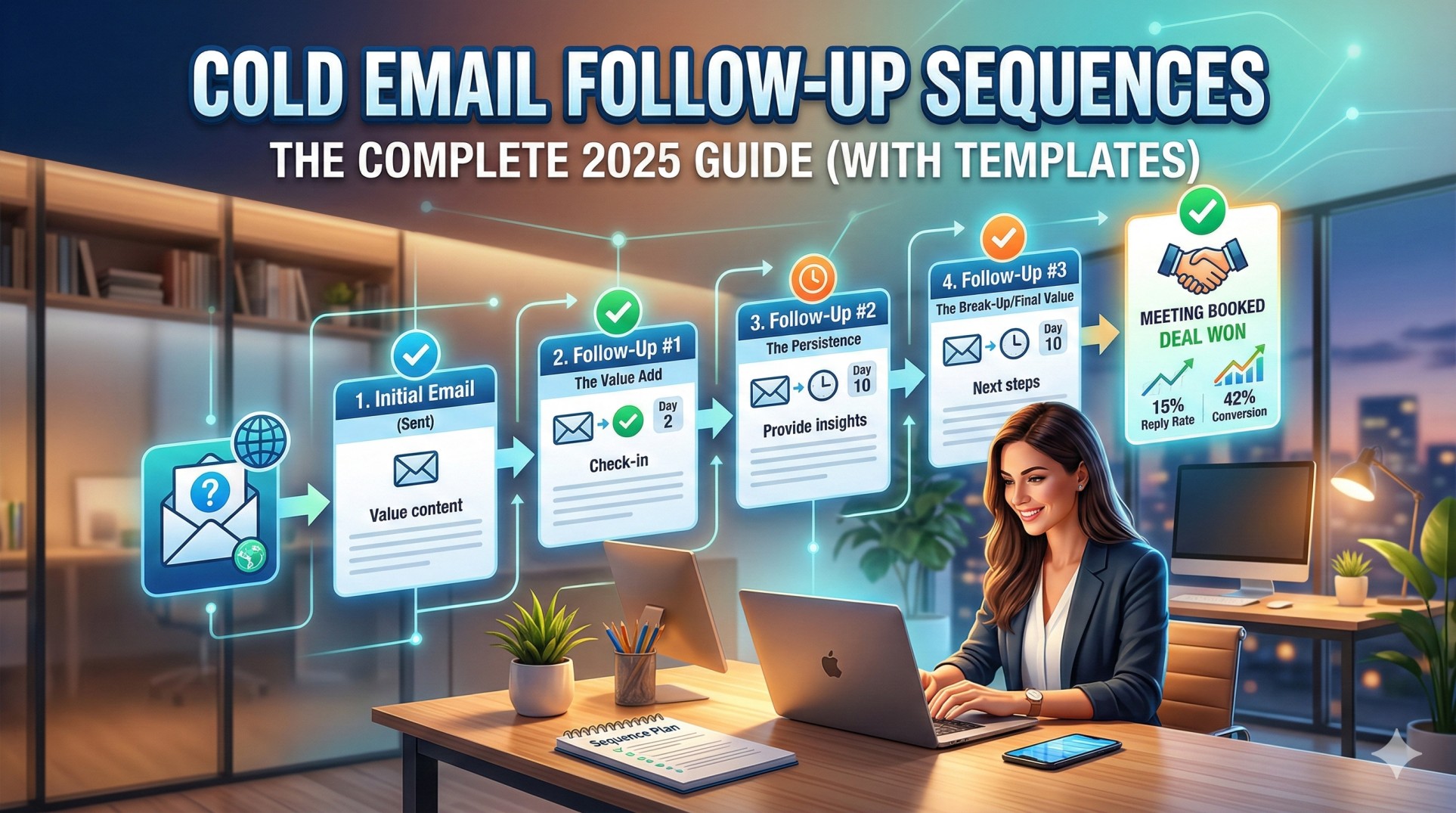
The most effective cold email follow-up sequences follow a clear progression. Each email has a specific job, a specific tone, and a specific place in the arc from "cold stranger" to "booked meeting."
Here is the five-email sequence structure used by top-performing B2B sales teams in 2025.
Email 1: The Initial Outreach (Day 1)
Job: Make a strong, specific, personalized first impression and present your core value proposition.
This is your most researched, most thoughtfully written email. It is not a pitch — it is the opening of a conversation. For a deep dive on making this email as strong as possible, including how to write opening lines that actually get read, see our guide to cold email strategy.
One rule: resist the urge to include everything here. Save material for your follow-ups.
Template:
Subject: Idea for {{Company}}'s [specific thing]
Hi {{First Name}},
[Specific, research-based opening line referencing something real about them — a post, a hire, a funding round, a competitor move.]
We help [type of company] [achieve specific outcome] — typically within [timeframe]. We recently helped [similar company] [specific result].
Would it make sense to spend 15 minutes seeing if we could do the same for {{Company}}?
[Your name]
Email 2: The Light Bump (Day 3–4)
Job: Resurface your email without repeating the pitch. Keep it short, casual, and pressure-free.
Most replies that come from follow-ups come from this email. Your prospect saw your first message, meant to reply, and got distracted. This email is simply a low-friction reminder that you exist.
Keep it to two or three sentences. That's it.
Template:
Subject: Re: [original subject line]
Hi {{First Name}},
Just wanted to resurface this in case it got buried — completely understand if the timing isn't right.
Still think there's a relevant angle here for {{Company}} if you have five minutes this week.
[Your name]
Email 3: The Value-Add (Day 7–9)
Job: Give the prospect something genuinely useful — without asking for anything in return. This resets the dynamic from "someone pitching me" to "someone who keeps sharing useful things."
This is the most underused and most powerful email in a sequence. Instead of repeating your ask, bring a relevant piece of evidence: a case study, an insight, a data point, or a specific observation about their business that demonstrates expertise.
Template:
Subject: Something relevant to {{Company}}
Hi {{First Name}},
Thought this might be useful regardless of whether we work together — [one specific insight, relevant stat, or short case study tied directly to a challenge they are likely facing].
[1–2 sentences connecting the insight to your offer, lightly.]
Happy to share more if it's relevant.
[Your name]
Email 4: The Pivot (Day 13–16)
Job: Try a completely different angle. Different pain point, different benefit, different framing. If your first three emails focused on efficiency, try revenue. If they focused on the VP of Sales, try addressing it from the CFO's perspective.
Sometimes the reason for silence is not disinterest — it is that your framing hasn't landed on the problem they are actively thinking about. The pivot email tests a new door.
Template:
Subject: Different angle on this, {{First Name}}
Hi {{First Name}},
I've been approaching this from a [angle 1] perspective — but thinking about it more, the bigger challenge for a company at {{Company}}'s stage might actually be [different pain point].
[One sentence connecting that pain to what you offer.]
Does that resonate more? Worth a quick call to explore?
[Your name]
Email 5: The Breakup (Day 20–25)
Job: Create urgency through absence. Signal that this is your last email — graciously, warmly, without guilt-tripping. This is consistently one of the highest-performing emails in any sequence.
The psychology is powerful: people are more motivated by the prospect of losing something than by the prospect of gaining it. When you tell someone you are removing them from your outreach, they suddenly have to actively decide whether that is okay — and many will respond simply because they don't want to close a door permanently.
Template:
Subject: Closing the loop
Hi {{First Name}},
I've reached out a few times without hearing back, which usually means one of two things: the timing isn't right, or this just isn't relevant — both are completely fair.
I'll stop reaching out after this. But if [specific challenge] becomes a priority at {{Company}} down the line, I'd genuinely welcome a conversation.
Wishing you a strong quarter ahead.
[Your name]
This email routinely generates replies from prospects who have been silent for weeks. Treat it as a genuine farewell — not a manipulation tactic — and write it with warmth.
Follow-Up Timing: When to Send Each Email
Timing matters less than message quality, but it still matters. Here is what the data says about optimal spacing.
The best time to follow up is 3 days after sending your initial message. After that, extend intervals as the sequence progresses — early follow-ups can be closer together, later ones should breathe more.
Recommended spacing:
Email 1 → Email 2: 3 days
Email 2 → Email 3: 4–5 days
Email 3 → Email 4: 5–7 days
Email 4 → Email 5: 7–10 days
Total sequence length: 20–25 days
This gives you enough persistence to catch someone at the right moment without crossing into territory that feels harassing.
On what day and time to send: emails sent between 9–11 AM local time see 30% higher engagement. Tuesday through Thursday consistently outperform Monday and Friday. That said, send-time optimization is a second-order concern — getting the message right matters far more than getting the minute right.
The 5 Follow-Up Mistakes That Kill Reply Rates
Knowing the right structure is half the battle. Knowing what not to do is the other half. These are the most common follow-up mistakes — and they are far more common than they should be.
1. Repeating the Same Email
The single most damaging mistake. Sending identical (or near-identical) content five times tells the prospect you have nothing new to offer, erodes trust, and increases spam complaints dramatically. Every email needs a distinct angle, a fresh piece of value, or a different framing.
2. Following Up Too Aggressively
Same-day or next-day follow-ups signal desperation and are treated as spam behavior by both prospects and email providers. Sending the fourth follow-up may result in a 1.6% spam rate and 2% unsubscribe rate — which will damage your sender reputation over time. Respect the spacing guidelines above.
3. Writing Follow-Ups That Are Too Long
Think two scrolls or fewer on mobile — that is 50–125 words. Follow-up emails should be shorter than your initial email, not longer. The more follow-ups you send, the shorter they should get. Email 4 and 5 can be as brief as three sentences.
4. Ignoring Engagement Signals
If a prospect opens your email five times without replying, that is a strong signal of interest. Many cold email tools can detect multiple opens and alert you to prioritize that prospect for a phone call or LinkedIn touch. Ignoring these signals and just continuing the automated sequence is a wasted opportunity. Set up behavior-based triggers: multiple opens = accelerate; zero opens after three emails = consider a different channel.
5. Stopping Too Early
Cold email reply rates improve by 50%+ with consistent follow-ups, yet 48% of reps never send a second message — missing the majority of their potential replies. If you are running one-email campaigns, you are effectively doing half the work and getting a fraction of the results.
Subject Lines for Follow-Up Emails
Follow-up subject lines deserve as much attention as first-email subject lines. The temptation to use "Re: [original subject]" for every follow-up is understandable — it creates a sense of continuation — but using fresh subject lines for emails 3, 4, and 5 consistently improves open rates because it prevents the thread from looking like an ignored chain.
High-performing follow-up subject lines:
Still relevant, {{First Name}}?One more thought on {{Company}}Closing the loopDifferent angle on thisA result you might find usefulQuick question before I stop bothering youWorth 15 minutes?Last one, I promiseRe: [original subject](for Email 2 only — creates continuity)Something I should have mentioned earlier
For the full breakdown of cold email subject line strategy — including data on which formats drive the highest open rates — read our complete guide to cold email subject lines.
How to Personalize Follow-Up Sequences at Scale
The tension between personalization and scale is real, but it is solvable. Here is the framework the best outbound teams use.
Tier 1 — Campaign-level relevance: Every email in a given campaign is written for a specific segment (same industry, same company size, same role). The messaging is already more relevant than generic outreach before any individual customization.
Tier 2 — First-line personalization: The opening sentence of Email 1 (and optionally Email 3) is customized per prospect based on a specific research trigger: a LinkedIn post, a company announcement, a job posting, a recent hire. This takes 2–3 minutes per prospect and dramatically improves the sense of personal attention.
Tier 3 — Behavior-based branching: Use your cold email tool's signal detection to branch sequences based on behavior. Prospects who open 3+ times get a more urgent follow-up or a personal phone call. Prospects who click a link get a follow-up referencing the specific content they viewed. This level of personalization requires a capable sending tool but produces outsized results.
For everything to work properly — personalization, sequencing, timing — your technical setup needs to be clean. Poor email deliverability will undermine even the most brilliantly written follow-up sequence by routing your emails to spam before they are ever seen.
Tools for Automating Cold Email Follow-Up Sequences
Manual follow-up does not scale. Once you are sending more than 20–30 emails per day, you need automation to manage sequences, track replies, stop sequences when prospects respond, and surface engagement signals.
The major categories of tools:
Purpose-built cold email tools — Instantly, Smartlead, Lemlist, and Reply.io are the most widely used. They handle multi-inbox rotation, built-in warmup, sequence automation, reply detection, and basic A/B testing. Best for sales teams and agencies running cold outreach at scale.
Sales engagement platforms — Outreach, Salesloft, and Apollo.io combine email sequencing with call tasks, LinkedIn steps, and deep CRM integration. More powerful and more expensive; best for larger sales organizations.
Key features to require from any tool:
Automatic sequence pause on reply (so prospects don't receive email 3 after they've already responded)
Reply detection for out-of-office and bounce handling
Multi-inbox rotation to protect sender reputation
Open and click tracking with engagement signal alerts
A/B testing at the subject line and body level
Whatever tool you choose, ensure your sending infrastructure is properly configured first. Even the best sequence tool cannot fix deliverability problems caused by missing authentication records. Mailfra's platform at mailfra.com handles the technical foundation so your sequences actually land in the inbox.
Frequently Asked Questions About Cold Email Follow-Up Sequences
How many follow-up emails should I send in a cold email sequence?
The data-backed sweet spot is 3–5 follow-up emails over 20–25 days. Three emails captures most of the available response rate improvement. Five emails, with each adding distinct value, can produce up to triple the replies of a single-email campaign. Beyond five, the risk of spam complaints and deliverability damage outweighs the incremental gain.
How long should I wait before sending a follow-up cold email?
Send your first follow-up 3 days after the initial email. After that, extend the gap: 4–5 days to the third email, 5–7 days to the fourth, and 7–10 days before the final breakup email. Never follow up the next day — it reads as desperate and increases spam complaints.
What should I say in a cold email follow-up?
Never repeat your original pitch. Each follow-up needs a fresh angle: Email 2 is a light bump, Email 3 adds a new piece of value (case study, insight, or data), Email 4 tries a different framing of your offer, and Email 5 is a warm farewell that invites future contact. The goal of each email is to give the prospect a new reason to reply — not to remind them you exist.
Should I use "Re:" in my follow-up subject lines?
Use "Re: [original subject]" for your first follow-up only — it creates a sense of continuity and increases opens slightly. For emails 3, 4, and 5, use fresh subject lines to prevent the thread from appearing as an ignored chain and to give each email its own open opportunity.
Does following up hurt my sender reputation?
Thoughtful, spaced follow-ups with distinct value do not hurt your sender reputation. What hurts your reputation is: daily follow-ups, repetitive content that triggers spam complaints, and sending to unengaged contacts for too long. Stick to the cadence above, keep each email genuinely useful, and use a cold email tool with proper inbox warming.
What is the best time to send follow-up cold emails?
Send between 9–11 AM or 2–4 PM in the recipient's local time zone, Tuesday through Thursday. However, message quality has a far larger impact on reply rates than send timing. Optimize your copy first, then optimize your timing.
The Bottom Line
Cold email follow-up sequences are where most outbound pipelines are won or lost. The data is clear: the majority of replies come from follow-ups, most salespeople never send them, and the ones who do — strategically, with distinct value in each email — generate two to three times the results of those who don't.
Build your five-email sequence. Space it properly. Make every email earn its place with something new to offer. And respect the breakup — it is often your most replied-to message.
Your next customer probably just needs one more email from you before they write back.
Want to get more out of your cold outreach? Read our complete cold email strategy guide, learn how to write cold email subject lines that get opened, and make sure your emails are actually reaching the inbox with our email deliverability guide.