
You built a list of 500 contacts, launched your first sequence, and 150 emails bounced before lunch. Your domain reputation tanked, your reply rate cratered, and you spent the next week cleaning up a mess that never should have existed.
This scenario plays out across dozens of teams every month. The cold email gets blamed. The tool gets blamed. The copy gets blamed. But in almost every case, the problem was the list — built before the campaign even started.
A B2B prospect list is not a spreadsheet of names. It is a precision instrument that determines whether your cold email strategy succeeds or fails before a single email is written. B2B contact data decays at 2.1% per month — meaning a list left untouched for six months is already 12.6% stale. The best list building approaches combine firmographic filtering with technographic data, intent signals, and real-time verification. Leading data providers maintain 91–95% email accuracy rates.
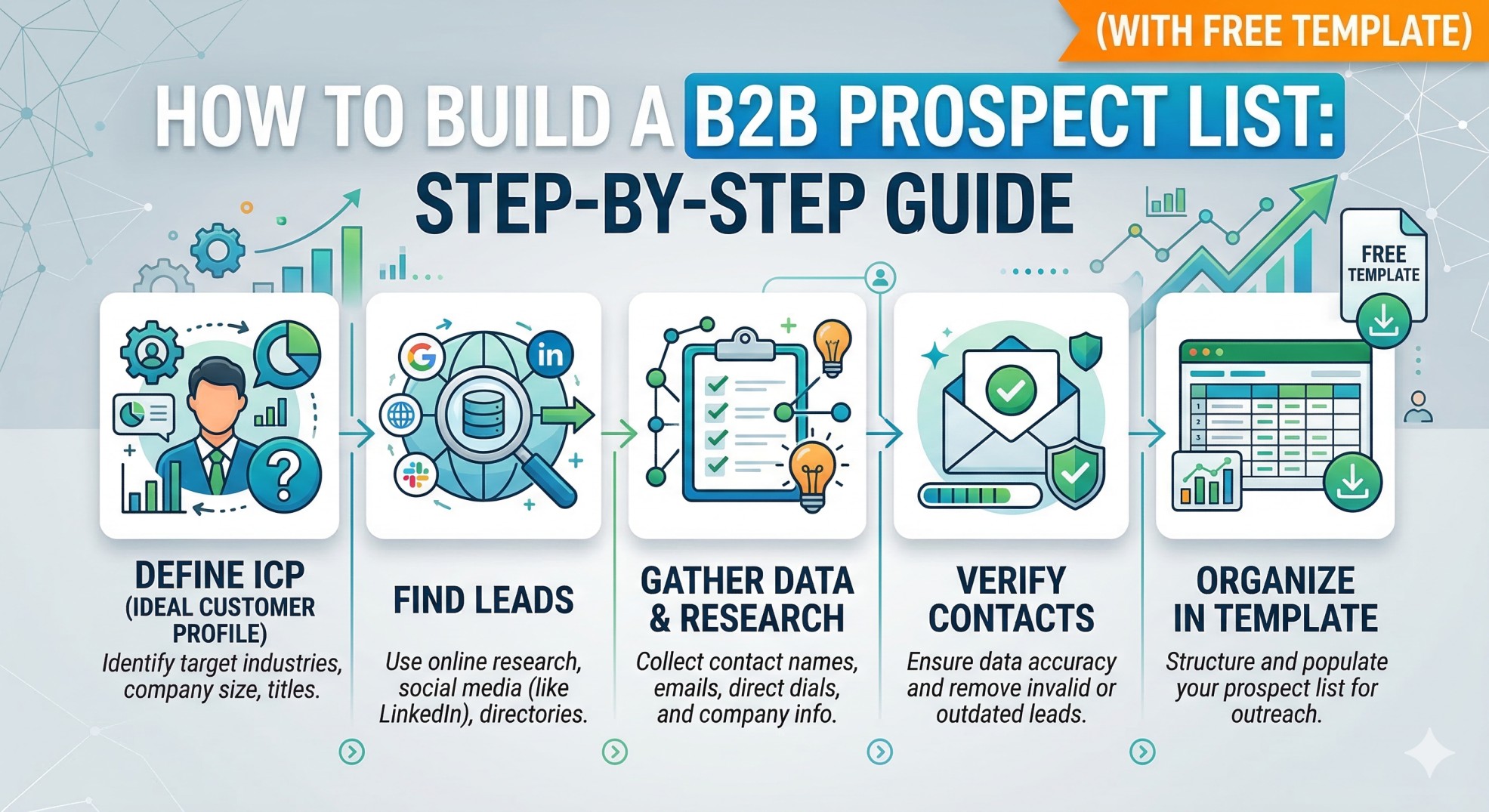
This guide gives you the complete system: a 14-field template covering everything a rep actually needs, a 5-step build process from ICP to activated list, a scoring framework for prioritization, a tool comparison table, a data decay management schedule, and the list hygiene process that keeps your sender reputation clean.
What Makes a B2B Prospect List Good (vs. Useless)
Most teams build prospect lists the wrong way. They pull 5,000 names from a database, export to CSV, and start sending. They confuse list size with list quality — and discover the difference when their bounce rate hits 15% and their domain gets flagged.
A smaller, accurate list outperforms a large, unverified list every time. The evidence is concrete: Snyk cut bounce rates from 35–40% to under 5% and saw AE-sourced pipeline jump 180% after switching to a higher-accuracy data source — with 50 AEs prospecting just 4–6 hours per week.
A high-quality B2B prospect list has four non-negotiable characteristics:
Characteristic What It Means How to Verify ICP alignment Every contact matches your ideal company profile Compare against ICP criteria before adding Data freshness Contact and company data is current — not 18 months old Verify within 90 days of use Verified emails Every email address confirmed deliverable Run through ZeroBounce or NeverBounce Reachability The right person with authority to make the buying decision Confirm title, seniority, and department
For most outbound teams, 200–500 highly targeted contacts per rep per month outperforms a list of 5,000 unqualified names.
Prospect List vs. Lead List vs. Account List
These three terms are used interchangeably — incorrectly.
List Type What It Contains Used For Prospect list ICP-qualified contacts vetted for fit, intent, and reachability Active cold outreach Lead list Anyone who has shown interest — qualified or not Nurture campaigns Account list Companies (not contacts) matched to ICP ABM, multi-stakeholder outreach
A prospect list contains ICP-qualified contacts vetted for fit, intent, and reachability. A lead list is broader — anyone who's shown interest, qualified or not. Lead lists focus on individual contacts, while account lists target entire companies, letting you coordinate outreach across multiple stakeholders.
Step 1: Define Your ICP Before Touching a Spreadsheet
Define your ICP before touching a spreadsheet. This is the foundation that determines who belongs on your list — and more importantly, who does not.
Your ICP for list building should answer:
Industry: Which specific verticals? (Not "technology" — which categories within technology?)
Company size: Employee count AND revenue range
Growth stage: Seed, Series A/B, growth-stage, enterprise
Geography: Countries and regions — also matters for legal compliance
Tech stack: What tools do they use that signal fit or intent?
Trigger conditions: What specific event makes them a buyer RIGHT NOW?
"Mid-market SaaS companies" isn't an ICP. "B2B SaaS, 50–500 employees, $5M–$50M revenue, US-based, using HubSpot or Salesforce" is. Teams that align sales and marketing on this definition see 36% higher retention and 38% higher win rates.
For the complete ICP framework with a 6-dimension template and real examples, see our what is an ideal customer profile guide.
Step 2: Choose Your List Building Sources
Different sources produce lists of different quality, coverage, and compliance. Here is the complete source landscape for B2B prospect list building in 2026:
Source Tier 1: Professional Databases (Highest Coverage and Accuracy)
Tool Database Size Email Accuracy Best For Pricing Apollo.io 275M+ contacts 65–80% All-in-one prospecting + sequencing Free tier; from $49/mo ZoomInfo 300M+ contacts 85–92% Enterprise accounts, deep firmographics $15,000+/year Cognism Large, GDPR-safe 87–95% EMEA markets, compliance-heavy industries Custom pricing Prospeo 300M+ profiles 98% verified Highest accuracy at lowest cost Free 75/mo; from $39/mo Lusha Large B2B 80–87% Phone + email combined Free 5/mo; from $29/mo Seamless.AI AI-crawled 70–80% Real-time email generation From $147/mo LinkedIn Sales Nav 900M+ members N/A (no export) Identification + research From $79.99/mo
The critical accuracy insight: Contact data decays at 2.1% per month. At 2.1% monthly decay, a list verified in January is already 6.3% stale by April. This is why static database exports — even from premium tools — need re-verification before use.
Source Tier 2: Intent and Signal Data (Highest Conversion Rate)
Source Signal Type Best Platform Conversion Lift Funding data Series A/B/C announcements Crunchbase Pro 3–5x vs no trigger Job change data New executives at target accounts LinkedIn alerts, Apollo 4–6x Hiring signals Active job postings by role LinkedIn Jobs alerts 2–4x Website visitors Companies visiting your site Clearbit Reveal, Warmly 5–8x Topic intent Companies researching your category Bombora, G2 Buyer Intent 3–5x Technology adoption New tool in their stack BuiltWith, Slintel 2–3x
Intent-signal-enriched lists are the highest-converting lists in B2B outbound. A prospect who matches your ICP AND shows active buying signals converts at 5–8x the rate of a prospect who matches ICP alone. Build signal monitoring into your list building workflow — not as an afterthought.
Source Tier 3: Manual and Public Sources (Free, Lower Scale)
LinkedIn profiles — Research individual prospects before adding to list
Company team pages — Often reveal direct email addresses and role clarity
Conference attendee lists — Highly targeted, event-specific relevance
Industry association directories — Niche audiences, high relevance
Google operators — Surface publicly available contact information
Job board postings — Companies hiring specific roles signal investment priorities
For detailed methods on finding specific email addresses from any source, see our how to find anyone's email address guide.
Step 3: The 14-Field Prospect List Template
Include 12–14 fields per prospect with a simple fit/intent/reachability score. Here is the complete 14-field template every B2B prospect list should include:
═══════════════════════════════════════════════════
B2B PROSPECT LIST — MASTER TEMPLATE
═══════════════════════════════════════════════════

CONTACT INFORMATION
────────────────────────────────────────────────
Field 1:  First Name
Field 2:  Last Name
Field 3:  Work Email (verified)
Field 4:  Phone (if available)
Field 5:  LinkedIn URL

PROFESSIONAL CONTEXT
────────────────────────────────────────────────
Field 6:  Job Title (exact)
Field 7:  Seniority Level (IC / Manager / Director / VP / C-Suite)
Field 8:  Department (Sales / Marketing / Ops / Engineering / etc.)

COMPANY INFORMATION
────────────────────────────────────────────────
Field 9:  Company Name
Field 10: Company Domain
Field 11: Industry (specific — not "technology")
Field 12: Employee Count
Field 13: Company HQ Location

QUALIFICATION FIELDS
────────────────────────────────────────────────
Field 14: ICP Score (1-3)
           1 = Partial match
           2 = Strong match
           3 = Perfect match + active trigger

NOTES COLUMN
────────────────────────────────────────────────
Field 15: Personalization Note (research-based first line draft)
Field 16: Data Source (Apollo / LinkedIn / Hunter / Manual)
Field 17: Verification Date
Field 18: Verification Status (Valid / Catch-all / Unknown)
Field 19: Email Sequence Status (Not Started / Active / Complete / Replied)
Field 20: Last Activity Date
═══════════════════════════════════════════════════
The most important fields most teams skip:
ICP Score: Forces qualification before outreach, not after. A score-3 prospect gets your best personalization. A score-1 gets a templated approach or gets removed entirely.
Personalization Note: Writing the first-line personalization at list-build time — when you are already researching the prospect — is 3x faster than doing it separately at send time.
Verification Date and Status: Without these, you cannot know when a list needs re-verification.
Step 4: The Prospect Scoring Framework
Not all ICP-matching prospects deserve the same outreach investment. A scoring framework lets you prioritize your highest-value, highest-intent contacts for your deepest personalization and most aggressive follow-up sequence.
The Fit + Intent + Reachability (FIR) Scoring System
Score each prospect on three dimensions (1–5 each) and prioritize by total score:
Fit Score (1–5): How well does this company match your ICP?
Score Criteria 5 Perfect match on ALL ICP criteria (industry, size, stage, tech stack) 4 Strong match — meets 4 of 5 ICP criteria 3 Good match — meets 3 of 5 ICP criteria 2 Partial match — meets 2 of 5 criteria 1 Poor match — stretch prospect, low priority
Intent Score (1–5): How strong are the buying signals?
Score Signal 5 Website visitor + active trigger (funding, new hire, job posting) 4 Active trigger event (single strong signal) 3 Soft trigger (content engagement, LinkedIn activity) 2 No trigger — fits ICP but no current signal 1 ICP match only — no signal evidence
Reachability Score (1–5): How easy is it to reach the right person?
Score Criteria 5 Decision-maker with verified direct email AND LinkedIn active 4 Decision-maker with verified email 3 Decision-maker identified — email needs finding 2 Influence but not decision-maker 1 Wrong contact — need to find the right person first
Priority tiers by total FIR score:
Total Score Priority Tier Outreach Approach 13–15 🔥 Tier 1 Hyper-personalized, multi-channel, immediate outreach 10–12 ⭐ Tier 2 Personalized first-line, full 7-touch sequence 7–9 🟢 Tier 3 Segment-level template, 4-touch sequence Below 7 🔵 Tier 4 Nurture only — not ready for active cold outreach
Step 5: Verify, Enrich, and Activate
A list of names and emails is not yet a prospect list. Before it is activated for outreach, it must pass three processing steps.
Step 5a: Email Verification
Run every email address through a verification tool before adding to your sending queue. We've watched teams switching from legacy providers regularly see bounce rates drop from double digits to under 4%.
Verification result action plan:
Result Action Valid Add to sequence Invalid / Hard bounce Remove permanently — never retry Catch-all Send cautiously — monitor bounce rate from this domain Unknown / Timeout Wait 24 hours, retry once, then treat as risky Role-based (info@, admin@) Remove — high spam complaint rate, low conversion Disposable Remove immediately
Target bounce rate: under 2%. Above 3% starts damaging sender reputation. Above 5% triggers active deliverability penalties from major inbox providers. For the complete deliverability framework that protects your sender reputation, read our email deliverability guide.
Step 5b: Enrichment
Enrich verified contacts with additional data that improves personalization and qualification:
LinkedIn profile URL — for social outreach and research
Company technographics — what tools do they use?
Funding stage and date — are they recently funded?
Job posting signals — what roles are they hiring?
Recent company news — personalization material
Tools like Clay automate this enrichment waterfall — querying multiple data sources in sequence until every field is populated. Clay aggregates data providers to verify email addresses and find hard-to-reach phone numbers, turning your raw contact list into a fully enriched prospect list in hours rather than days.
Step 5c: Segmentation
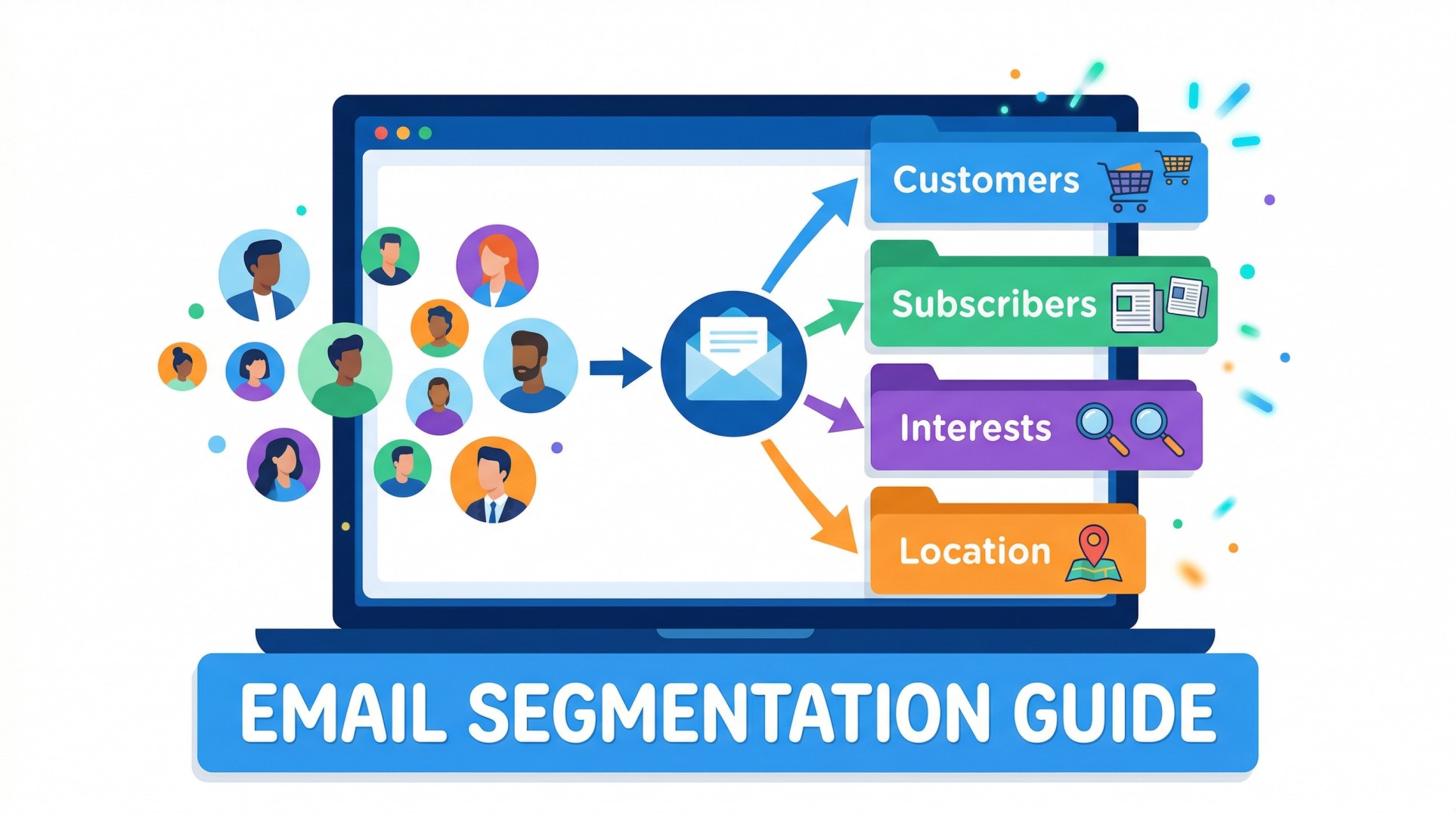
Segment your verified, enriched list by:
ICP tier (Tier 1/2/3 accounts)
Industry vertical (for industry-specific messaging)
Persona (VP of Sales vs. Head of Marketing vs. Founder)
Trigger type (funded vs. new hire vs. job posting vs. no trigger)
Each segment gets its own cold email sequence — not because segmentation is administratively convenient, but because every segment has different pains, different language, and different buying contexts that demand different messaging. For the personalization system that turns segmented lists into emails that feel individual, read our cold email personalization guide.
The B2B Prospect List Maintenance Schedule
A list is not an asset you build once. Treat your prospect list as a living dataset, not a static file. B2B data decays relentlessly — people change jobs, companies pivot, emails go inactive. The teams generating the most pipeline per rep are not building bigger lists. They are refreshing their existing lists continuously.
The Recommended Maintenance Schedule
Frequency Action Why Daily Process hard bounces — suppress permanently Protect sender reputation Weekly Deduplicate — remove contacts already in active sequences Avoid double outreach Monthly Remove contacts who have been unresponsive for 90+ days List hygiene Quarterly Re-verify entire list — run through ZeroBounce or NeverBounce B2B data decays ~22.5% annually — a list left untouched for six months is already 11% stale Quarterly Refresh ICP scoring — add new trigger signals, remove disqualifiers Keep list accurate as ICP evolves Annually Full list audit — archive inactive accounts, rebuild core target list Clean slate for new fiscal year
The Data Decay Problem in Numbers
Contact data decays at 2.1% per month. Here is what that means for list accuracy over time:
Time Since Verification Estimated Accuracy Action Required Fresh (0–30 days) 97–99% Safe to send 1–3 months 92–96% Safe to send with monitoring 3–6 months 86–91% Re-verify before major campaign 6–12 months 78–86% Re-verify entire segment 12+ months Below 75% Full rebuild recommended
The financial impact of ignoring data decay is severe: at 15% invalid rate (6-month-old unverified list), a campaign of 1,000 emails generates 150 hard bounces — enough to trigger deliverability penalties that affect every email your domain sends for months.
Best Tools for Building B2B Prospect Lists in 2026
The B2B prospecting tool market hit $4.49 billion in 2026 and is growing at over 16% annually. Here is the complete tool landscape organized by function:
Contact Database Tools
Tool Best For Accuracy Free Tier Paid From Apollo.io All-in-one: data + sequencing 65–80% 50 exports/mo $49/mo Prospeo Highest accuracy, best value 98% 75 verifications/mo $39/mo ZoomInfo Enterprise data depth 85–92% No $15,000+/yr Cognism GDPR-compliant global data 87–95% No Custom Lusha Phone + email combined 80–87% 5 credits/mo $29/mo
List Enrichment and Waterfall Tools
Tool What It Does Best For Clay Automated waterfall enrichment across 50+ data sources Teams building at scale Clearbit Real-time enrichment API Product/marketing teams LeadIQ Job change tracking + AI email writing SDR teams on LinkedIn Bombora B2B intent data (topic surge) Intent-driven prioritization
Email Verification Tools
Tool Accuracy Free Tier Paid From ZeroBounce 98%+ 100/mo $15/mo NeverBounce 97%+ Pay-as-you-go $0.008/email Kickbox 97%+ 100/mo $5/mo (500 credits) Prospeo (built-in) 98% Included Included
Recommended Stack by Team Size
Team Size Recommended Stack Monthly Cost Solo / 1–2 reps Apollo free + Prospeo free + ZeroBounce $0–$50 Small team (3–10 reps) Apollo Core + Clay + ZeroBounce $150–$300 Mid-market (10–50 reps) Apollo Professional + Clay + Cognism $500–$1,500 Enterprise (50+ reps) ZoomInfo + Clay + Bombora + Salesforce $3,000+/mo
For the complete LinkedIn-based prospecting workflow that feeds your list building system, read our LinkedIn Sales Navigator guide.
The 7 Prospect List Building Mistakes That Destroy Campaigns
Mistake 1: Buying a List Without Verification
Purchased lists are the leading cause of bounce rate catastrophes in cold email. Even premium purchased lists contain 10–25% invalid addresses. Never activate a purchased list without running full email verification first. Better: build lists from first-party sources rather than purchasing.
Mistake 2: Skipping ICP Scoring
Adding everyone who vaguely matches your industry to the list and treating them identically wastes your best personalization on low-fit accounts and your templated approach on high-fit ones. Score every prospect before outreach. Tier 1 accounts deserve Tier 1 treatment.
Mistake 3: Ignoring Role-Based Addresses
info@, contact@, admin@, support@ — these addresses go to teams or ticketing systems, not decision-makers. They generate high spam complaint rates, low conversion rates, and deliverability damage. Remove them from every list before sending.
Mistake 4: One List for All Personas
A VP of Sales and a Head of Engineering at the same company have completely different pains, completely different languages, and completely different buying motivations. Sending them the same email produces the same result as sending a generic blast to 10,000 people. Segment by persona before sequencing.
Mistake 5: Not Capturing the Personalization Research at Build Time
The most efficient time to write the personalization note for each prospect is when you are already researching them for the list. Doing it separately at send time doubles the research effort. Add a "Personalization Notes" column to your list template and fill it in as you build.
Mistake 6: Building Once and Forgetting
The 22.5% annual data decay rate means a list built in January is a liability by July. Set quarterly re-verification reminders. Treat list maintenance as an ongoing operational task — not a one-time project.
Mistake 7: Using Volume as a Proxy for Quality
On paper, it sounds logical. In practice, it's a fast way to burn budget. Even with strong copy, solid personalization, and the best outreach tools, a vague prospecting list will always underperform. You can't convert people who don't need what you sell, can't afford it, or don't have the authority to say yes.
Frequently Asked Questions About Building B2B Prospect Lists
What is a B2B prospect list?
A B2B prospect list is a curated database of potential business customers who match your Ideal Customer Profile — including their contact information, company details, and qualification data. Unlike a general lead list, a prospect list contains ICP-qualified contacts vetted for fit (how well they match your target profile), intent (whether they show buying signals), and reachability (whether you have the right contact with decision-making authority). A smaller, accurate list outperforms a large, unverified list every time.
How do I build a B2B prospect list from scratch?
Build your B2B prospect list in five steps: (1) Define your ICP with specifics — industry, company size, growth stage, tech stack, and trigger conditions; (2) Choose your data sources — professional databases like Apollo or Cognism, LinkedIn Sales Navigator for identification, and intent data tools like Bombora for signal-enriched prospects; (3) Apply your 14-field template to structure the data — contact info, company context, qualification score, and personalization notes; (4) Score every prospect using a Fit + Intent + Reachability framework to prioritize your highest-value accounts; (5) Verify every email address before sending — target a bounce rate below 2%. For the complete email finding guide, see our how to find anyone's email address guide.
How many contacts should be on a B2B prospect list?
For most outbound teams, 200–500 highly targeted contacts per rep per month outperforms a list of 5,000 unqualified names. List size should be determined by targeting precision and outreach capacity — not by the ambition to "reach more people." A rep sending 50 personalized emails per day needs 1,000–1,500 verified prospects per month to maintain a full pipeline. Scale your list size to your capacity, not your aspirations.
How often should I update my B2B prospect list?
Process bounces daily, deduplicate weekly, and run full verification quarterly. B2B data decays ~22.5% annually, so a list left untouched for six months is already 11% stale. Contact data decays at 2.1% per month — meaning a 500-contact list loses 10–11 valid contacts per month through job changes, email changes, and company closures. Set a quarterly re-verification reminder and treat list maintenance as an ongoing operational priority.
What tools should I use to build a B2B prospect list?
The recommended three-tool stack: (1) Contact database — Apollo.io (best value, from $49/month), Prospeo (highest accuracy at 98%, from $39/month), or ZoomInfo (enterprise-grade, $15,000+/year); (2) Enrichment tool — Clay for automated waterfall enrichment across 50+ data sources; (3) Email verification — ZeroBounce or NeverBounce (both 97–98% accuracy, from $15/month). The B2B prospecting tool market hit $4.49 billion in 2026 and is growing at over 16% annually. Most teams need three tools — not ten. Pick one for contacts, one for enrichment, and one for verification.
What is the difference between a prospect list and a lead list?
A prospect list contains ICP-qualified contacts who have been vetted for fit, intent, and reachability. A lead list is broader — it includes anyone who has shown interest, whether or not they are fully qualified. In practice: prospects are ready for active cold outreach. Leads require further qualification before they deserve your best personalization and outreach investment. For cold email, always work from a prospect list — never from an unqualified lead list.
How do I ensure my prospect list complies with GDPR and CAN-SPAM?
For US contacts (CAN-SPAM): use honestly obtained business email addresses from publicly available professional sources; include your physical address and unsubscribe mechanism in every email; honor opt-out requests within 10 business days. For EU contacts (GDPR): document your legitimate interest basis; use only professionally relevant contacts (company email addresses used in a business capacity); include your data source in the email ("I found your contact via LinkedIn"); provide a clear opt-out. Never use purchased lists from unknown sources — the data provenance cannot be verified, creating compliance exposure in every jurisdiction. For the complete legal guide, see our is cold email legal guide.
The Bottom Line
A B2B prospect list is the foundation of every cold email campaign, every outbound sequence, and every pipeline you will ever build. Get it right and everything upstream — your copy, your personalization, your sequences — has a chance to work. Get it wrong and it does not matter how good the rest is.
The teams generating the most pipeline per rep are not building bigger lists. They are building more accurate, better-targeted lists and refreshing them continuously.
Define your ICP first. Build from quality sources. Score every prospect. Verify every email. Enrich with intent signals. Segment before sending. Maintain quarterly.
That is the complete system. It is not complicated. But it is disciplined — and the discipline is what separates the teams generating consistent pipeline from the ones wondering why their cold email is not working.
Build your complete outbound system on top of your list: master the cold email strategy that turns your list into booked meetings, personalize at scale with our cold email personalization guide, find missing email addresses with our email finder guide, identify the right prospects using our LinkedIn Sales Navigator guide, protect your sender reputation with our email deliverability guide, discover every sales prospecting technique that fills the pipeline, and integrate list building into your complete B2B lead generation strategy. Build smarter lists at mailfra.com.
Comments(0)
Loading comments...