
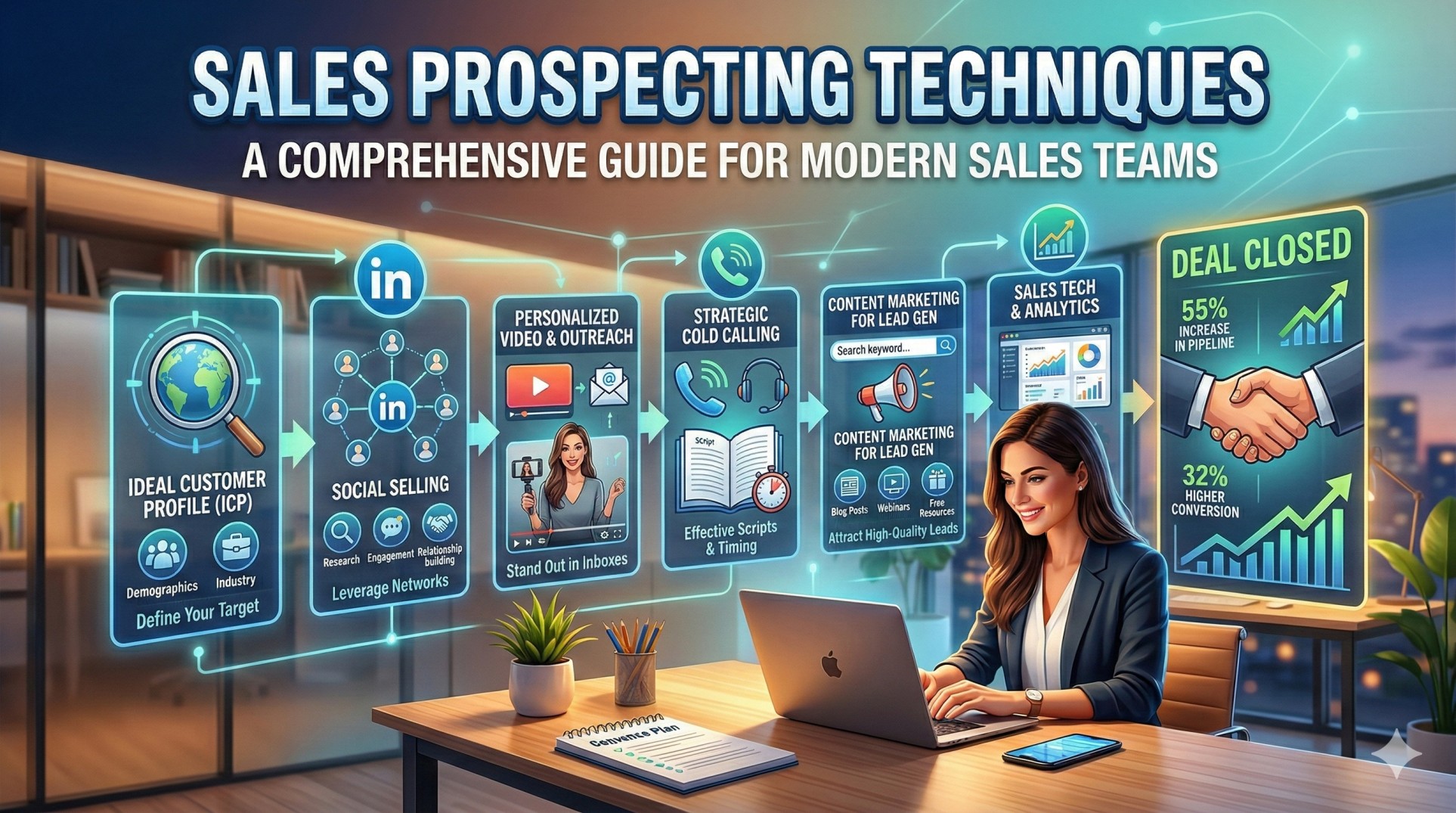
Sales prospecting is broken for most teams — not because the techniques don't work, but because they are using the wrong ones, in the wrong order, with no system behind them.
The numbers tell the story: 42% of salespeople say prospecting is the hardest part of their job — harder than closing, harder than negotiating, harder than handling objections. Yet companies that excel at prospecting are 2x more likely to meet or exceed their revenue targets, according to Salesforce.
The gap between average prospectors and elite ones is not talent. It is technique, consistency, and an understanding of what the data actually says works in 2025.
This guide ranks 17 of the most effective sales prospecting techniques by real-world impact, with the statistics to back each one up, and a practical framework for building them into a system that fills your pipeline consistently — month after month.
What Is Sales Prospecting? (And Why Most Teams Do It Wrong)
Sales prospecting is the process of identifying potential customers — prospects — who match your Ideal Customer Profile (ICP) and initiating contact to determine whether they are a fit for your product or service.
Done well, it is the engine of revenue growth. Done poorly — which is the default for most teams — it produces a leaky pipeline full of low-quality leads that never close.
The most common mistakes:
Prospecting without a defined ICP — sending generic outreach to everyone and converting almost nobody
Single-channel dependency — relying entirely on cold email or cold calls when buyers now require an average of 8 touches across multiple channels to book a meeting (Crunchbase)
Stopping too early — 92% of salespeople give up after four "no's", but 80% of prospects say "no" four times before they say "yes" (Marketing Donut)
No system — sporadic bursts of prospecting activity that create feast-or-famine pipeline cycles
The 17 techniques below, applied systematically, fix all of these problems. Let's get into them.
The 17 Best Sales Prospecting Techniques in 2025
1. Cold Email Outreach (With Genuine Personalization)
Impact level: ★★★★★
Cold email remains the highest-ROI prospecting technique available to B2B sales teams. 73% of B2B buyers prefer email as their method of contact over any other form of outreach — more than phone calls, LinkedIn messages, or in-person meetings.
But generic cold email is dying fast. Emails tailored to the recipient's specific interests achieve a 32% higher response rate than generic messages, and personalization creates 10% higher open rates and double the reply rates compared to generic outreach.
The winning formula in 2025: a highly specific ICP, a research-backed first line for every email, and a structured sequence that follows up without being pushy. For a complete breakdown of how to do this at scale, read our guide to cold email outreach.
Quick wins:
Personalize the first sentence using a specific trigger: a funding round, a LinkedIn post, a new hire, or a competitor move
Keep the body under 100 words
End with a single, low-friction call to action
2. Trigger-Based Prospecting
Impact level: ★★★★★
Trigger-based prospecting means reaching out to prospects at the exact moment a meaningful event signals buying intent. The timing alone can 2–5x your response rates compared to cold outreach without a trigger.
The most powerful triggers to monitor:
Funding announcements — newly funded companies are in spending mode and actively evaluating vendors
Leadership changes — new executives re-evaluate everything in the first 90 days; a new VP of Sales or CMO is a prime opportunity
Job postings — a company posting five SDR roles is telling you they are investing in outbound and may need support infrastructure
Product launches — new launches create new needs for adjacent tools and services
Technology changes — tools like BuiltWith or Slintel can alert you when a prospect adopts or drops a technology relevant to your solution
Prospects are 70% more likely to accept a meeting when outreach is based on a relevant, timely trigger. Set up Google Alerts, LinkedIn alerts, and Crunchbase notifications for every account in your target list.
3. LinkedIn Social Selling
Impact level: ★★★★☆
78% of salespeople engaged in social selling outsell their peers who are not. LinkedIn is the single most important platform for B2B prospecting, and most sales reps use it at a fraction of its potential.
Effective LinkedIn prospecting in 2025 goes far beyond sending connection requests with a generic pitch. The reps producing results are:
Publishing content that attracts inbound interest from their ICP
Commenting thoughtfully on prospects' posts before ever reaching out (creating familiarity before a cold message)
Using Sales Navigator's advanced filters to identify prospects by seniority, company growth signals, recent job changes, and keyword-based activity
Sequencing LinkedIn touches with cold email — a LinkedIn connection request followed by a cold email followed by a LinkedIn message creates multi-channel familiarity
Buyers are willing to interact with salespeople via LinkedIn 21% of the time — making it the joint top social channel alongside SMS for B2B outreach.
4. Cold Calling (Done Differently)
Impact level: ★★★★☆
Cold calling is not dead. 69% of buyers answer calls from new providers — a number that consistently surprises people who have written off the phone. The problem is not cold calling. It is cold calling done badly.
What separates effective cold callers from ineffective ones: 55% of successful cold callers cite a personalized, research-driven approach as their most effective technique. They know what the prospect's company does, what challenges companies of that size and stage typically face, and what specific reason they have for calling this person specifically.
The phone also has a timing advantage email does not. Web-generated leads responded to with a phone call within five minutes are 100 times more likely to be qualified than those where the response is delayed by hours. Speed-to-call is one of the most underrated levers in sales prospecting.
Use cold calls as part of a multi-channel sequence — not as a standalone channel. Pair them with cold email and LinkedIn touches for dramatically better results.
5. Multi-Channel Outbound Sequences
Impact level: ★★★★★
The single biggest shift in B2B sales prospecting between 2020 and 2025 is the rise of multi-channel sequencing. Email-only campaigns are generating almost 30% fewer leads year-on-year. Relying on a single channel is no longer enough.
The most effective prospecting sequences combine:
Cold email (primary channel)
LinkedIn connection + message (social layer)
Phone call (personal layer)
Content engagement (commenting on posts, sharing relevant material)
A typical high-performing sequence looks like this:
Day Action 1 Cold email #1 + LinkedIn connection request 3 LinkedIn message (if connected) 5 Cold email #2 (follow-up) 7 Phone call 10 Cold email #3 (value-add) 14 LinkedIn comment on their post 18 Final cold email (breakup)
It takes an average of 8 touches to set up a meeting with a new prospect. A multi-channel sequence makes it possible to deliver those 8 touches naturally, across different channels, without feeling like harassment.
For the email component of your sequences, read our complete guide to cold email follow-up sequences.
6. Referral Prospecting
Impact level: ★★★★★
Referral-based prospecting is the highest-converting technique in this entire list — and the most underused.
Prospects are 70% more likely to accept a meeting when the outreach is based on a mutual connection. Referred leads close at a higher rate, have shorter sales cycles, and churn less. The economics are unambiguous.
Building a referral engine requires:
Systematically asking happy customers for one or two introductions to peers they respect
Mapping your network before going cold — LinkedIn's second-degree connections view tells you who you know who knows your prospect
Making referrals easy — give customers a one-sentence description of your ideal prospect so they know exactly who to introduce you to
The mindset shift: referrals are not a bonus that happens occasionally. They are a prospecting channel that can be engineered, systematized, and scaled.
7. Ideal Customer Profile (ICP) Refinement
Impact level: ★★★★★
This is not a prospecting technique in the traditional sense — it is the foundation that makes every other technique dramatically more effective.
Companies with a strong sales prospecting strategy are 2x more likely to meet or exceed revenue targets, and the most fundamental element of a strong strategy is knowing precisely who you are targeting.
A well-defined ICP includes:
Firmographics: industry, company size, revenue range, geography, growth stage
Technographics: tools and platforms they use that signal fit
Trigger conditions: the specific situations that create urgency for your solution
Persona details: job title, seniority, decision-making authority, and the specific pains they wake up thinking about
Most teams think they know their ICP. Most are wrong — they are targeting too broadly, including segments that never convert or churn quickly. Run a cohort analysis on your best customers: what do they have in common that your average customers do not? That is your real ICP.
8. Intent Data Prospecting
Impact level: ★★★★☆
Intent data tells you which prospects are actively researching solutions like yours right now — before they reach out, before they fill in a form, before you know they exist.
Tools like G2 Buyer Intent, Bombora, Demandbase, and 6sense track which companies are consuming content about specific topics, visiting competitor websites, or searching for product categories relevant to your space. When a company in your ICP suddenly spikes in intent signals for your category, they are almost certainly in an active buying process.
Reaching out to a prospect with high intent signals is fundamentally different from cold outreach — you are not creating interest, you are meeting interest that already exists. Response rates on intent-triggered outreach are consistently 2–3x higher than baseline cold outreach.
9. Content-Led Prospecting
Impact level: ★★★★☆
Content-led prospecting — publishing valuable content that attracts your ICP and then using that content as a prospecting tool — is one of the most scalable techniques available.
It works in two directions:
Inbound: prospects find your content via search, engage with it, and self-identify as interested. 71% of buyers want to hear from reps when they are actively looking for ideas to drive stronger business results — and content puts you in front of them at exactly that moment.
Outbound: use your own content as a value-add in cold outreach. Instead of asking for a meeting in your first email, share a relevant piece of your content — a data study, a case study, an insight report. This shifts the dynamic from pitch to value exchange and dramatically increases the likelihood of a response.
10. Video Prospecting
Impact level: ★★★★☆
Personalized video in sales outreach can increase response rates by 80%. Video prospecting — recording a brief, personalized 60–90 second video for a specific prospect and embedding a thumbnail in your cold email — is one of the highest-engagement techniques available and one of the least used.
Why it works: video is almost impossible to fake at scale. When a prospect sees a video thumbnail with their name written on a whiteboard, or a screen recording of their own website, they know it was made for them specifically. That proof of effort signals that you are serious and that your outreach is worth engaging with.
Tools like Loom, Vidyard, and BombBomb make this easy to produce and embed. Reserve video prospecting for your highest-value accounts — it takes 5–10 minutes per video, so it does not scale to 500 prospects per day, but for the top 20 accounts in your pipeline, the conversion uplift makes the time investment highly worthwhile.
11. Account-Based Prospecting (ABM)
Impact level: ★★★★☆
Account-Based prospecting flips the traditional funnel: instead of casting wide and filtering down, you identify a short list of high-value target accounts and orchestrate highly personalized, multi-stakeholder campaigns specifically for each one.
In ABM, you are not just reaching out to one person at a company — you are simultaneously engaging the economic buyer, the champion, the technical evaluator, and the procurement gatekeeper, with coordinated messages that approach the same problem from multiple angles.
More than half of sales teams are already using AI for personalized outbound emails, and AI is handling account research for 45% of teams — making ABM more scalable in 2025 than it has ever been. AI tools can now generate account-level research, identify stakeholder maps, and draft personalized messages in a fraction of the time it once required.
ABM is most appropriate for enterprise deals with high ACVs that justify the per-account investment.
12. Asking for Referrals at the Right Moment
Impact level: ★★★★☆
Timing a referral request correctly is a technique in itself. The best moment to ask for a referral is immediately after a positive experience — the first successful implementation, the first meaningful result, the first time a customer says "this has been really valuable."
The reason: satisfaction is highest in those moments, and the reciprocity impulse — the natural human desire to give something back to someone who has helped you — is most activated. Waiting until a quarterly business review six months later is too late. The emotional momentum has dissipated.
Script the ask: "I'm really glad this has been valuable for your team. If you know one or two people facing similar challenges, I'd genuinely appreciate an introduction — it would mean a lot." Short, direct, and non-pressured.
13. LinkedIn Sales Navigator Advanced Filtering
Impact level: ★★★★☆
Most people who use LinkedIn Sales Navigator use it at a fraction of its capability. The basic filters — industry, company size, job title — are where most prospectors stop. The advanced filters are where the real targeting power lives.
Filters most prospectors miss:
"Changed jobs in past 90 days" — identifies new decision-makers in the buying window
"Posted on LinkedIn in 30 days" — identifies active users who are more likely to respond to LinkedIn outreach
"Company headcount growth" — surfaces companies growing aggressively (a common buying trigger)
"Following your company" — warm prospects who already know you exist
"Viewed your profile" — people who have already noticed you; a warm outreach reason built in
Combine three or four of these filters with your core ICP criteria and your prospect list quality improves dramatically — as does your outreach response rate.
14. Prospecting at Industry Events and Conferences
Impact level: ★★★☆☆
34% of buyers are willing to interact with salespeople in person at industry events — making events the highest in-person conversion channel in B2B sales.
But event prospecting only works if you treat it as a prospecting technique with a pre-defined system — not as a loose networking exercise. That means:
Researching the attendee list before the event and identifying your top 20 target conversations
Reaching out via LinkedIn or cold email before the event to set up a specific time to meet
Preparing a one-sentence opener that is about them, not you
Following up within 24 hours of every meaningful conversation with a specific reference to what was discussed
78% of decision-makers have taken an appointment or attended an event based on an email or cold call — meaning your pre-event cold outreach to other attendees has a high probability of resulting in a real conversation if it's timely and targeted.
15. Prospecting Through Case Studies and Social Proof
Impact level: ★★★★☆
Nothing breaks down a prospect's resistance faster than evidence that you have already solved their exact problem for someone exactly like them. A well-deployed case study in a cold outreach context can convert prospects who have ignored multiple previous emails.
The key is specificity: a case study is most powerful when the customer featured is in the same industry, at the same company stage, with the same job title as the prospect receiving it. The more the prospect sees themselves in the success story, the more credible and relevant the proof becomes.
Use case studies as the centerpiece of your Email 3 value-add in your follow-up sequence — after you've already made initial contact but before the prospect has committed to a meeting. Frame it as a gift, not a pitch: "Thought this might be useful regardless of whether we work together."
16. AI-Assisted Prospecting
Impact level: ★★★★☆
More than half (54%) of sales teams are already using AI for personalized outbound emails, and AI is handling account research for 45% of teams. The teams not adopting AI-assisted prospecting are increasingly competing at a structural disadvantage.
AI's highest-value applications in prospecting:
Account and contact research — AI can synthesize public information about a prospect (LinkedIn activity, company news, job postings, content published) into a research brief in seconds rather than minutes
First-line personalization — AI can draft personalized opening sentences for each prospect based on the research brief, which a human then reviews and refines
ICP scoring — AI models can score incoming leads by likelihood to convert based on historical data, helping reps prioritize their time
Email copy generation — AI drafts initial versions of prospecting emails that a human refines; the result is often faster and sometimes better than starting from scratch
The most effective model: AI for research and drafting, human for review and judgment. The largest group of sales teams — 45% — have embraced a hybrid human-AI approach as the sweet spot for scale without losing personal touch.
17. Consistent Daily Prospecting Habits
Impact level: ★★★★★
The most underrated technique on this list is not a channel or a tool — it is the discipline of prospecting consistently, every single day, regardless of pipeline status.
Top salespeople spend an average of 5 hours per week on prospecting activities. Not 5 hours when the pipeline is dry. 5 hours every week, without exception.
The reason most sales pipelines are feast-or-famine is that prospecting is the first thing reps deprioritize when they are busy closing. Then the quarter ends, the deals close (or don't), and suddenly they are looking at an empty pipeline with no prospect conversations in flight.
Daily prospecting protection means: block time on your calendar every morning for prospecting activity. Treat it as a non-negotiable commitment. Even 45 minutes of focused prospecting per day — 10 new prospects added, 5 follow-ups sent, 3 LinkedIn touches — compounds into a consistently full pipeline over time.
How to Build a Sales Prospecting System
Individual techniques are useful. A system is transformative. Here is how to turn the 17 techniques above into a repeatable engine.
Step 1: Define (or Refine) Your ICP
Before you prospect a single person, articulate exactly who belongs in your pipeline. Industry, company size, growth stage, job title, pain profile, and — critically — the trigger conditions that indicate buying intent. Without this, every hour of prospecting is partially wasted.
Step 2: Choose Your Primary and Secondary Channels
Based on your ICP, determine which channels your prospects are most reachable on. Most B2B teams should have cold email as their primary channel, LinkedIn as a primary secondary channel, and phone as a tertiary. For enterprise ABM, the mix shifts toward more personal touches.
Step 3: Build a Sequenced Outreach System
Map out a specific sequence for each segment: how many emails, on which days, with what content in each. Automate what can be automated. Personalize what cannot. For your email sequences, make sure your email deliverability is solid before you scale — great sequences cannot overcome broken infrastructure.
Step 4: Set Weekly Prospecting KPIs
Metrics to track every week:
New prospects added to sequence
Emails sent
Open rate and reply rate
LinkedIn connection acceptance rate
Meetings booked
Pipeline created from prospecting
Step 5: Review, Learn, and Iterate
Run a weekly 30-minute review: what is working, what is not, which segments are converting, which are not. The teams that improve fastest are not the ones with the best initial strategy — they are the ones with the tightest feedback loop between action and learning.
Sales Prospecting Tools Worth Knowing in 2025
You do not need a complex tech stack to prospect effectively, but the right tools dramatically multiply your output and quality.
For finding prospects: Apollo.io, LinkedIn Sales Navigator, ZoomInfo, Lusha, Hunter.io
For trigger monitoring: Crunchbase, LinkedIn alerts, Google Alerts, Bombora (intent data)
For cold email sequencing: Mailfra, Instantly, Smartlead, Lemlist — for multi-inbox cold outreach with proper warming and deliverability protection
For CRM and pipeline tracking: HubSpot, Salesforce, Pipedrive — businesses that use a CRM are almost nine times more likely to exceed their sales goals than those without one
For video prospecting: Loom, Vidyard, BombBomb
For AI-assisted research and copy: Clay (for enrichment), ChatGPT or Claude (for first-line personalization at scale)
Frequently Asked Questions About Sales Prospecting
What is the most effective sales prospecting technique in 2025?
No single technique dominates universally — but multi-channel outbound sequences combining cold email, LinkedIn, and phone consistently produce the highest pipeline conversion rates. Cold email remains the highest-ROI starting channel, with 73% of B2B buyers preferring it. The key is sequencing channels together rather than relying on any one in isolation.
How many touches does it take to book a meeting with a prospect?
It takes an average of 8 touches to set up a meeting with a new prospect, according to Crunchbase. This means a 5-touch sequence leaves most prospects under-contacted. Build sequences of 7–8 touches across multiple channels over 3–4 weeks.
How much time should salespeople spend on prospecting?
Top salespeople spend an average of 5 hours per week on prospecting activities — roughly an hour per working day. Consistency matters more than volume: 45 focused minutes of daily prospecting compounds into a reliably full pipeline over time.
What is the biggest mistake in B2B sales prospecting?
Stopping too early. 92% of salespeople give up after four "no's", but 80% of prospects say "no" four times before they say "yes." Most prospecting failures are not failures of technique — they are failures of persistence. Build follow-up sequences that run long enough to catch prospects at the right moment.
Does cold calling still work for sales prospecting?
Yes. 69% of buyers answer calls from new providers, making cold calling far from dead. What has changed is the standard: generic, unprepared cold calls perform poorly. Research-driven, personalized cold calls — especially when used as part of a multi-channel sequence — remain a powerful prospecting technique, particularly for senior decision-makers who are harder to reach by email.
How do I build a sales prospect list?
Start with your ICP definition, then use tools like LinkedIn Sales Navigator, Apollo.io, or ZoomInfo to build targeted lists based on firmographic and technographic filters. Verify every email address before sending to keep bounce rates below 3%. Layer in trigger data — funding events, leadership changes, job postings — to prioritize the highest-intent prospects for immediate outreach.
What is trigger-based prospecting?
Trigger-based prospecting means reaching out to prospects at the exact moment a specific event signals they may have a buying need. Common triggers include funding announcements, new executive hires, product launches, job postings, and technology changes. Trigger-based outreach can produce 2–5x higher response rates than untriggered cold outreach because it arrives at a moment of genuine relevance.
The Bottom Line
Sales prospecting in 2025 rewards the specific, the persistent, and the systematic. It punishes the generic, the sporadic, and the one-channel dependent.
The 17 techniques in this guide are not new ideas — the best of them have been working for decades. What is new is the expectation: buyers now require more touches, more channels, more relevance, and more personalization before they agree to a conversation. Meeting that expectation requires a system, not a series of one-off efforts.
Build the system. Block the time. And send one more email than you think you need to.
Ready to put your prospecting into action? Start with the fundamentals: master cold email outreach, write cold email subject lines that actually get opened, build follow-up sequences that convert, and make sure your emails are reaching the inbox with our email deliverability guide. Or start prospecting today at mailfra.com.
Comments(0)
Loading comments...